Hollywood icon Mickey Rooney dies, aged 93
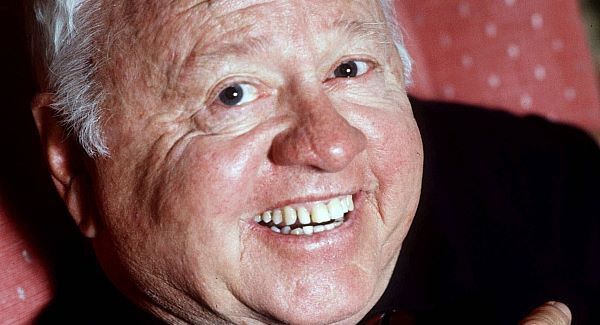
A superstar in his youth, Rooney was Hollywood’s top box-office draw in the late 1930s to early 1940s. He epitomised the “show” part of show business, even if the business end sometimes failed him amid money troubles and a seesaw of career tailspins and revivals.
Precocious, impish, irrepressible — perhaps ‘hardy’ is the most suitable adjective for Rooney, a perennial comeback artist whose early blockbuster success as the vexing but wholesome Andy Hardy and as Judy Garland’s musical comrade in arms was bookended 70 years later with roles in Night at the Museum and The Muppets.
Rooney died on Sunday aged 93 surrounded by family at his North Hollywood home. He died a natural death.

Rooney had attended Vanity Fair’s Oscar party last month, where he posed for photos with other veteran stars and seemed fine. He was also shooting a movie at the time of his death, The Strange Case of Dr Jekyll and Mr Hyde.
He was nominated for four Academy Awards over a four-decade span and received two special Oscars for film achievements, won an Emmy for his television movie Bill, and had a Tony nomination for his Broadway smash Sugar Babies.
“I loved working with Mickey on Sugar Babies. He was very professional, his stories were priceless and I love them all... each and every one. We laughed all the time,” Carol Channing said.
A small man physically, Rooney was prodigious in talent, scope, ambition, and appetite. He sang and danced, played roles both serious and silly, wrote memoirs, a novel, movie scripts, and plays, and married eight times, siring 11 children.
His first marriage — to the glamorous, and taller, Ava Gardner — lasted only a year. But a fond recollection from Rooney years later — “I’m 5ft 3, but I was 6ft 4 when I married Ava” — summed up the man’s passion and capacity for life.
Joe Yule Jr, born in 1920, was the star of his parents’ vaudeville act by the age of 2, singing ‘Sweet Rosie O’Grady’ in a tiny tuxedo. He was barely six when he first appeared on screen, playing a midget in the 1926 silent comedy short Not to Be Trusted, and he was still at it more than 80 years later, working incessantly as he racked up about 250 screen credits.
“I always say, ‘Don’t retire — inspire,’” Rooney told the AP in March 2008. “There’s a lot to be done.” This from a man who did more than just about anyone in Hollywood.
Rooney was among the last survivors of the studio era, which his career predated, most notably with the lead in a series of Mickey McGuire kid comedy shorts from the late 1920s to early 1930s that were meant to rival Hal Roach’s Our Gang flicks.
After signing with MGM in 1934, Rooney landed his first big role playing Clark Gable’s character as a boy in Manhattan Melodrama. A year later, still in his teens, Rooney was doing Shakespeare, playing an exuberant Puck in Max Reinhardt’s A Midsummer Night’s Dream, which also featured James Cagney and Olivia de Havilland.
Rooney was soon earning $300 a week with featured roles in films such as Riff Raff, Little Lord Fauntleroy, Captains Courageous, and The Devil is a Sissy.
Then came Andy Hardy in the 1937 comedy A Family Affair, a role he would reprise in 15 more feature films over the next two decades.
He played a delinquent humbled by Spencer Tracy as Father Flanagan in 1938’s Boys Town and Mark Twain’s timeless scamp in 1939’s The Adventures of Huckleberry Finn.

Rooney’s peppy, all-American charm was never better matched than when he appeared opposite Garland in such films as Babes on Broadway and Strike up the Band, musicals built around that “let’s put on a show” theme.
One of them, 1939’s Babes in Arms, earned Rooney an Oscar nomination for best actor, a year after he received a special Oscar shared with Deanna Durbin for “bringing to the screen the spirit and personification of youth, and as juvenile players setting a high standard of ability and achievement”.
He earned another best actor nomination for 1943’s The Human Comedy, adapted from William Saroyan’s sentimental tale about small-town life during the second World War. The performance was among Rooney’s finest. “Mickey Rooney, to me, is the closest thing to a genius I ever worked with,” Human Comedy director Clarence Brown once said.
Brown also directed Rooney and Elizabeth Taylor in 1944’s horse-racing hit National Velvet, but by then, Rooney was becoming a cautionary tale for early fame. He earned a reputation for drunken escapades and quickie romances, and was unlucky in both money and love. In 1942 he married Gardner. They divorced a year later and Rooney joined the army, spending most of his war service entertaining troops.
When he returned to Hollywood, disillusionment awaited him. His savings had been stolen by a manager and his career was in a nose dive. He made two films at MGM, then his contract was dropped.
“I began to realise how few friends everyone has,” he wrote in one of autobiographies. “All those Hollywood friends I had in 1938, 1939, 1940, and 1941, when I was the toast of the world, weren’t friends at all.”
His movie career never regained its prewar eminence. “He was undoubtedly the most talented actor that ever lived. There was nothing he couldn’t do. Singing, dancing, performing... all with great expertise,” Margaret O’Brien said.
“I was currently doing a film with him, The Strange Case of Dr Jeckyll and Mr Hyde. I simply can’t believe it. He seemed fine through the filming and was as great as ever.”
After splitting with Gardner, Rooney married Betty Jane Rase, Miss Birmingham of 1944, whom he had met during military training in Alabama. They had two sons and divorced after four years. (Their son Timothy died in September 2006 at age 59 after a battle with a muscle disease, dermatomyositis.
His third and fourth marriages were to actress Martha Vickers (one son) and model Elaine Mahnken.
The fifth Mrs Rooney, model Barbara Thomason, gave birth to four children. While the couple were estranged in 1966, she was found shot to death in her Brentwood home; beside her was the body of her alleged lover, a Yugoslavian actor. It was an apparent murder and suicide.
A year later, Rooney began a three-month marriage to Margaret Lane. She was followed by a secretary, Caroline Hockett — another divorce after five years and one daughter.
In 1978, Rooney, 57, married for the eighth — and apparently last — time. His bride was singer Janice Darlene Chamberlain, 39. Their marriage lasted longer than the first seven combined.
After a lifetime of carrying on, he became a devoted Christian and member of the Church of Religious Science. He settled in suburban Thousand Oaks, about 65km west of Los Angeles.