Council criticises insolvency guidelines
The group said household budgeting is primarily done by women, and the new guidelines, which limit spending on food and other items, “will add an additional stress on to women and families that are already struggling”.
The average family of two adults and two children will be allowed up to €1,760 a month to live on under new rules outlining what should be considered reasonable living expenses for people in mortgage distress.
Debtors may be asked to move to cheaper accommodation, give up cars and health insurance, and prove the economic rationale for childcare arrangements under the guidelines for personal insolvency deals.
A clause in an earlier draft of the guidelines, which allowed banks to force parents to give up work if childcare cost more than they earned, was removed from the final version.
However, it states that “the reasonableness” of childcare can be considered, and parents will have to prove an economic rationale for paying for it. Personal insolvency practitioners, who will act as mediators between banks and debtors, will consider “the typical cost of childcare needed, the type of childcare, eg crèche, childminder etc, and the typical costs of childcare in the debtor’s locality”.
The National Women’s Council said it welcomed the reassurance that nobody would be asked to leave their jobs due to high childcare costs.
However, its policy officer, Ann irwin, said: “While the guidelines view childcare as a legitimate expense in relation to employment, there is a lack of recognition for other reasons such as access to education or training and personal reasons.”
She said: “There is also an overemphasis on pre-school childcare. After-school care is equally important for families.”
She said the food allowance — of €278 per month for parents and €133 for an infant — was not enough. Allowances of €31 a month for medical expenses were “wholly inadequate for individuals and families and risk putting their long-term health at risk”, she said.
“We call on the Insolvency Service to review these allowances and apply sufficient flexibility in adapting these to each family context.”
Meanwhile, Tánaiste Eamon Gilmore said the Government would examine the reasons why the Croke Park Agreement was voted down by public sector workers — including whether it was perceived as being anti-women and anti-family.
“A feature of the public service generally is the high number of women who are employed in it. We need to hear the assessment that the unions make of the reasons of why the agreement was voted down.”
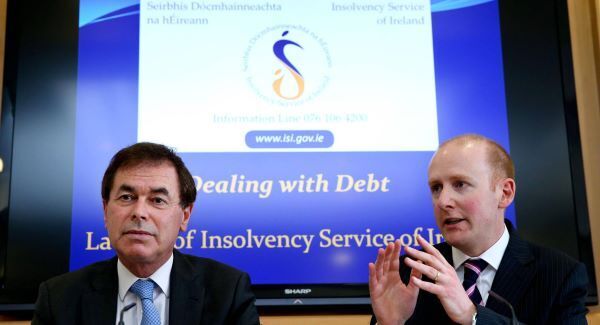
Lorcan O’Connor will be paid a salary of €127,000 to both develop and head the Insolvency Service of Ireland.
The 37-year-old former financial adviser was recruited following an open competition by the Department of Justice and brings with him a wealth of expertise in the area.
Before assuming the position, he was director of Deloitte Restructuring Services, where he worked for 15 years advising companies in financial distress and advising institutions in relation to under-performing loans.
He led a number of formal insolvency assignments, including the receiverships of Waterford Wedgwood plc and Hughes & Hughes Ltd.
Between 2006 and 2008 he was seconded to the Department of Transport where he was a financial adviser on a wide range of transport assignments, including the floatation of Aer Lingus, state airport restructuring, and the Transport 21 investment programme.
With qualifications in business and law, Mr O’Connor will be in charge of the delivery of the new insolvency regime.
He is a chartered accountant and business and legal studies graduate of University College Dublin.
His position in the Insolvency Service is paid on an assistant secretary level with four scales ranging from €127,796 to €146,191.