Kerry birthplace of former leader’s great-grandmother thought to have been used by IRA during Troubles
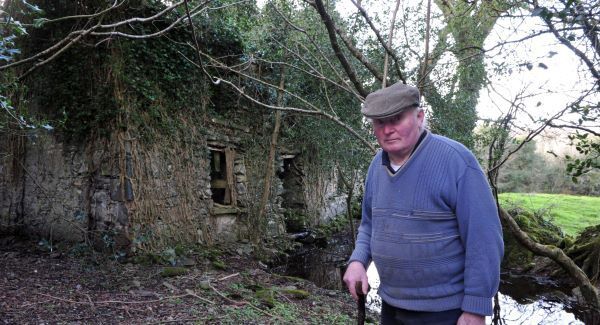
Comfortable in their working gear and wellingtons, Paddy O’Shea and his nephew Neilie O’Shea went about their farm chores in the normal way, several times walking past a tree-shaded ruin yards from cattle sheds.
They scarcely had time to watch live TV coverage and the sombre-suited statesmen, politicians and royalty attending Margaret Thatcher’s funeral in London. In striking contrast to the deep, solemn tones of choirs in the great cathedral, birdsong offered a humble requiem, to the rhythm of branches blowing in the wind.
But, the O’Sheas were conscious of history in their midst, for the lonely ruin is believed to have been the birthplace of Baroness Thatcher’s great-grandmother Catherine Sullivan who was born in Dromanassig, four miles outside Kenmare, Co Kerry, in 1811.
Just 100 yards off the main Kenmare to Glengarriff road, the four, two-feet thick walls stand defiantly, just like the Iron Lady in her heyday. A wall divides the two rooms on the ground floor, but the roof is long gone, only a few slates remaining in a corner. There were at least two rooms upstairs.
Paddy O’Shea, who purchased the 43-acre farm from Paddy Egan in 1987, is one of several owners since Catherine Sullivan walked down the narrow lane from her home and departed around 1830.
She worked as a washerwoman after emigrating to England and she later married Thomas Smith, a farm labourer. Their daughter Ellen married Benjamin Roberts, whose son Albert was Margaret Thatcher’s father, a grocer in Grantham, Lincolnshire.
‘’Didn’t they [Catherine’s descendants] do all right? They kept moving up the line until one landed in Downing Street,’’ quipped Paddy with a glint in his eye.
Catherine’s surname was sometimes spelt the more colloquial “Selewin’’ in England. Like her great granddaughter she, too, was made of tough stuff for she lived to be 93, dying in 1904.
The three-time British prime minister once acknowledged her Kenmare connection while at 10 Downing Street, but never visited the area, nor has she any known relatives there.
Paddy O’Shea believes the house was occupied into the early years of the 20th century and, according to local tradition, was even used by the IRA during The Troubles, which the haughty baroness would hardly have agreed to.
“Some of the old people here years ago used to tell of a wake in the house, with women caoining and all that, around 1896,’’ he recalled.
“The Egans, one of them a teacher locally, are also remembered and a number of them went to America. That was around 1915. I met one of the Egans in America and he came back here later.’’
Though the house is thought to be more than two centuries old, Paddy remarked it was still solid enough for its age, adding that some structural work could make it look far more presentable. Cattle have been housed in the ruin in the past.
“It was a good house for its time and shows that the Sullivan family must have been fairly wealthy,’’ said Paddy.
So what’s the future of the Thatcher’s Irish ancestral home, overlooked by a towering Scotch pine tree that may well date to Catherine Sullivan’s time? As Kenmare is a well-established tourist area, there’s a view that it could be a visitor attraction.
That’s a touchy subject locally, though — Thatcher’s notorious divisiveness has spread to Kenmare. There are mixed views in the area on whether her family’s link should be remembered.
A framed photograph of Mrs Thatcher once hung on the walls of Kenmare Heritage Centre, but was taken down some years ago and not put back up. Some people now believe it should be restored.
The O’Sheas are undecided, with Neilie commenting: “We’d want to know what would be in it for us, as there would be issues with public access to a farm, animals, insurance and such things. But, if it [opening up the property to the public] would help the area, we would do everything we could.’’
Bonane Community Council has opted not to include the location of the ruin in a guidebook for the Sheen Valley, which is going to print shortly, but a spokesperson said it had not been ruled out completely and they may reconsider next year.
The number of British visitors to Ireland has dropped by a million in recent years. Tourism Ireland is currently engaged in a multi-million euro marketing campaign to lure them back and some might even be tempted to call to the Dromanassig ruin... if they knew where to find it.