Why Barack needs bill
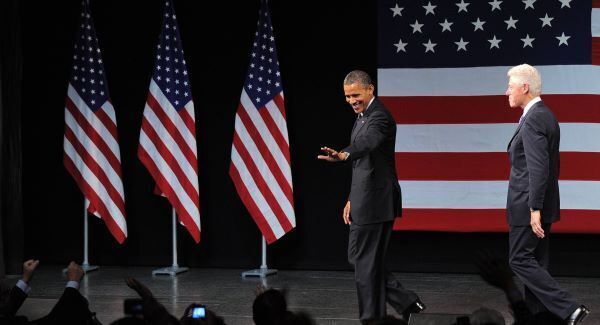
WHEN Bill Clinton took centre stage at the Democratic National Convention in Charlotte last night, he made a characteristically forceful case for the party’s other big dog, Barack Obama, arguing that a second Obama term is a vital necessity, and sounding for all the world as if the current president has no greater admirer than the man from Hope.
Every Democrat in the arena, and many beyond, knows better.
The relationship between the 44th president and the 42nd has been an uneasy one since 2008, when Obama denied Clinton a third turn in the White House by defeating Hillary Clinton for the Democratic nomination. That bitterly fought primary campaign inflicted real wounds — including the suggestion by Obama’s side that Clinton slyly tried to help his wife’s chances by inserting race into the contest. Public reconciliation, and the top job at state for Hillary, followed, but the rift never really closed.
Clinton is said to occasionally brood over the fact Obama has not eagerly availed himself of the counsel of the party’s best political mind (Clinton’s). For his part, Obama cannot have failed to notice that Clinton has hardly faded from the scene, operating, through his Clinton Global Initiative, what sometimes seems a sort of shadow presidency.
Nor could Obama have been cheered when Clinton complicated the incumbent’s key campaign offensive this spring by declaring Mitt Romney’s business career as “sterling”, or when Clinton said the Bush-era tax rates should be extended, including for the very rich.
Obama knows he needed Clinton to lift a convention many Democrats pointedly avoided, and to help rescue an imperilled re-election bid that will be nothing like the relatively easy ride that Clinton enjoyed in 1996.
So, Clinton was in Charlotte, but Clintonism — that brand of centrist New Democrat politics that helped make him the first president of his party to win re-election since FDR — was mostly missing. Conservative and centrist Democrats, so critical to Clinton’s efforts to reform welfare, balance the budget, and erase the image of the party as being reflexively anti-business, have nearly vanished.
Their absence complicates Obama’s bid for re-election, and his chances for an effective second term, if he gets one. Clinton’s brand of liberalism was designed to win elections, and brought Democrats back after a generation in the wilderness; Obama’s brand of liberalism produced the line that became the Republicans’ favourite refrain last week in Tampa: “You didn’t build that.”
The New Democrat movement began to die on Dec 12, 2000, when the Supreme Court decided Bush v Gore, effectively giving the presidency to George W Bush. With Al Gore out of the picture, the party took an ever more stridently leftward turn, and by 2004, what Howard Dean called “the Democratic wing of the Democratic Party” was in full ascent.
The energy in the party resided in the anti-war left, reawakened by Iraq, and by 2008, candidates in the Democratic presidential primary were expected not only to oppose the war, but to apologise for ever having supported it — and all but Hillary Clinton did (no apology was required of Obama, who had opposed the “dumb” war from the start).
The left’s complaint about Clintonism was that it made the party less distinct from the Republicans — which, in effect, it did. When Clinton, Gore, and other Democratic centrists joined the Democratic Leadership Council in the 1980s, their purpose was to find a way to sell a liberal programme to a nation that consistently rejected it, by moderating the programme.
THE council emphasised private-sector growth, government efficiency, personal responsibility, and an affirmation of mainstream values. The chief prize was the Reagan Democrat — that white, working-class voter who was increasingly going Republican in places like Clinton’s Arkansas.
Clinton called those voters “the forgotten middle class”, and he appealed to them not only with his New Democrat policy programme, but by relating to them personally, and grounding his own political identity in their experiences. The main thrust of that ’92 convention, and of much of the campaign thereafter, was to introduce Clinton to the US as “the man from Hope”, who never knew his father, and whose mother left him with her parents while she attended nursing school.
“He devoted his candidacy to that forgotten middle class, it was a conscious strategy,” says Paul Begala, a key Clinton strategist, who now advises Obama.
Although anti-Clintonism wasn’t the overt theme of Obama’s 2008 candidacy (it is surprising, in retrospect, the degree to which “Hope and Change” seemed agenda enough in that referendum election), Obama’s presidency has seemed, in key regards, a repudiation of the New Democrat idea.
Clinton Democrats embraced business; Obama attacked private equity. A New Democrat would have championed the Keystone XL Pipeline; Obama, yielding to environmentalists, has resisted it. Although Obama campaigned in coal country in 2008 as a friend of the industry (and of all those blue-collar jobs associated with it), his Environmental Protection Agency has established regulations so severe that one administration official admitted, “if you want to build a coal plant you got a big problem”.
Many of the workers affected by such policies are swing-state voters, who are also keenly sensitive to values issues. Obama’s healthcare mandates on contraception may help him with single women and urban voters, but it might hurt him among Catholics in places like Pennsylvania and Ohio.
Bill Clinton signed the Defence of Marriage Act; Obama stopped enforcing it, and then declared himself a supporter of gay marriage — the day after North Carolinians voted a traditional definition of marriage into the state’s constitution.
“I think the New Democrat movement can be saved,” says Al From, founder of the Democratic Leadership Council. “We do go through cycles. But it would have been a lot better if we had had a second New Democrat president to cement it.”
Clinton’s ’92 convention belonged nearly as much to From and his council as to Clinton. He was profiled in The Washington Post (“The Life of the Party”), cheered by strangers who knew he was somebody important, and jeered by the liberals he had helped to supplant (“he doesn’t know shit from Shinola”, declared Ohio senator Howard Metzenbaum). “It was the best week of my life,” From says.
From is now quietly working as a consultant, commuting from his home in Annapolis to an office in Washington, DC, several days a week. The Democratic Leadership Council is defunct, having closed its doors early last year. Although there are some prominent New Democrats serving in the Obama administration (former CEO Bruce Reed is now Joe Biden’s chief of staff), From says he has little contact with the Obama team.
He did not go to Charlotte, which is probably just as well; he says he scarcely recognises the party he once shaped. A founding tenet of the council held that: “We believe the Democratic Party’s fundamental mission is to expand opportunity, not government.” The era of big government isn’t over anymore.
“It seems to me that you have the growth on the coasts of cultural liberals, and they’re a big part of the party now,” he told Newsweek.
“And the other part of the party is the people who, as government has gotten bigger, are on the other end of government checks. In this case, it’s not just all the liberal interest groups, even though they’re a big part of it, but it’s everybody. It’s corporate America, with the corporate welfare, too. It’s everybody.”
Some Democrats have gone further than just skipping this week’s convention.
Artur Davis, who represented Alabama’s 7th District, has defected from the Democratic Party, is campaigning for Mitt Romney, and was a featured speaker at the Republican convention. This is a notable development, not least because Davis, who is black, had been a rising star in the Democratic Party, an early supporter and friend of Obama’s, who seconded his nomination at the 2008 convention.
Davis lost a race for governor in Alabama in 2010, and it was about then that his new political awakening began. Obama had once claimed to be a New Democrat, but Davis says he came to realise that Obama, by inclination and experience, was not capable of Clintonian triangulation.
“The big difference between Barack Obama and Bill Clinton is that Clinton had to build a political career in a state that was drifting to the right,” says Davis. “In every election, Bill Clinton had to figure out how to get people who had voted for Richard Nixon, who were voting for Ronald Reagan, to vote for him. In contrast, Barack Obama’s political career was built in a Democratic state with a weak Republican Party, where his essential political purpose was figuring out how to rally the Democratic base around him.
“In 2008, because of the collapse of the Bush administration’s popularity in the second term, Obama never had to do what Clinton had to do regularly in his political career, which was to figure out how to construct some kind of other political case that appealed to conservative-leaning voters.”
Another critical distinction between Obama and Clinton is Clinton’s unalloyed love for the game of politics. Begala remembers Clinton holding his staff captive in the basement of the Arkansas governor’s mansion while he conducted policy seminars lasting late into the night; but Clinton also obsessed as much about the nuts and bolts of electioneering.
Obama is a different sort of political creature, one famously capable of projecting a grand vision, but it can seem a distanced one, delivered from on high. “You often get the sense that he was born at Harvard Law School, or in the Oval Office,” says Begala.
Obama has also seemed to govern at a remove, which leaves it to others to define his presidency. There’s a danger in this. “What he did poorly — and, in part, it was because he wasn’t an experienced leader because he’d come from a legislative background — was he let Congress basically write the stimulus and healthcare bill,” says former Pennsylvania governor Ed Rendell.
“It would have been much better, with the level of popularity that he had coming into office, if he had written both bills and kept out a lot of the junk and the extraneous stuff that were in both bills, and sat down with the Republicans on healthcare. And on stimulus, if he’d said, ‘OK, give me your ideas’.”
With a terrible economy as his greatest vulnerability, Obama has taken to claiming Clinton’s economic approach as his own (“we’ve tried our plan, and it worked”) — a reach that galls some Clintonites.
“What David Axelrod and Obama have done is they have substituted class warfare for Clintonism,” says Doug Schoen, a Democratic political analyst and pollster who has advised both Clintons. “At every juncture, they have substituted class-based politics — resentment of the rich, taxing the rich — for fiscal discipline, and prudence.”
Such centrists believe Obama missed his chance to make a bold claim to fiscal responsibility when he declined to champion the recommendations of the debt commission he appointed — the so-called Bowles-Simpson plan. “It was a failure in leadership,” says Rendell. “It was an instance of politics trumping substance.”
Artur Davis argues that the post-Clinton Democratic Party has willingly set a course towards the model of the fringe European left. “I do see the Democratic Party slipping in that direction, of becoming a self-conscious vehicle of the left, that is more concerned about developing a righteous leftist platform than one that has a particular project to govern,” he said.
Other Democratic centrists, of course, hold a less dire view of Obama’s tenure, even while disagreeing with some of his policy positions and rhetoric. Jim Hunt, former governor of North Carolina, became the New Democrat prototype in two separate eight-year stretches in office.
He was an early adopter of workfare, but he was also a firm believer in government investment in schools and infrastructure. Like Clinton, Hunt believed an alliance with business was critical to achieving liberal programmes, and says if the Democrats allow themselves to be manoeuvred into an identity as the pro-government, anti-business party, “that would be a terrible mistake for our party — that’s why we mainstream moderate Democrats, who are pro-education and pro-business, have got to stay involved in this party”.
Hunt has winced over some of the president’s rhetoric, but he stoutly defends Obama to sceptical Carolinians, reminding them of the circumstances facing Obama when he entered office. “We were within inches — inches — of a depression the month that this man came into office,” he says.
“In January of 2009, the country lost 750,000 jobs... yes, I want us to come back to the time when we are moving toward cutting that deficit and cutting that debt dramatically. But it’s gonna take a while to get back to it. Gosh A’mighty, it took us 10 years and a world war to get out of the Depression. So this man has been leading under terribly difficult circumstances, trying to just get us off of our back.”
ED RENDELL, who has criticised the president (objecting, for example, to the Obama campaign’s attack on private equity), also argues that Obama has been constrained by an unprecedented obduracy in his Republican opposition. “I can’t ever recall a newly elected president being faced with the leader of the other party’s caucus saying ‘Our No 1 priority is to make this president a one-term president’,” says Rendell, citing the remark made by Mitch McConnell, the Senate minority leader, that exemplified the fierce partisanship of Obama’s tenure.
“That McConnell would say that in the first nine months of Barack Obama’s tenure is absolutely stunning, disgraceful, disgusting — you name the term.”
Bill Daley, too, faults Republicans, saying that hyperpartisanship denied to Obama the grand compromises that were available to Bill Clinton. When Clinton found accord with his nemesis, Newt Gingrich, he knew that Gingrich, as leader of the Republican Revolution, would be able to bring his members along. Not so the current Republican House leaders in their dealings with their Tea Party members. “They didn’t owe a thing to John Boehner or Eric Cantor,” Daley says. “They rode into leadership on this wave that they did not create.”
Daley doubts that there will be time between now and the election for Obama to craft a message that convinces those working- and middle-class Democrats and independents whom Clinton inspired.
Obama, whose father was absent, and who was raised by a single mother and who, for a time, relied on food stamps, has downplayed his own very Clintonian tale.
“It’s very much available to him, I can’t say why he doesn’t do it,” Begala says. “It’s so interesting to me that the guy who has written the most literate presidential autobiography since I don’t know who, has somehow lost the narrative thread of his character, the character in his play.”
It is possible that Obama’s joining hands with Clinton in Charlotte, and Clinton’s prominent role in the closing weeks of the campaign, signals a centrist turn in a second Obama term. Doug Schoen thinks not. “This is political artifice,” he says. “It is designed to achieve a short-term political result. This is not a change in philosophy.”
nPeter J Boyer joined Newsweek/Daily Beast after spending 18 years as a staff writer at The New Yorker, where he wrote on a wide range of subjects, including politics, the military, religion, and sports.