Avoiding a blame game
THE trial of Geir Haarde should have come with a warning — don’t try this at home.
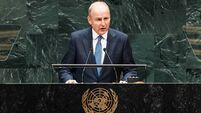
Haarde is the former prime minister of Iceland, who was put on trial for his role in the collapse of the Icelandic economy in 2008. Last Monday, he was found guilty of a minor charge and not guilty on the three main issues. The offence for which he is deemed culpable was his failure to call an emergency cabinet meeting in the run-up to the crisis.
Brian Cowen, for one, must be relieved that his erstwhile fellow PM was nabbed for neglecting to consult his cabinet. The former taoiseach has his ass well covered on that front.
Cowen famously did call an emergency cabinet meeting to ratify a decision to issue a blanket bank guarantee in Sept 2008. John Gormley and Willie O’Dea have given colourful descriptions of being woken in the dead of night to be told that the move was necessary for the financial survival of the State. The rest is history, or perhaps, just endless austerity.
Haarde is the only politician to face trial in relation to the various ructions that turned the global economy upside down in 2008.
For some, his trial is a rare example of the powerful being brought to book. The general consensus is that a combination of incompetence and craven capitulation to banks informed much political decision making at the time. And practically nobody has been held to account.
In this regard, Iceland is exhibited as a paragon of virtue, standing in splendid moral isolation.
It’s a seductive picture, particularly in this country where impunity for both political and business elites has generated huge anger. At least the Icelandic people have had their day in court. At least somebody has had to answer publicly for how he conducted himself as the walls came tumbling down. At least there is a semblance of justice in that country. So goes the populist portrait of what unfolded in Iceland, but the reality begs to differ.
Rather than being subjected to accountability, Haarde was hauled before a kangaroo court.
He was prosecuted under a law enacted in 1905, when democracy was but a pup in Europe. The statute was designed to ensure that government ministers didn’t go offside, and over a century later, Haarde became the first defendant before this court.
A parliamentary inquiry found he was one of four politicians who were culpable for the collapse of the economy in Iceland. Yet, he was the only one subjected to a trail. Two of the others who were deemed to carry blame are still government ministers, which is lucky for them.
Haarde, by contrast, is a beaten docket, and therefore ideal to measure up for scapegoating.
The court assembled to decide his fate consisted of 15 members. Six were judges, another a law professor and eight members were appointed by parliament. With a majority on the panel, Haarde was effectively being tried by his political opponents who are now in office.
What unfolded was something of a show trial, in which the former PM had to justify his actions publicly in a forum where his freedom was at stake. (A guilty verdict was punishable by up to two years in prison.)
The result was nothing short of a show trial that should have no place in a functioning democracy. In the end, he was found guilty on the minor charge about failing to call a cabinet meeting. No penalty was deemed necessary. The result stank of a face saving gesture to justify the procedure.
On Tuesday, Haarde spoke to RTÉ’s Morning Ireland about that to which he had been subjected.
“The process as such was absurd and ridiculous but the victory… I mean the outcome at the end of the day yesterday was a big victory for me. Although I consider the final count of the indictment on which I was found guilty [to be] absurd.”
He said the whole process was “purely politically motivated”.
“The politics of the day should not get involved in the world of the courts. So I don’t think this is an example to be emulated elsewhere.”
Over here, there have been a couple of inquiries into the seminal events of 2008. The governor of the Central Bank, Patrick Honohan, did his digging. Peter Nyberg performed another excavation. Neither satisfied the national palate. Nobody was hauled into the stocks for a pummelling.
Instead, it appears that impunity reigns for those who at the top. Most of them — in banking, politics and the upper reaches of the public service — have slinked off to enjoy bloated pensions with not as much as a by your leave on the way out.
There is no provision for a political show trial in this country, and that is just as well. However, even post-Honohan and Nyberg, there is a thirst to find out what went wrong, and, if possible, point fingers.
Now, however, the Public Accounts Committee is to go ahead with its own inquiry. What exactly it hopes to achieve is unclear.
For one thing, the outcome will not be supplying bodies to the public stocks. As of now, a parliamentary inquiry cannot make adverse findings against any individual, and an attempt by the Government to change that was rejected by the electorate in a referendum last year.
One of the arguments that was put forward against the referendum was that the inquiry process would be weighed down with political considerations. Just as Haarde was put on trial by his political opponents when he was a beaten docket, so also a PAC inquiry into the banking collapse could deal a blow to what’s left of Brian Cowen’s reputation.
It could pack Cowen up in a ribboned parcel, print the word “blame” on it and dispatch him to further opprobrium. That the committee is chaired by Fianna Fáil’s John McGuinness would be no impediment to such a course. He was widely viewed as, and considered himself to be, something of a dissident in the time of Cowen.
But that’s not going to happen because the committee is not empowered to make the negative findings on individuals. So what is it going to do?
There is a case for examining how the Government, both permanent and political, handled the latter years of the property bubble, culminating in the bank guarantee. Last week, a series of emails found their way into the media which show that at least one mid-ranking civil servant within the Department of Finance had severe misgivings about the direction of the economy for three years prior to the balloon going up.
“I have reservations about theminister ignoring the possibility of a housing market crash,” Marie Mackle wrote in Jan 2005. Her concerns were buried further up the chain of command.
In Oct 2006, when it was still possible to redirect the economy from the rocks, she referenced an ESRI report which warned of the dangers of the direction of the economy. Typically, in those years, ESRI reports were regarded in government as being little more than extremely cautious.
“The point the ESRI are making is that fiscal policy needs to react before any downturn,” wrote Mackle. “I am not an expert in fiscal policy, but I do think the ESRI and others’ concerns merit attention or action.”
Quite obviously, blind eyes were turned at senior civil servant level in deference to the priorities of their political masters. If any inquiry could militate against a similar outcome in the future it would be a worthwhile exercise. Similarly, a detailed explanation from Cowen and all the others who were involved in the bank guarantee would inform the official record as to what exactly happened.
However, there will be no blood on the floor, and maybe that’s not a bad thing. For one lesson to be learned from Iceland is that any inquiry involving politicians is likely to subjugate facts and prevailing realities in pursuit of scoring a political point, particularly through feeding somebody’s reputation to an angry public.
“When we look back, when we know all what we know today, clearly there are things that we would like to do differently,” Haarde said last week.
We sure would, and we would like to know what exactly happened. But any look back needs to be undertaken in a neutral and expeditious manner, without any agendas to sully the record, or throw diverting dirt into the eyes of the public.