A TALE OF TWO SPEECHES
THERE is a burst of applause and a chorus of cheers and whoops. It is Saturday May 10, 2008, three days after Brian Cowen has been elected to replace Bertie Ahern as Taoiseach.
Mr Cowen is on a celebratory homecoming tour to his native Offaly, and has already visited Edenderry and Tullamore.

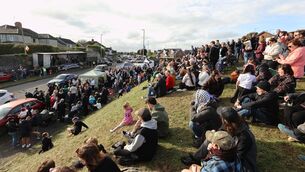
Now he is in his hometown of Clara, addressing several thousand people from a stage truck perched on the town green, and the reception is rapturous. He could deliver some bland, perfunctory remarks, tell a few jokes and wrap the whole thing up in ten minutes, but Mr Cowen has no intention of doing that. His predecessor, who departed in ignominy amid a tribunal investigation, had, even in his best periods as Taoiseach, frequently been accused of lacking the “vision thing”. Mr Cowen, by contrast, is determined to spell out his vision right from the start.
He begins, however, by saying thanks — to the people “the length and breadth of this country” who have offered him in recent days “their very best wishes, their prayers, their hopes, their expectations”.
He tells them it is both “a privilege and a pleasure” to be Taoiseach, and says he can promise only one thing: “That I will give you all of my effort, all of my endeavour, that I will work with everybody in Government and indeed everyone in parliament whose job it is to do their job from the opposition benches, to give you a vibrant and energetic democratic life in this country, to engage in a conversation with the nation about who we are and where we’re going, about what the priorities should be, about how we organise this society.”
THIRTY months later, Mr Cowen is delivering a very different type of speech: a fiery defence of his record, a thundering denunciation of his critics.
It is November 20, 2010, and the location is Castlefin in Donegal South West, where the Taoiseach is addressing a rally for Brian Ó Domhnaill, who is standing for Fianna Fáil in the by-election for the constituency. The warmth and promise of Clara in 2008 are little in evidence now. Although he throws out the occasional one-liner, mostly at the opposition’s expense, this is a grimacing, knuckle- dusting, no-holds-barred effort in which he routinely pumps his fists and thumps the lectern as he flays Labour leader Eamon Gilmore or the media or anyone else who would suggest he protected the banks at the expense of the public.
He has barely finished a few brief introductory remarks about Fianna Fáil when he gets to the real theme of his speech: “I want to talk tonight about lies. Because it has come unfortunately the new lexicon, the new vocabulary, of modern politics, and it’s ugly, and I don’t like it, and it’s not required,” he thunders.
“I’m prepared to come up here and talk to the people about their different opinions, about how they see us, how they see the Government, how they see (its) success and failings. But I will not accept, from any political opponent, the charge of treason or liar.”
There is long applause, as this is a Fianna Fáil rally and Mr Cowen is speaking to his own. In the next 45 minutes or so, he will get to the by-election, to the party candidate, to the state of the country and the prospects for recovery.
But the reference to lies is a reference to Mr Gilmore, who last March in the Dáil voiced his belief that Anglo Irish Bank was included in the September 2008 bank guarantee scheme merely to “save the skins of a number of individuals, some of whom were connected to Fianna Fáil”.
Mr Gilmore went onto suggest that if his belief was correct, “that decision was an act of economic treason for which this country is now paying very dearly”.
An emotional Mr Cowen responded angrily at the time and, several months on, is still angry.
The accusation clearly drove in deep, and the wound is still raw. He aims several punches at Mr Gilmore in the speech, and puts all his force behind them, swinging out in sheer, unadulterated rage. He claims, for example, that Labour’s decision to oppose the bank guarantee scheme was nothing but political opportunism.
“That’s the position he took and he’ll have to live with,” Mr Cowen bellows of the Labour leader.
“And that’s the man that accused me — that man accused me when I made that decision of making the greatest act of economic treason since the foundation of the state. What act of treason would it have been if you’d had a man like that in government that hadn’t the courage to take the decision?”
ENDA Kenny, by contrast, gets off fairly lightly. Mr Cowen says he has been “studying” the Fine Gael leader’s economic policy.
“Mondays, Tuesday, Wednesday, Thursday, Friday — on odd days, you find something that makes sense, but on even days, he’s away with the fairies altogether.”
It’s an open-handed swipe rather than a full-blooded punch at an opponent whom Mr Cowen clearly believes is not in his weight-class. Still, when combined with the attack on Eamon Gilmore, the marked change in tone is noticeable. In Clara in 2008, Mr Cowen spoke in inclusive terms, saying of Government and opposition alike: “I can say to you, for all our flaws and for all our efforts, that everyone I know in politics, of whatever political persuasion, is out there to do the best they can by the community they represent.”
That speech was, of course, almost like an inaugural address in a way, and so by its very nature, Mr Cowen had to be inclusive. Still, his respect for, and generosity towards, his political opponents was unmistakable.
But two and a half years on in Donegal in the midst of winter, a political freeze has set in, and Mr Cowen is now glacial to the opposition — hardly a surprise after the bitter political war that ensued in the wake of the economic crash.
AH, yes, the crash. When Mr Cowen became Taoiseach in 2008, the global economy had been in a tailspin for several months and its effects were beginning to be seen in Ireland, with unemployment having reached its highest levels since 1999. During the run-up to his taking office, Mr Cowen had acknowledged that public spending would have to be reined in, but he insisted the “fundamentals” of the economy remained strong and warned against taking too pessimistic a view of the country’s finances.
In Clara, he touched upon the emerging problems, saying: “I will take whatever temporary adjustments have to be made to avoid permanent damage being done to our economy, and I’ll have to make sure that, in that context, we make sure that the most vulnerable and the weakest are not the casualties of that correction.”
But he didn’t appear to think the correction would be a major one.
Instead, he spoke of it being a “hump”, and said previous generations had faced far worse. “We’ll overcome this hump and the next hump and the following hump, and we’ll have a decent country, a good country, one that we can be proud of at home and abroad,” he said.
Indeed, Mr Cowen’s fear seemed not to be that Ireland could run out of money. It was that the country was becoming too selfish because of the seemingly endless amounts of money it had.
The central theme of the speech was Mr Cowen’s vision of a “Responsible Society”, whereby people would overcome narrow self-interest and focus instead on the interests of the wider community.
“In this country, we’re not simply consumers, we’re not simply people who go through the everyday life without a stake in this society,” he said. “We are citizens of this Republic, and with rights and entitlements have come obligations and responsibilities.”
In addressing this theme, he praised the elderly, “who have come through and seen so much progress in this country, who’ve come through hard times, and who have passed on to us from those periods of adversity the values that are just as germane and relevant in this age of prosperity”.
The firmest clue of Mr Cowen’s thinking came in those last four words, because he spoke of the “age of prosperity” in the current tense. Despite being finance minister for the previous four years, despite being witness to the turmoil in the global markets, despite the unemployment figures, he appeared to foresee only “humps” and relatively small challenges, all of which could be overcome.
The prosperity, he evidently thought, would continue.
“We live in a wonderful country,” he added. “We’ve a great quality of life. Most people are able-bodied and thankfully have a prospect of a job or have a job. More people are setting up their own businesses. Our young people look to us for example — they look to see how we’re handling prosperity — and let’s make sure we do so responsibly.”
BUT by the time Mr Cowen rises to his feet in Donegal, he has endured one of the most humiliating and calamitous weeks of any political leader in Irish history. The EU, ECB and IMF have arrived in town to bail out Ireland, just days after the Government insisted no bailout was in prospect. What little trust there was in his administration has now evaporated, and Mr Cowen would seem a beaten Taoiseach. But he’s not going down without a fight, and is determined to state his case, feeling the media have not allowed him to do so in recent months.
“I would ask that those who commentate on our discourse — and it’s an important part of our democratic life — please look to the facts, please look to the issues, please look to the context, please look to the content of what we say.”
He then launches into a defence of both his and the Government’s record.
He talks about the gains made in the previous 13 years of Fianna Fáil-led government, pointing to the new schools, hospitals and roads built, the extra gardaí recruited, and so on.
“People would suggest it was a mirage, it never happened at all, it was all a wisp,” he says. “Nothing could be further from the truth. And I ask people who are serious about covering politics in this country to look and analyse the real strengths that will enable us to come through this huge crisis.”
As examples of these strengths, he points to the fact that more than 1.8m people are still working and says that the education system can compete with “the best in the world”.
As for the health service, he says he gets calls and letters from “many appreciative families… who have been grateful and gratified” for the care they received.
“And of course there are service pressures in our health services. Of course the media can point to an issue where something that happened shouldn’t have happened. Of course you can find out some issue where there was a lack of professionalism or where some person let the system down. But I know of thousands of people, I know of tens of thousands of people (who have benefited from) a healthcare system that is as good as any in the developed world.”
HE mentioned “thousands” and “tens of thousands” in Clara too, but in a different context.
Back then, he was talking about the waves of emigration that, in previous generations, had tragically washed away loved ones from so many families to the furthest edges of the world.
Just as he thought the age of prosperity was still with us, Mr Cowen spoke of emigration essentially as a thing of the past.
“Let’s remember, when you think back about the psyche and memory and history of what it is to be Irish, in the past, the political narrative of this country was about grievance and impoverishment, about lack of opportunity, about people forced to leave our shores through force of circumstance and lack of opportunity,” he said.
He segued from there into a brief overview of the fight for independence, declaring: “The whole legacy of the independence movement, which is our legacy to cherish and to remould and to fashion in our own time… was to give to the Irish people a sense that they could, through their own freedom of action, decide their own destiny, that they could escape from the provincialism of empire and bring about a chance of an independent Ireland.”
But the long chain of economic catastrophes between 2008 and 2010 — which has seen the spectre of forced emigration come back to haunt this country — ensures Mr Cowen has ditched the stirring rhetoric in Donegal and instead opted for spin.
The bailout, in the eyes of many, means a loss of sovereignty, as the EU and IMF will have to be consulted on economic policy for the foreseeable future. Mr Cowen’s coalition partner, Green leader John Gormley, admits it does represent a loss of economic sovereignty. But the Taoiseach himself is in no mood to do so. The phrase “ceding economic sovereignty”, he says, belongs to a “rather tired, passe, rather undeveloped political philosophy”.
He proceeds to ask: “What is sovereignty in an interdependent world? (It) is about governments making decisions in the interests of our own people and working with colleagues in other international communities and organisations who share our values, who share our economic space, who share in many ways our future.”
In one sense, it could be argued that Mr Cowen’s 2010 downplaying of sovereignty is not actually that far removed from what he said in Clara in 2008. This is because in Clara, he drew a straight line from independence to the decision to reach out to the wider international community by joining the EU. He drew this line so that he could urge people to vote for the Lisbon Treaty, the referendum on which was due a month after he spoke in his hometown.
He wanted people to see the benefits that being part of the EU had brought. He wanted people to recognise that the world was now a “global village”, and that Ireland, an economy hugely dependent on both exports and foreign direct investment, could not afford to be shut off.
He wanted people to send the right signal to the 10 accession countries which had joined the EU in 2004, and which were eager for the same kind of success that Ireland had enjoyed.
“For heaven’s sake,” he urged, “let us not send a signal of indifference to those that have the opportunity and who look to Ireland for the model of development”.
But of course, the Lisbon Treaty crashed to defeat in that first referendum. And it would only be a year later, when the full scale of the economic collapse was becoming apparent for all to see, that Ireland did approve the treaty in a second referendum out of nothing but sheer fright.
The country did the EU’s bidding second time round because it realised it might need the EU’s financial assistance down the road. But even then, few realised the staggering degree to which Ireland would ultimately need the help of not alone the EU, but the IMF too.
And that’s where the thin link between what Mr Cowen said in 2008 about the EU and 2010 about economic sovereignty collapses.
In 2008, he envisaged a future where Ireland would continue to prosper working in tandem with its EU colleagues.
He never envisaged that, in 2010, the prosperity would be gone and a bailout would be forced upon him by those same European colleagues.
Or worse, that he would be in charge as Ireland’s former colonial masters agreed to contribute to that bailout, while desperately trying to avoid patronising language in the process.
THERE was something else Mr Cowen didn’t envisage in 2008: his political career ending prematurely. He declared in Clara that he would “lead from the front”: “I will not breach your trust. I’ve never done it in 24 years and I’m not going to do it in the next five or six.” The last part of that sentence would seem to suggest Mr Cowen not only envisaged serving as Taoiseach for the remainder of the Government’s term until 2012 but beyond that.
In fact, far from serving five or six years, he won’t even make it to his third anniversary as Taoiseach, which would fall on May 7. The Greens have forced his hand by demanding a general election early next year.
In Clara, Mr Cowen used a sporting metaphor to pledge unstinting effort. “I’ll leave nothing on the field,” he vowed.
But he’s about to be hauled off and will not get the chance to finish the match. If his Donegal speech is anything to go by the humiliation and the hurt will be intense.
As he dwelt at length in that speech on Eamon Gilmore’s “treason” charge, Mr Cowen declared: “I am beholden to nobody, never have been, never will be, only to the people of Ireland.”
That he had to say it all indicated how spectacular both his and this country’s fall has been.