Is this one crisis too many for the Greens?
When they faced almost wipe out in last June’s local elections, they said they were going through what they rather cryptically described as a “crisitunity”.
And today, according to their defecting Senator, Déirdre de Búrca, they have simply “lost their way”.
The junior coalition party has always appeared uncomfortable in its adjustment from opposition to authority.
It failed to turn its crisis into an opportunity or stage any effective fight back following the disastrous local elections, when they lost all but three of their 18 councillors.
The response at the time from Minister Eamon Ryan that the Green Party “are part of an international movement that is going to define the politics of this century” shows they have failed to evolve from their niche agenda, which is no longer exclusively theirs since most parties are embracing environmentalism.
And so the Greens are left without much of an identity of their own apart from what de Búrca described yesterday as “an obedient add on to Fianna Fáil”.
Discomfort, frustration, paralysis and fear are all words she uses in her resignation letter to describe the mental state of the Green Party as it holds on to office for fear of a wipe out in a possible election.
“Any suggestion that we challenge Fianna Fáil, or face it down over important issues, seems to bring up a great fear in us that we will have to leave government. In fact staying in Government appears to have become an end in itself now for the Green Party,” she said.
It was easy for de Búrca to blame party leader John Gormley when the reality is that her political career was going nowhere.
She failed to get elected in the 2007 general election and again in the 2009 European elections. She was only sitting in the Seanad because the Taoiseach appointed her to the position so she would vote for and defend his policies, often against her will.
She used the “crisitunity” of her resignation to let the public know that “the party has had almost daily meetings now since well before Christmas, at which we have discussed the very real problems we are experiencing in getting Fianna Fáil to co-operate with us in implementing policy initiatives that were agreed as part of the original, and the revised, Programme for Government.”
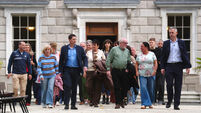
When asked by reporters if this was true yesterday, the “united” Green TDs lined up in the plinth of Leinster House simultaneously gave directly opposed answers.
“Yes” said Minister Ryan, while Ciaran Cuffe said the meetings were every week.
While the party insisted in a joint statement that they are operating in a “collegiate way”, some of the issues raised in the resignation letter seem to have an element of truth.
“She does seem to be throwing up a lot of questions that we will have to answer,” said one of their six TDs, Paul Gogarty, who admitted he and other members of the parliamentary party have been articulating their frustration at party meetings.
“Every day in Government is a struggle” said the party’s other Senator, Dan Boyle, who himself threatened to resign as finance spokesperson in recent weeks because of his dissatisfaction with the Government’s plans for the banking inquiry.
“Overall I still think it’s right for us to be in Government despite the circumstances,” he added.
Former party leader and junior minister Trevor Sargent accepted there can be difficulties in getting what they want out of Fianna Fáil but “that’s the dynamic that keeps the coalition on its toes.”
He said: “We don’t get everything we want, but we certainly have got a hell of a lot implemented.”
According to Boyle, de Búrca had been “semi-detached” since the European elections, when she failed to get elected and saw her party almost wiped out at local level, where she had started her career.
But her true frustration with being part of Government was fuelled throughout that summer by Justice Minister Dermot Ahern, who the Greens see as the big bad wolf in Fianna Fáil.
There was tension over Ahern’s cutbacks in the budget of the Equality Authority leading to the departure of chief executive Niall Crowley.
Then there was a perceived reluctance on the Minister’s part to bring forward legislation on Civil Partnership.
It came to a head one Tuesday evening in mid-July when Taoiseach, Brian Cowen met with Minister Gormley as de Búrca and Boyle abstained from a vote on the Criminal Justice (Amendment) Bill in the Seanad in protest at minister Ahern’s policy.
Boyle said yesterday that this issue was “handled badly” by Government and it obviously did not help de Búrca’s growing sense of unease.
But Boyle and other colleagues suggested there is something more to her resignation.
“I don’t think her letter explains the full circumstances of why she decided to resign,” said Boyle. “She was thinking of herself and her own life. She would have decided politically after the election that she wouldn’t have seen a future for herself in politics.”
Deputy Gogarty said she was “feeling very bruised”.
He said: “I do think there is a human element to it. To take a decision like this, like George Lee did earlier in the week, it’s not something a person does lightly.”
It appears that a number of factors in this story are yet to come to light.
For bigger parties like Fine Gael, a crisis like this offers a good opportunity for a change of leadership to cleanse a party from their past and start afresh.
But a leadership challenge would cause too much internal strife for a small party like the Greens, who, for the time being, are seeing more crisis and less opportunity.