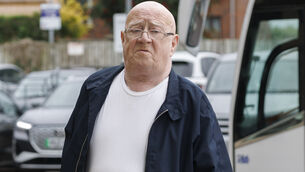
Byrne’s legacy will follow him into retirement

IT’S an unfortunate coincidence that Garda Commissioner Pat Byrne retires in the same week as six gardaí appear in court charged with assault causing harm against civilians.

Byrne’s legacy will follow him into retirement

The officers, due to appear in the Circuit Court today, face charges in relation to their handling of the Reclaim the Streets demonstration on Dublin’s Dame Street last year.

The trial comes as the Commissioner yesterday carried out his last official public function at the Westmanstown Sports Centre in Dublin.

This Friday he will have a farewell bash at Dublin’s Citywest Hotel, where 500 people will see him off and then at 12pm on Sunday he will formally end his stewardship of An Garda Síochána.

Commissioner Byrne’s retirement will mark the end of a tumultuous and disturbing period for the force.

He was appointed in the middle of a heady summer in 1996, which saw the killing of Garda Jerry McCabe, communities marching on the homes of drug dealers, and the murder of Veronica Guerin.

He landed the post largely on his plan to combat organised and paramilitary crime.

He can look to the dismantling of the ‘untouchable’ John Gilligan gang, and the charges and convictions brought against many of its members, as one of his biggest successes.

The establishment of the Garda National Bureau of Criminal Investigation, the Garda National Drugs Unit (with its local sub-units), the National Surveillance Unit and the Criminal Assets Bureau have all happened under his watch and have scored dramatic results.

They have all ensured that the ‘untouchables’ that existed when he took over are no longer that and, at the very least, that their assets are harder to hide.

The Special Branch and the Security and Intelligence Section have had significant success in infiltrating dissident republican organisations, interrupting their activities and bringing charges.

The Domestic Violence and Sexual Assault Unit has achieved considerable success, seen most dramatically in Operation Amethyst, a nationwide crackdown on child pornography.

Road deaths fell between 472 in 1997 to 376 in 2002.

It would be churlish not to note these and other successes.

But they have come against the backdrop of increasing public order offences, sexual offences, firearms offences and homicides as well as a staffing and morale crisis among rank and file gardaí.

Moreover, Commissioner Byrne’s term of office has been marked by a series of controversies and scandals as well as a lack of openness regarding internal garda inquiries.

Some of the scandals - the Morris Tribunal, investigating a can of worms in the Donegal division, and the Barr Tribunal, investigating the garda handling of an armed, but depressed, man - could lead to devastating findings of fact for the force.

Commissioner Byrne can look forward to a grilling at both tribunals regarding what he knew and how he responded.

The activities of individual guards during interrogations - in the Colm Murphy prosecution and the framing of Frank Shortt - attracted unprecedented criticism in the courts.

Internal investigations set up to examine garda activities - in the Colm Murphy case, the Walsh sisters’ case, the Dean Lyons case and others - were never published.

In most of the internal inquiries, no disciplinary action was taken against the guards.

Mr Byrne knows that although he is retiring, he won’t be leaving it all behind him.

In his parting words yesterday, he said: “If I have to take responsibility, fair enough. I have no problems with that.”

More in this section

Lunchtime News

Newsletter

Keep up with stories of the day with our lunchtime news wrap and important breaking news alerts.

Cookie Policy Privacy Policy Brand Safety FAQ Help Contact Us Terms and Conditions

© Examiner Echo Group Limited