Protesters issue call to arms for Irish language in EU
Neither was the reason behind yesterday's protest too far removed from the cause of the battles of that year. Again it was the plight of the Irish, the downtrodden Gael or in this case Gaeilge that prompted pikemen to march on the former symbol of royal authority in Ireland.
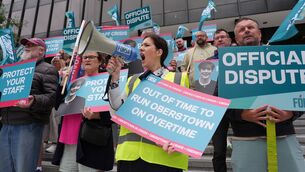
In a bid to embarrass the Government for its failure to insist on the inclusion of Irish on the list of official EU working languages, Irish language enthusiasts timed their protest to coincide with the first Forum of Europe meeting during Ireland's Presidency of the EU.
"Thanks to Government inertia, Irish will soon be the only one of 20 European Union languages without official status in Brussels," said protestor Emer Ní Chonchubhair.
In May, nine new languages Estonian, Latvian, Lithuanian, Polish, Czech, Slovak, Hungarian, Slovene and Maltese will become official languages, alongside English, Danish, Swedish, Spanish, French, Italian, Portuguese, Dutch, Finnish, Greek and German.
This will mean 20 official languages, requiring in each case 150 new translators and interpreters. If Irish was given official status it would also mean EU laws and official documents would have to be issued in Irish. Irish currently has "treaty language" status which means that under Article 21 of the EU Treaty an EU citizen can write to an EU institution in Irish and receive a reply in the same language.
When the Irish Government stated in 1971 that it did not wish Irish to become an official and working language of the European Community, the reason given was the translation work would present serious practical problems. The protestors held no truck with this view.
"Not listing Irish as an official working language, means it will not be recognised as a second language when Irish-speakers apply for a job in Brussels which requires the candidate to have two EU languages. It will place them at a huge disadvantage," Ms Ní Chonchubhair said.
More people know Irish than Maltese, Latvian or Estonian, the protestors claimed. Unlike the governments of Malta, Latvia and Estonia, our Government refuses to push our national language as an official and working EU language.
"There are 300,000 fluent Irish speakers in this country; 30,000 people have signed a petition demanding that Irish be made an official language, the Government has let the issue slide long enough," Ms Ní Chonchubhair said.
Solicitor Daithí MacCárthaigh, who spearheaded the protest, said it was ludicrous for Government to spend money on teaching Irish when it would not support promoting it to official EU language status.
CONNECT WITH US TODAY



Be the first to know the latest news and updates