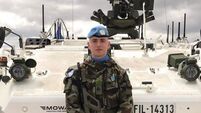
Seán Rooney inquest: Corporal was 'frustrated' with commander for leaving their vehicle behind
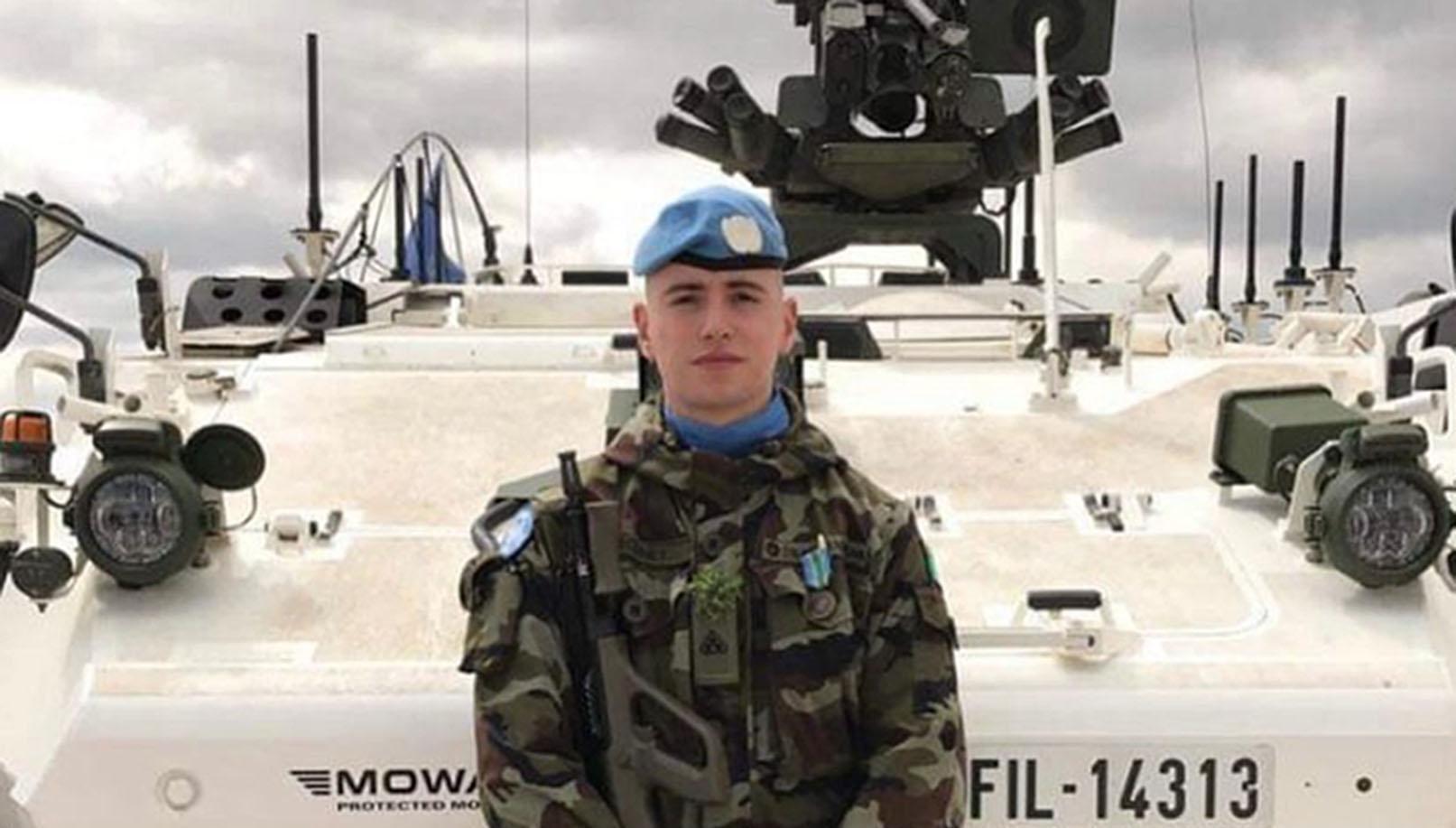
The inquest into Private Seán Rooney's death heard that five calls ensued between Capt. Kelly and Cpl Phelan after Pte Rooney's vehicle had become separated from the lead vehicle in hostile Lebanese territory.
The soldier in command of an armoured vehicle in which Private Seán Rooney was shot dead said he felt angry with his commanding officer for leaving their vehicle behind.
Corporal Josh Phelan told an inquest into the death of Pte Rooney that he had felt frustrated with his commander Captain David Kelly after their convoy became separated in hostile Lebanese territory on the night of December 14, 2022.
Asked by Sean Guerin SC for Pte Rooney's family if he had been angry with Captain Kelly, Cpl Phelan told Dublin District Coroners' Court that "I just remember being frustrated". "That he was gone essentially," he added.
On the night in question the vehicle containing driver Pte Rooney, Cpl Phelan, and Troopers Shane Kearney and Nathan Bryan, became separated from the first vehicle in the two-vehicle convoy containing Captain Kelly at a mandatory stop at the Litani River.
With the first car disappearing from sight the second vehicle had continued along a minor road into the village of Aaqbiyeh, missing a turn-off for the main coastal highway which was to bring the convoy to Beirut's airport.
Read More
Cpl Phelan told the inquest that he "wasn't familiar at all" with the route the car was due to take through hostile territory before it became lost. He said that Captain Kelly was "extremely familiar" with the route as he had "gone through the route I don't know how many times".
The corporal was on his first tour of duty in Lebanon and had only arrived one month previously. He said that no formal briefing — which would normally last close to an hour — had been held in advance of the ad hoc mission, which had been laid on to drop Tpr Kearney and one other soldier to a flight to Ireland to attend separate funerals.
He said a very short briefing, less than 10 minutes and potentially less than five minutes, took place at the armoured cars before they were due to depart Camp Shamrock that evening.
He said that briefing was dominated by other soldiers saying their goodbyes to their departing colleagues and said he could not recall an instruction to make the turn at a garage, and could only remember "codewords for roads, Alpha 1, 'move on to Alpha 2'".
He agreed that the convoy was under time pressure in order to reach the airport in time for the departing soldiers' flights.
Cpl Phelan, who appeared deeply distressed throughout much of his evidence, said he had likewise had no formal training regarding Denial of Freedom of Movement (DFOM) incidents, four of which his car would endure via a hostile crowd of more than 50 people when driving back through Aaqbiyeh in an attempt to relocate their lead car before their boot and back window was breached and Pte Rooney was shot dead.
"My understanding was that generally it's teenagers (involved in a DFOM), they're bored, making a name for themselves, and that they'd last no longer than 15 to 20 minutes," he said.
He agreed with Mr Guerin that the first indication his vehicle had gone astray was when he realised that they should have caught up with the first vehicle after several minutes of driving at high speed in an attempt to catch up.
The inquest heard that five calls ensued between Capt. Kelly and Cpl Phelan — two in quick succession at 10.50pm and 10.54pm from Capt. Kelly during which he instructed Cpl Phelan to turn the vehicle around and proceed back through Aaqbiyeh and to meet the first vehicle at the junction they had missed, where it would be waiting with its hazard lights on.
Cpl Phelan subsequently called Capt. Kelly at 11.06pm and 11.10pm at which point the vehicle had been stopped by a blockade of vehicles and a hostile crowd.
The final call between the two was made by Capt. Kelly at 11.16pm, at which point Cpl Phelan was no longer speaking directly to the other officer and had placed his phone on his lap as the crowd laid siege to the vehicle.
Regarding the call he had made to Capt. Kelly at 11.06pm when the DFOM was turning increasingly violent, Cpl Phelan said: "I thought he would make contact faster".
Disparities in the recollections of the events surrounding the movements of the lead car in slain Private Sean Rooney's armoured convoy were been highlighted at the inquest on Thursday afternoon.
Corporal Richard Shanahan, a signalman in the lead vehicle in the convoy which separated from the second car being driven by Pte Rooney on December 14 2022, said he was "not trying to deceive" the inquest when inconsistencies in his statements were pointed out during his testimony.
Pte Rooney was shot dead while driving away from a hostile crowd in the village of Aaqbiyeh in Lebanese territory on the night in question after he and his colleagues became separated from their lead vehicle.
Cpl Shanahan said he and his colleagues realised they had become separated from the second vehicle after a mandated stop, known as EP28, on the Litani River while travelling to Beirut Airport.
They initially attempted to return to EP28 but were forced to abandon their armoured vehicle after it suffered a blowout that they were unable to repair.
Under questioning from Sean Guerin, counsel for Pte Rooney's family, Cpl Shanahan agreed there were inconsistencies in his previously given statements on the matter, but insisted: "I'm not trying to deceive."
The inquest heard that after the two cars became separated, the lead car, under the command of Captain David Kelly, made a sharp turn right off the coast road followed by another turn left onto the main coastal highway to Beirut. The second car missed the first turn and continued on towards Aaqbiyeh by mistake.
Cpl Shanahan agreed that he, in his initial depositions on the incident taken soon after it had occurred, said the lead car went a short distance down the slip road of the highway before Capt Kelly ordered the driver to pull over and turn on his hazard lights to verify if the second car was still behind them.
Under questioning from Mr Guerin, he agreed that the car may have gone much further down the highway before realising the second car was no longer with them.
Asked if there were "any question that the truth is the vehicle drove several hundred metres down the MSR (Military Supply Route)", Cpl Shanahan replied "no".
He agreed that even if the second car had made the first turn from the coast road, it still could easily have missed the second turn onto the highway.
Asked why he had told gardaí eight months after the incident that his car had not gone beyond the highway's slip road, Cpl Shanahan replied "passage of time maybe".
Mr Guerin noted that Cpl Shanahan was also unable to say if his car had made it back to EP 28 when looking for the second car.
"The jury may form the opinion that those two mistakes are a feature of recollection of more than one of the occupants of that vehicle," Mr Guerin said.
"It seems to be a common affliction of those in the lead vehicle."
"I'm not trying to deceive," Cpl Shanahan replied. "I'm not sure why it (his statements) would have changed."
Mr Guerin suggested that the corporal had not made any reference to attempting to use his car's VHF (very high frequency for long range communication) radio to raise the second car after it became separated because he had failed to do so.
Cpl Shanahan replied: "I don't know."
He insisted that a full VHF handset had been present in the lead car.
He was also unable to explain why, in his initial deposition, he had said that a screenshot of the second car's location during the time it was under attack showed it to be 15km away, when in evidence on Thursday he said the distance had been "7-8km as the crow flies".
The inquest continues.
CONNECT WITH US TODAY



Be the first to know the latest news and updates