Higgins slams claims linking Gaza criticism to anti-Semitism as 'outrageous'
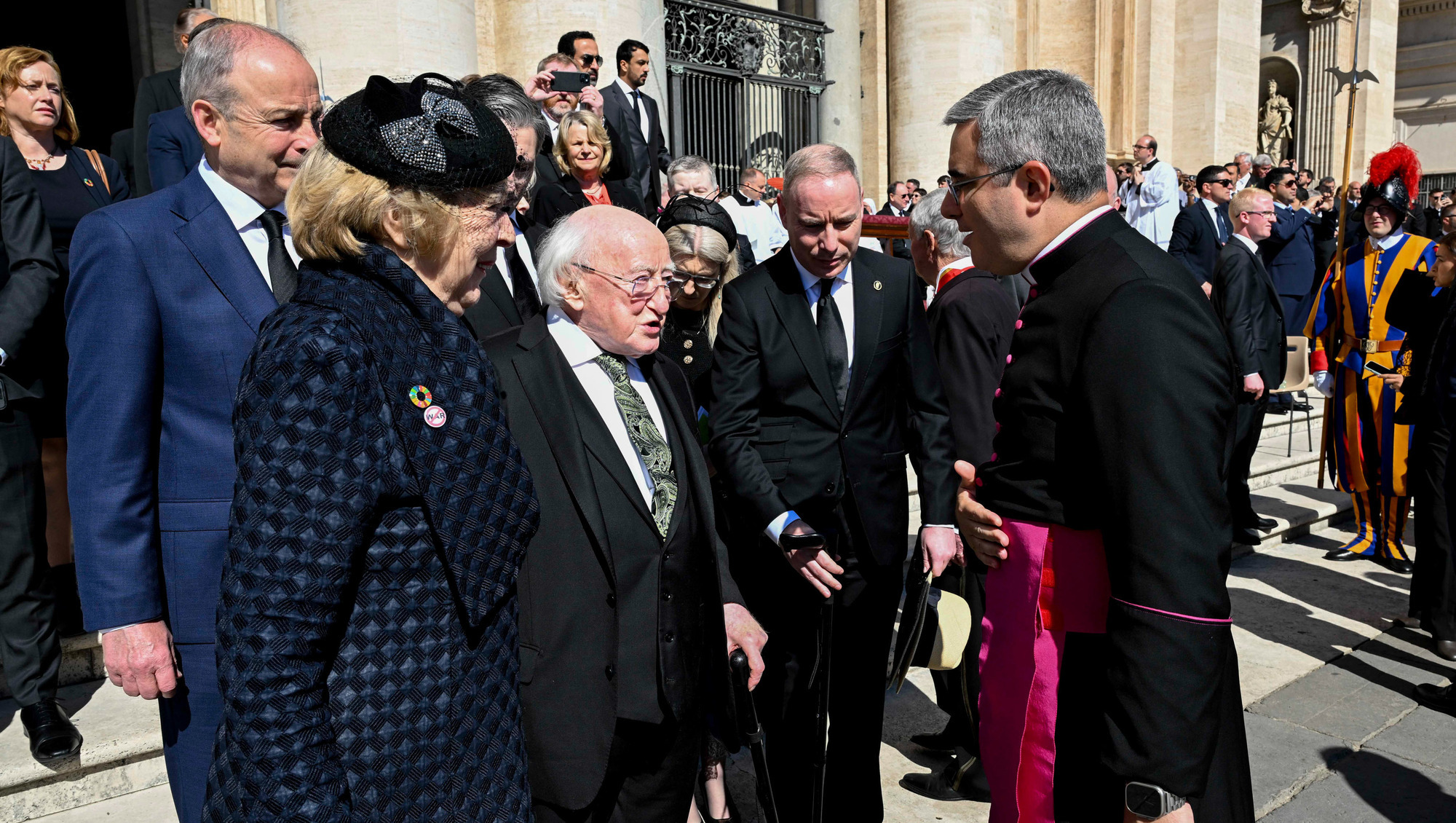
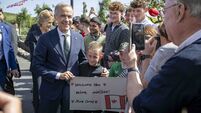
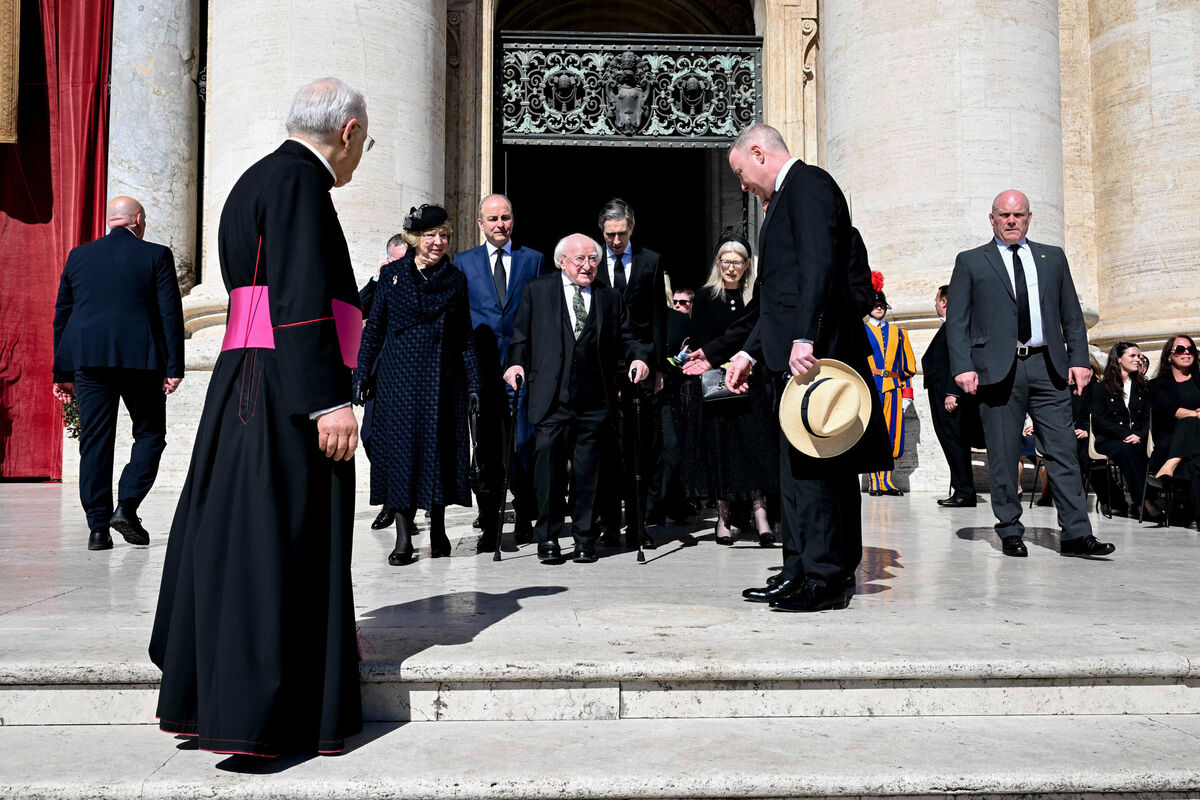
President Michael D Higgins, his wife Sabina, Taoiseach Micheal Martin and Tanaiste Simon Harris attend the funeral of Pope Francis in Vatican City. Picture: Maxwells/PA wire
President Michael D Higgins has described as “outrageous” and a “lie” the claim that anybody who criticises Israel over its war on Gaza should be labelled anti-Semitic or a supporter of Hamas.
He was speaking at a press conference at the Pontifical Irish College in Rome hours after the funeral of Pope Francis.
During his remarks, President Higgins said it was "very significant" not only who attended the funeral, but also who was "missing".
Neither Russian president Vladimir Putin nor Israeli prime minister Benjamin Netanyahu were present.
Without naming Netanyahu directly, President Higgins said it was "outrageous" to suggest someone is anti-Semitic if they "criticise a prime minister who is directing an army that is in breach of international humanitarian law."
He also said it was "a great lie" to claim that expressing concern for civilians in Gaza amounts to supporting Hamas.
An arrest warrant has been issued for Mr Netanyahu by the International Criminal Court (ICC) for alleged war crimes and crimes against humanity related to the conflict in Gaza since October 8, 2023.
Last year, Israel’s Foreign Affairs Minister Gideon Sa'ar announced the closure of Israel’s embassy in Dublin, citing what he described as "anti-Semitic rhetoric" in Irish political discourse and accusations of attempts to "redefine genocide" regarding Ireland’s support for Palestinian statehood.
President Higgins also criticised what he described as the silence of many nations on the humanitarian crisis in Gaza, citing restrictions on food, medicine, water, and basic supplies. “Have we become numb?” he asked.
Separately, the President spoke about clerical abuse scandals and Pope Francis' handling of them.
He said he understood those who believe the late pope should have been made aware of abuses earlier, and he drew parallels between institutional abuses in the Church and failures within civilian society.
“There’s something yet to be faced,” he said, highlighting abuses within work settings beyond religious institutions.
He said he understands those who say he should have known more and known earlier.
He also understands it when they say people should have given him the information earlier.
“There is a lesson in it as well, because there's a lesson in it, not just for churches, but for governments, too,” he said.
“It’s about what happens when the procedures take precedence over the purpose.
“In that sense, it was that the amount of damage done and the consequences were never confined to the people directly involved but also to those who depended on them.”
He added: “There's something yet to be faced, and it is that the abuses that were going on in institutional settings were repeated and extended by people in civilian society who abused people in work settings.”
President Higgins also reflected on Pope Francis’ 2018 visit to Ireland, saying he had conveyed to the pontiff the deep anger felt by survivors of clerical abuse.
The issue of abuse came up when the late pope was received at Áras an Uachtaráin, in Phoenix Park.
In his tribute following the Pope’s death, Mr. Higgins said Pope Francis had made “very difficult” efforts to address abuse and that the steps he had taken should be built upon.
President Higgins also said of the Pope that it was “important the steps he took are built upon as they constitute a source of hope in the years to come”.
Tánaiste Simon Harris also paid tribute, describing Pope Francis as a “remarkable spiritual leader” whose 2018 visit was “a moment of reflection and dialogue, of healing and hope."
He said: “It was an honour and a privilege for me to attend the funeral.
“We joined with people from every corner of the globe in mourning a remarkable spiritual leader who left an indelible mark on our world.
“In Ireland, he will forever hold a special place in our hearts for his historic visit in 2018. That visit was a moment of reflection and dialogue, of healing and hope, and it resonated deeply with people of all faiths and none.”
He added: “Pope Francis challenged us all to be better—to care more, to judge less, to lead with kindness. His legacy will continue to inspire generations to come.”
CONNECT WITH US TODAY



Be the first to know the latest news and updates