Lexus RZ 500e review: no steering wheel, bold new tech — and a glimpse of the future of driving
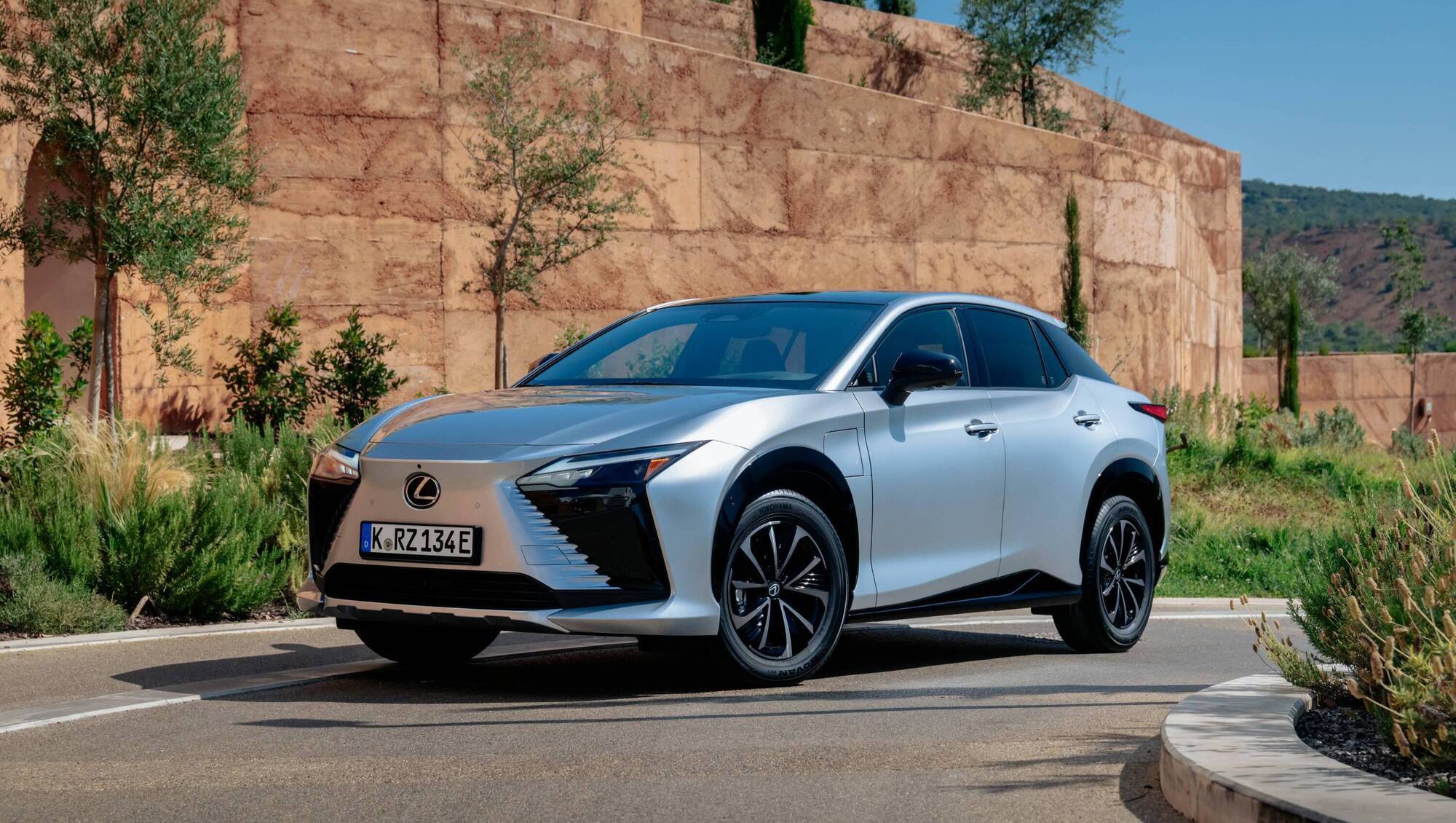
The Lexus RZ 500e is exceptionally planted on the road and therefore inspires a great deal of faith in its roadholding.
|
LEXUS RZ 500E |
|
|---|---|
|
|
★★★★☆ |
|
|
From €66,280 - €79,990 as tested |
|
|
Two 280kW motors, a 77-kWh battery and 381bhp |
|
|
457km |
|
|
To say it’s thorough would be an understatement |
|
|
Lexus is ahead of the production pack with some of the high-end tech on offer here |
Pioneering technology is something every manufacturer should strive for; such an approach is, after all, the lifeblood of the automotive industry, providing relevance, innovation and something new for the buying punter to boast about.
Some pioneering motoring inventions have gone a long way towards saving lives, increasing performance and making life a lot more comfortable; others, however, have proven to be dreadfully impractical, even if they looked great on paper.
Such as the seat belt, airbags, ABS brakes were all huge successes and rightly adopted across the board; others, such as BMW’s joystick shifter of the early 2000s, or Pontiac’s talking car from the 1980s, or even Cadillac’s ‘sanitary unit’ built-in toilet from the late 1940s, truly failed to gain a foothold.
Many such tech missteps were driven by a desire to meet customer demand or address specific motoring challenges, but more often than not, they proved to be expensive and embarrassing cautionary tales. As the late British comedian Bob Monkhouse put it: “When the inventor of the drawing board messed up, what did he go back to?”
Read More
It’s all very well being ground-breaking or state-of-the-art, but if stuff simply doesn’t work or Joe or Jane Public don’t like/want what’s on offer, then it is more than useless.
Occasionally, though, the industry comes up with stuff that’s been pioneered in something like F1 racing and makes it work for road cars. Drive-by-wire, where electronics or electromechanical systems are used in place of mechanical linkages, has long been adopted in Grand Prix cars and has been successfully employed in the mainstream industry.
Steer by wire is another aspect of this and is where the wheels of a car can be steered without a steering column being mechanically attached to the wheel axles. It sounds scary, but it works, and it’s a feature on this week’s tester, the Lexus RZ 500e Direct4.
Upon sitting in the car, the first thing you will notice is that there’s a complete absence of one of the first things that normally attracts your attention – a steering wheel. Instead, there is a small butterfly-shaped ‘yoke’, which does indeed look like something from an F1 car.
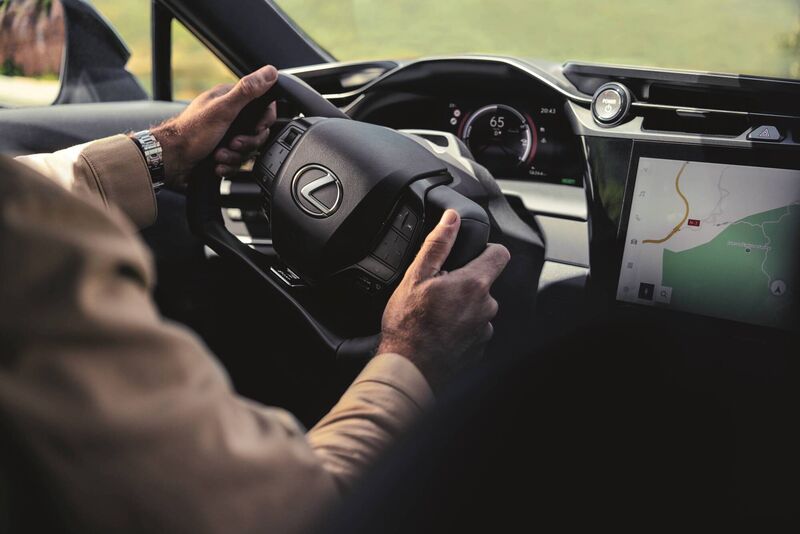
Aside from getting your head around the fact that the thing in front of you is not fully (or nearly) circular, you have to adapt to a number of things. Firstly, the manner of leveraging yourself in and out of the vehicle by having a hand on the wheel is no longer an option.
Secondly, if you adhere to the ‘ten-to-two’ hand position (which is incorrectly taught as the ideal one) for driving, you won’t be able to adopt it here, as the yoke forces you resolutely into a ‘quarter-to-three’ pose.
Thirdly, if you – as so many do – like to swing into a corner with just your right or left hand at or near the top of the steering wheel, once more you’ll be forced to adapt. All in all, this system demands you adapt quickly to a whole new style of driving.
Quirky too is the fact that the yoke only moves 200 degrees to either side from dead-centre, which, in reality, means that a full lock-to-lock swivel is just about one full turn. That’s much less than a conventional wheel, and while this makes tight manoeuvres such as parking a doddle, once again, it is hard to get your head around.
It will take you time to adjust to what is, effectively, a completely new way of doing business when you’re driving. That you will no longer be able to allow the wheel to spin through your hands when it returns to centre after being on full lock is also strange.
All that said, the system really works well, and after a period of adjustment, you will be surprised how quickly you adapt.
One minor quibble here is that too much is packed into the tiny space of the steering wheel boss, and the lights/indicator and wiper stalks move with the wheel, as do the so-called gearchange buttons. Elements here look like they might need rethinking.
The reality of driving the car is that what you have here is a vehicle that can be placed precisely where you want it on the road and where you want it to go. There might be little of the traditional feedback you expect from a steering wheel, but that’s fine once you gain confidence that the car will do exactly what you want it to do – and it does.
The Direct 4 four-wheel-drive system – which relies on electric motors on either axle – means there is little of the expected understeer in corners, and the potential to induce oversteer is rather limited. For anyone other than a rally driver, this means the RZ 500e is exceptionally planted on the road and therefore inspires a great deal of faith in its roadholding.
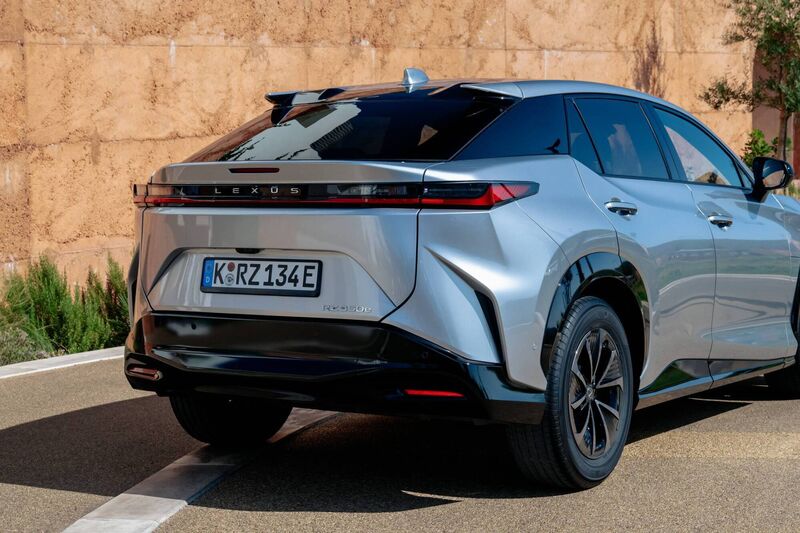
Ride too is top drawer, and by retuning the suspension from the last iteration, Lexus has sharpened up the game of the car, making it all the more pleasurable to drive. That’s further helped by a drivetrain system which is also among the best in the business right now.
Two 280kW motors, along with a 77-kWh battery and a single-speed reduction gear auto ‘box, give the RZ an output of 381 bhp, a 0-100 km/h time of 4.6 seconds and an official range of 457km, all of which add up to a brisk and entertaining piece of kit.
While the range is good – and fairly honest too – it’s not anywhere near that of the new BMW iX3, which might slacken enthusiasm among potential buyers in the executive realm. But there are aspects of the car which will keep sales ticking over.
Since the outset, Lexus has prided itself on producing exquisite interiors, and this one is no different. The materials used – all now either vegan or made from recycled stuff – feel and look divine, and touches like the laser-cut patterns in the door cards are innovative and attractive, especially so at night where they give life to the ambient lighting.
The inside of the car is a really nice place to be, and roomy too for the rear passengers. Sure, the instrument binnacle is small, and the large central touchscreen controls everything, which makes mastering the climate something of an ordeal when you’re on the move. Generally, though, there’s a ‘wow’ factor here, which is something not many can boast.
The boot is huge too, and for the execs among you, don’t worry about getting your golf clubs – and those others in your fourball – into it.
There are loads of nice touches as standard – panoramic roof, loads of safety tech (none of which is too intrusive), climate control, an excellent sound system, 360-degree parking aids and so forth – so it should please the tech-heads too.
There is a case to be made against manufacturers who strive to be different just for the sake of it and who invent complicated technical solutions to problems that, for the majority of drivers, don’t really exist. Then there is also a case to be made for those manufacturers to strive to use technology to make their cars better.
This car certainly falls into the latter category, and Lexus has done a good job of making advanced technology applicable and worthwhile. They might have fallen short in a few of the tiny details, but the overall product certainly withstands all and any examination.
Some might feel this to be a step too far with certain of the tech applications, but in reality, it’s a look at the future – now.