Kudos for Koleos but the Renault is no front runner
FORMULA ONE motor racing is a fickle and curious thing — and particularly so for those manufacturers who choose to invest gazillions of euro taking part in what is truly a global sport with an amazingly large fan base.
It can be hugely rewarding if you’re good at it, or massively damaging if you’re not, writes .
Take two cases in point: Honda and Renault. Both have been in and out of the Grand Prix whirl on several occasions over the last 60 years or so and both have experienced many highs and terrible lows too.
Both companies have been involved both as a manufacturer — whereby they design and build both engines and chassis — and, more simply, as a mere provider of engines to customer teams.
For Honda, it came into the sport in the 1960s, building the complete car, although it did eventually have to lean on expert chassis builder Lola to give its racing department a hand — leading to the cars being branded “Hondola” in some quarters.
Having opted out of F1 in the 1970s, in the ’80s, Honda came back solely as an engine builder and enjoyed massive success with the likes of Williams, McLaren and Lotus.
It then opted out again, only to return in recent years — without any success at all — with such as McLaren and Toro Rosso. Next year Honda will provide engines for the high-achieving Red Bull squad.
Similarly, Renault entered the frame as a manufacturer in the mid-1970s and revolutionised the sport with its unique, and ultimately, all-conquering 1.5-litre four-cylinder turbocharged engines.
An eight-year spell as a constructor ended in 1985 after many race wins, but no titles. Through the ’90s it returned as an engine supplier and had great success with constructors such as Williams.
In 2002, the Renault name emerged once more as a constructor but something of an up and down time followed until it eventually won the World title thanks to Fernando Alonso in 2005 and a constructors title in 2006.
A crash involving Nelson Piquet Jr in Singapore in 2008 eventually led to race-fixing allegations against the team the following year and the scandal prompted the Renault main board to sell 75% of the team to an investment company.
This in turn led to the formation of a new team called Lotus Renault which raced with some success before Renault eventually bought the whole thing back and started racing once more as a constructor in 2016. But since 2007 it had also begun providing customer engines and with Renault engines in the back of its cars, the Red Bull team won 50 races and several drivers’ titles.
This season is the final year of the deal with Red Bull (although the engines are no longer badged as “Renault” units for commercial reasons) and it has been staggering to note that while the works effort has been largely uncompetitive and winless, the units they supply to Red Bull still propel winning cars.

Ironically, from next year Red Bull’s cars will run with Honda engines and the speculation within the sport is that Renault will not miss an outfit that rarely did anything but complain about their products, while also being able to concentrate more on their own works effort.
But there has been huge embarrassment at the “Regie” that it has not been able to build a package capable of winning races, particularly given the amount of dosh that has been invested trying to do so. The company’s marketeering geniuses have been left stumped by this failure and have been singularly unable to sell the company’s street-going cars on the back of any F1 success — largely because there hasn’t been any.
That being so, the current wellbeing of Renault in markets across the globe has been very welcome in the boardroom, because efforts in this regard have not been helped by the costly F1 exercise.
Models such as the Clio and Megane have been great mainstream successes, while the SUV models such as the Captur and the Kadjar have also proven to be hugely popular.
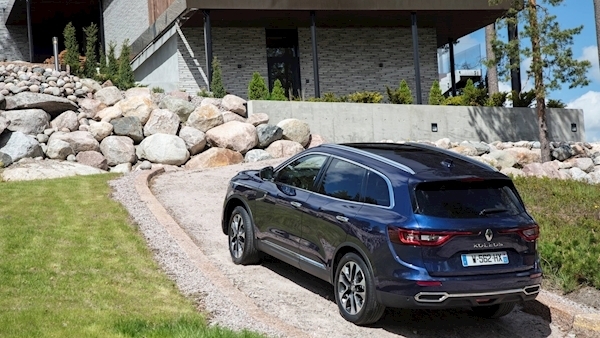
And Renault has a third string to its SUV bow and that is the biggest one they make, the Koleos, which in an increasingly crowded marketplace has also found its niche.
We tested one earlier this year and were very impressed by its size, value for money, specification and its relative fleetness and economy despite having only a 1.6 turbodiesel. Indeed the only big flaw was that it only had five seats, as against the seven offered by many competitors.
This week we try the two-litre turbodiesel version and it is a very decent addition to range, despite coming — in testing guise at least — with a CVT “rubber band” gearbox, a form of transmission design we have long loathed.
That said it is not at all the worst such thing we have ever driven and, if the car is used primarily as a long distance load-lugger, it will suit just fine. Not so in solely an urban environment though.
With 175 bhp on tap you’d have thought that it might be a bit sporty; think again. The 10.7 second 0-100km/h time is not exactly glacial, but not far off it and the 202 kph top speed isn’t Formula One-esque either. The 5.3 l/100km consumption rate (52 mpg) is not bad but the 156g/km emission rate — for an annual tax bill of €570 — might put some off.
Less fuss, on the road quicker.#KOLEOS has joined the #EasyLife range.
— Renault UK (@renault_uk) October 11, 2018
Find out more: https://t.co/XFuHtBroH8 pic.twitter.com/sq5Mke1Bom
Handling is acceptable rather than wonderful and while the ride is really pretty good, Renault has built a car that is good rather than great and while the full-time 4WD will be a boon to rural dwellers and adventurers, it won’t mean much to city folk.
On top of that, the ever-so-slightly tinny sound when you close doors will have some buyers looking at German offerings instead.
A terribly handsome car with wonderfully comfortable seats, a lot of interior space and a truly serious specification list (including cruise control, traffic recognition, auto headlights and wipers, rear camera and a sliding panoramic roof), the Koleos does offer a lot, apart from seven seats and the five-seat only routine will be a negative for many.
Worth noting — from a practical point of view — is that it has a full-sized spare wheel as standard, while I also found that the R-Link infotainment and connectivity systems were really easy to use and live with.
It is funny to note how some car makers’ high-end activities mirror their normal day-to-day deeds and in the case of Renault, it would appear the company’s current mid-grid, no winner Grand Prix endeavours are very closely reflected in products like the Koleos — good, but not really close enough to make it to the front of the grid.
Colley's Verdict
from €34,490 - €47,365 as tested
decent two litreoil-burner, but avoid the CVT gearbox if you can
spectacular
nearly never won the race



