Something feels missing: Bring back the trolley service on every train journey
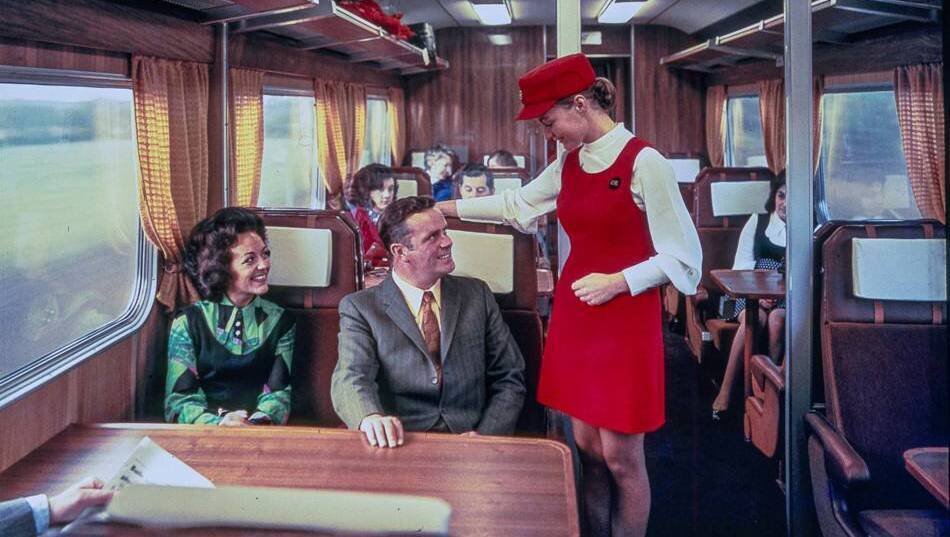
Lap of luxury: A glossy brochure image of Irish railway travel in the 1970s. Many trains do not even have a trolley service today
Westport station is modest: It has no shop, no vending machine, and no chance to grab a drink.
After taking my seat on the train, I noticed an unopened bottle of Coke belonging to a fellow passenger, someone more organised than me. He didn’t seem thirsty, while I was drooling.
Six years ago, this wouldn’t have been an issue. I might have had to wait to buy a tea or a juice, yes, but not until my destination. At some point, there would have been that familiar rattle of bottles and cans as a staff member appeared in the carriage like a fairy godmother, albeit one who charged €3.50 for a can of Club Orange. She would have come bearing gifts, or at least overpriced goods, for sale: Tea, coffee, sandwiches, crisps, chocolate, maybe beer and wine. An array of treats.
Alas, this trolley service is no more on most of our railways, with the exception of a few lucky lines.
Its absence is particularly felt on longer routes, like Dublin to Mayo, a three-and-a-half hour journey. Unlike the Dublin-to-Cork and Dublin-to-Belfast services, where a trolley still operates, passengers on the Dublin-to-Mayo line have to bring their own refreshments.
It’s a route that draws a wide mix of people: Older passengers heading west for so-called ‘golden years’ hotel deals; groups travelling for weekends along the Wild Atlantic Way; hen and stag parties making the trip to one of Ireland’s most popular destinations, but often with far more enthusiasm than provision.
The Dublin-to-Mayo route is not a commuter hop. It’s a long enough journey for comfort, and the option of a little indulgence, to matter. Those on-the-go vinos had a distinct taste of indulgence and, occasionally, regret.
There was no formal decision to remove the trolley service. A spokesperson for Iarnród Éireann said it was initially suspended during pandemic restrictions in 2020, when onboard catering was not permitted.
When restrictions eased in 2022, the previous provider had withdrawn from the contract, and attempts to source a replacement proved difficult, with price quotes coming in at up to four times the previous costs.
A limited service has since returned on certain routes — Dublin to Cork and Dublin to Belfast — but funding constraints mean a full roll-out is not possible.
The company says it is continuing to explore options to restore catering across all inter-city routes, though no timeline has been confirmed.
It’s a practical explanation in the context of rising costs and post-pandemic restructuring. But for passengers, the loss feels less logistical and more personal.
Of course, for Iarnród Éireann, the challenge is balancing that expectation with financial reality. With limited funding from the National Transport Authority and a shrinking pool of catering providers, restoring the service across all routes is not straightforward. The company says it is engaging with potential suppliers and seeking more creative, cost-effective solutions. But for passengers, that process is largely invisible.
What remains is the journey itself. There’s something about train travel that slows you down. It’s one of the few spaces where you are, by necessity, offline from the usual demands. The trolley once complemented that. Even if you were not particularly hungry or thirsty, there was tea, coffee, a sandwich. A sense that you were being looked after. The trolley punctuated the journey.
In its absence, the experience feels flatter. Now, you either arrive prepared, coffee in hand, snacks packed, or you go without.
You might joke with a fellow passenger as you both competed for the last bag of cheese-and-onion crisps, a silent understanding that neither of you truly needed them. The small bit of banter that arose from comparing who opted for tea versus something stronger. That brought a communal spirit to a solo trip.
Now, a railway journey minus a trolley feels more subdued. The etiquette has become headphones in, everyone contained within their own space.
The trolley sounds like a small thing. But its absence is more conspicuous than you might expect, most noticeably in the middle of the journey, where something now feels missing. It would be nice to get a bottle of Coke without having to test the limits of social boundaries by bartering with a passenger who had the good sense to come prepared.