Kinsale’s warm welcome and warm food make it ideal to visit
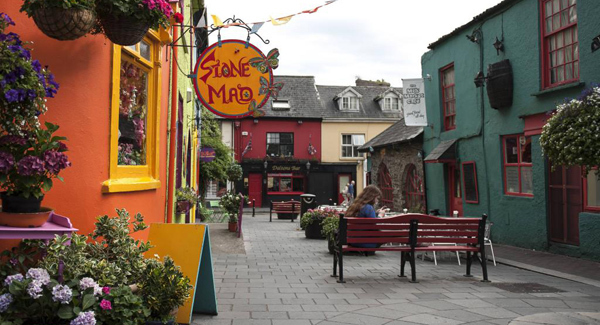
The cafe on Main Street is also a book exchange and a beacon of light and warmth as dusk falls outside and the wind bites hard.
Climbing and descending for a few hours via ancient flights of hidden steps, known as Sallyports, exploring the town’s historic past, lead down to little streets lined with restaurants, music pubs, cafes, art galleries, designer workplaces and gift shops.
The walls of Poet’s Corner are crammed with books you can peruse even as you are tempted by cakes and biscuits.
A slice of raspberry oat bar, with frothy Cappuccino, adds up to perfect happiness on a chilly Friday evening.
Asked “Are you ok”, “are you alright” everywhere, a lately returned emigrant like myself nearly replies “I hope so”.
Those normal throwaway enquiries and the magic words “no problem” are a big improvement on a clipped Dutch “Dag” (‘good day’) or an unsmiling, disinterested “wordt u geholpen?” (‘are you being helped’?).
A litmus test of a good tourist destination is to arrive in the darkest days of February, when the seasonal attractions are shut.
If you enjoy great food (and not just fine dining; more affordable options have increased greatly since my last visit, years back) you are in the right place, regardless of the weather or season. The friendliness and conversations provide the warmth.
Bring rain-gear and go on bracing walks. My favourites took us along the Scilly walking path and, another day, we wandered in fields surrounding James Fort on the opposite side of the bay, which is reached via the beautiful little beach behind the Dock bar.
As Ireland’s ‘best small tourism town for 2014’, Kinsale does not batten down the hatches nor go into hibernation, though some businesses, including most water-based activities, and a few B&Bs and museums (except for Charles Fort’s superb site and exhibition centre) are closed out of season.
Most attractions and accommodation will have re-opened by April. (See www.kinsale.ie , Kinsale Tourism and information on 021-4774026).
From late October until March (traditionally St Patrick’s weekend) is when Kinsale and its pubs are returned to their grateful residents — who catch up with all the news and banter before the start of a new tourism season.
“There will be a lot more pints sold in places around now than Irish coffees,” one local joked.
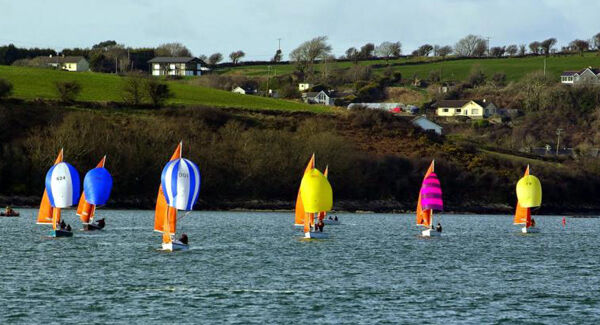
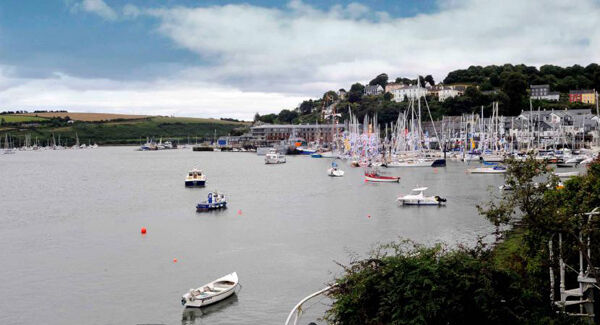
Kinsale’s impact is immediate. No wonder that juxtaposition of old world charm, tiers of centuries of old buildings above, medieval landmarks standing aloof, and the gentle clatter of the yacht masts in the harbour draw tourists from all over the world.
There are lots of highlights, if you enjoy winter weekend walks and, afterwards, a sit-down in one of the town’s lively music bars, or the quieter ambience and comforting open hearth of an authentic pub, like the Tap Tavern, in the centre of town. Seasonal ghost tours of medieval Kinsale depart nightly from here.
A half-day on your weekend can be spent on the Scilly Walk and beyond, where you can enjoy views of waterside and bay.
Charles Fort, which was constructed in the late 17th century and associated with some of the most momentous events in Irish history, is still out of sight as you pass the famous Bulman bar and restaurant (www.thebulman.ie) at Summercove. The excellent exhibition centre and star-shaped fort site is worth a long visit.
I continued the walk on to the signposted Charles fort, that winds downhill, and then returned to the Bulman, having worked up an appetite for lunch.
I had sea-fresh mussels steamed with savoy cabbage, bacon and laced with cream. My companion had the generously filled open-crab sandwich. With two glasses of wine, the bill was just over €30.
The scion of Kinsale history is guide Dermot Ryan, whose walks start daily from the tourist office. His walk is an entertaining, informative, and relaxed history lesson.
Special former residents range from Alexander Selkirk, the model for the story of Robinson Crusoe, to the Kinsale giant Patrick Cotter. Dermot knows all the stories (see www.kinsaleheritage.com ).
Wily town officials in centuries past knew how to flatter visiting ships captains, Dermot says.
They would hire a ‘rent a crowd’ to cheer as the foreign VIPs were brought uphill on sedan chairs to the Desmond Castle, to pay their hefty landing taxes.
“That was one way of ensuring they kept coming into Kinsale and didn’t sail up to Cork, instead.”
Dermot carries a folder showing pictures, maps and engravings that bring the past alive, the days when Pearse Street was under water and called the Long Quay.
This is where the Kinsale hookers were berthed and the travelling fishwives gutted and salted mountains of fish exported in barrels to faraway lands. Don’t miss this tour.
The Old Presbytery B&B, Cork Street. See www.oldpres.com for a flavour of old world Kinsale, a warm welcome and a fabulous breakfast.
The Trident Hotel, www.tridenthotel.com , is open all year, and located on the waterfront with stunning views and a good restaurant.
Catch of the Day food truck, the New Bridge — the best fish and chips for miles, at the weekends (12pm to 7pm), under €10, including a drink.
Romantic ambience and good value at The Steak House (Sunday lunch roast beef plate for €13.95 and an extensive a la carte menu), 021-4709850, Lower O’Connell St.
For great tapas, wine and ambience, The Black Pig Winebar, Lower O’Connell St, 021-4774101. For fish,Fishy Fishy seafood restaurant on The Pier; www.fishyfishy.ie
Headline spring events in Kinsale, 2015: Lace Week, March; All Ireland Chowder Cook-off, April; Heineken Kinsale 7s, May; Lusitania Centenary Commemoration, May.
Jillian Naughton rises to the challenge of a bread-making class
Recently, I attended the Kinsale Gourmet Academy’s day-long masterclass in bread-making.
Arriving into the beautiful grounds of Ballinacurra House, my sister and I were greeted by a gentle giant, the resident Irish wolfhound, Oscar.
He lumbered off as we got our bearings, and we spotted the purpose-built cookery school, a wall of glass leading into a bright, modern space, with polished stainless-steel surfaces, elegant, Neff appliances and a funky, industrial-style, corrugated-iron counter.
It was around this that we perched, sipping coffee as chef David Rice took us through the plan for the day.
We would be making white bread, brown soda, brioche buns and pizza before lunch, and potato focaccia and banana-and-walnut loaf to end with.
He explained kitchen safety advice, including chopping techniques, before effortlessly kneading-out dough for the white bread and mixing chopped apricots, walnuts and sea salt into his soda bread.
Having worked alongside many of Ireland’s top chefs and in a variety of renowned kitchens, David’s relaxed and approachable teaching style set the tone for the day.
He calmly chatted and answered questions, as he stretched out the strands of gluten, explaining how the oil gives bread a longer shelf life and resisting the temptation to add more flour.
I was easily the least-experienced: my only previous baking was to burn and under-cook brown bread in first-year home economics. As the people around me discussed the pungency of sourdough starters, I began to feel nervous.
Luckily, David’s demonstrations called for dry yeast and he had kindly measured out the ingredients for our first two loaves.
Donning our lovely, long aprons at our workstations, we were let loose on the kitchen and a few minutes of panic set in as I tried to remember what had looked so straightforward only ten minutes before.
This quickly passed, as we also had detailed instructions to reference, and banter built up among the group, all of us energetically kneading and cleaning as we went.
One couple were engaged to be married in Ballinacurra House later this year, while a husband-and-wife team were keen cooks and cake-makers and wanted to add another string to their bow. David came around to check on our progress and the springiness of our dough.
Mine needed a spin in the mixer, but he assured me there was no shame in that and it would still work out fine.
It wasn’t long before we had the white loaves proofing and, as we slid closed the oven doors on our soda bread, David’s was ready from the morning demo, so we got to sample straight away what we had just made.
This created a lovely flow to the day, a detailed demonstration followed by supervised practical work and then these delicious tastings.
As we sat there, tucking into these salty, yet sweet, slices of delicious fresh bread, I suddenly couldn’t wait to get stuck back in, realising this would potentially be the result of my own morning’s endeavours.
David took us through pizzas and brioche and then handed the kitchen back to us. People were getting serious now, and the concentration levels rose, much like the temperature in the kitchen. My heart rate also rose, from excitement now, not nerves.
There was white bread to knock back and get in the oven, two types of yeast bubbling away, soda bread about ready and more proofing to do. David passed around samples from the pizzas he had just made, to keep our stamina up.
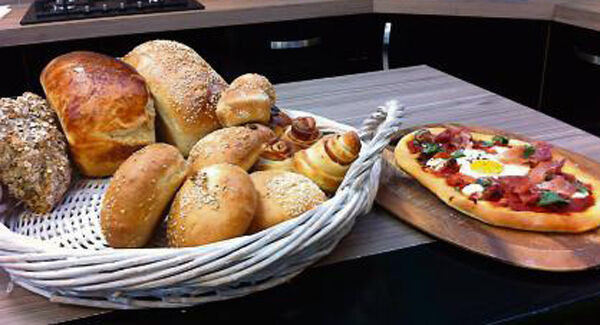
He then demonstrated how to plait strands of dough together for decorative effect and we rolled-up strips of cooked ham with grated parmesan to make savoury buns.
Finally, it was time for lunch and the group sat down together, proudly enjoying our own freshly made pizzas and a well-deserved glass of wine.
My sister had adventurously cracked an egg on hers before cooking, while I had gone with the onion marmalade. After lunch, we busily made focaccia with thin slices of potato and rosemary and, for dessert, a gluten-free banana-and-walnut loaf.
As we waited for ours to bake, we were treated to warm slices of this final cake, with a scoop of chocolate ice cream.
At the end of the day, it was with some reluctance I removed my apron, but I left with my belly and arms full, and with a confidence that the skills learned in this class would benefit my family and me for years to come.
Chef David Rice and his team offer a range of courses, for individuals and groups. Please see the course calendar on the website for a list of dates and classes.
They also specialise in private groups and will work with you to design a course, or combination of classes, for between eight and 60 people.
www.kinsalegourmetacademy.com ; www.ballinacurra.com ; 021-47790

CONNECT WITH US TODAY



Be the first to know the latest news and updates