When the journey is the destination
I’m lying awake in a sleeping car, watching silhouettes ghost by outside. I catch the outlines of trees, fleeting glimpses of the moonlit Carpathian Mountains. The train’s hypnotic clickety-clack makes the moment feel like an old movie.
There’s a knock on my door. Outside, a border policeman stands with sleeves rolled up.
“Passport,” he mumbles.
The syllables slip from beneath a moustache the size of a clothes brush. I wouldn’t be surprised to see Hercule Poirot standing behind him, taking notes. We’re passing from Hungary into Romania under a cloak of darkness, and it feels like anything could happen.
My ride is the Danube Express, and ever since I boarded at Budapest’s Nyugati Station, it’s been obvious this is no ordinary train. Passengers gather in the Royal Waiting Room. Trays of champagne float through a sea of ornately-framed mirrors. Our transport is a throwback to a golden age, the only private train in Europe with en-suite facilities.
I’m excited. In an age of budget airlines and ultra-connectivity, travel is all about speed. A lot has been gained from that, sure — but something has also been lost. Getting from A to B has become a necessary evil, something to be suffered rather than part of the adventure.
Great railway journeys are different. From the Trans-Siberian to the Orient Express, they return passengers to a time when the journey was the destination, when you could observe every inch of the passing landscape, when fellow travellers were people to be engaged with, rather than tolerated, ignored or battled for every last millimetre of elbow room.
This sense of old-world luxury was heightened by the recent announcement that The Danube Express will next year become the first European private train to enter Iran. An epic, 15-day journey from Istanbul to Tehran is planned for Oct 2014.
Naturally, its exclusivity comes at a price. Nobody boards The Danube Express without shelling out around €3,500. Time travel is an expensive product.
Leaving Budapest, I sat back in my carriage — a smartly-upholstered sanctuary panelled in Hungarian beech. By day, it contains several seats. By night, discreet staff transform them into an L-shaped sleeping configuration. But whatever the time or mood, the picture window is perfect for watching cityscapes, rural fields and dusky forests float by.
Which brings me to Romania — stealthily, under the light of the moon. Hercule Poirot? Right now, I’m feeling more like Jonathan Harker, the young solicitor who travelled by coach into the Carpathians, setting in train the terrible events of Bram Stoker’s Dracula. “We are in Transylvania,” the count informs him. “And Transylvania is not England. Our ways are not your ways, and there shall be to you many strange things.”
The following morning, the train stops at Sighisoara, the beautifully preserved birthplace of Vlad the Impaler, who is believed to be one of Stoker’s inspirations (his surname was ‘Dracul’, meaning ‘dragon’). An 16th century clock tower watches over a pretty little citadel crammed with vampire souvenirs and tour guides unsettlingly well-versed in the finer points of impaling.
Inside the kooky clock tower, I browse through a museum dotted with eclectic exhibits — including a ghastly-looking collection of 19th century medical instruments. If Vlad the Impaler didn’t get you, it seems, the barber surgeons of Sighisoara clearly would.
Stop-offs and excursions like this are a feature of the Danube Express, which takes a maximum of 50 passengers from Budapest and Istanbul to Prague, as well as my own journey from Budapest to Istanbul. On the trip, we get to experience a horse ranch on the Great Hungarian Plain, Veliko Turnovo (the medieval capital of Bulgaria), the Carpathians and Shipka Memorial Church, a Bulgarian confection topped with onion-shaped domes.
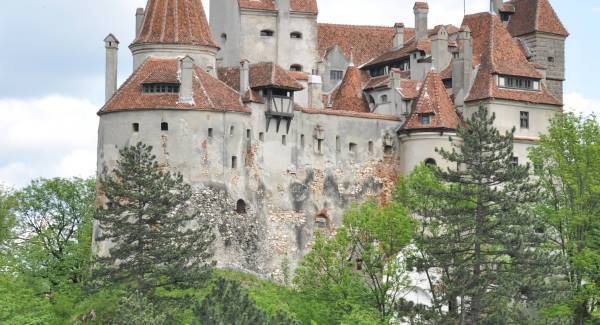
The main sightseeing event, however, is Bran Castle. Bram Stoker never set foot in Romania, but there’s a strong tradition that Dracula’s domicile was inspired by this castle — a forbidding building “from whose tall black windows came no ray of light”, as Harker observes. Bran Castle is perched majestically on a rock outside Brasov, even if its connections with Dracula are flimsy, as our guide delights in telling us. Vlad the Impaler may have spent a few nights here, but that’s about it — the most famous resident was Queen Maria (1875-1938).
The touristy village at its base is thronged with tatty fangs, mugs, jigsaws, t-shirts and fridge magnets.
I’m thankful not to be spending the night. After a few hours touring Brasov, we repair back to the train station to continue our journey. It’s at moments like these that the hotel-on-wheels concept really clicks… after the sticky heat of a Transylvanian summer, I can shower in my suite, order up a cold drink from the carriage attendant, and dress leisurely for dinner. Meals and drinks are included in the ticket price, and you see parts of Europe others don’t. The 1950s feel is authentic. The Danube Express is a mix of restored postal carriages and retired cars from the former Hungarian government fleet. Creature comforts like heated towel rails, fresh fruit and private bathrooms are the icing on the cake.
You still need to pack an intrepid spirit, mind. There’s no Wi-Fi on board, border crossings can come at awkward times and sleeping on a luxury train isn’t as flawlessly restful as I’d imagined. Finally, if you’re a (wealthy) backpacker or honeymooning couple considering a splash, bear in mind that strict timetables limit the opportunity for independent exploration, and that many passengers are older veterans of luxury rail travel. It’s not a party train.
My parting glass is a morning scene. By now, I’ve gotten used to the quirky motion, and wake pleasantly as we pull through the outskirts of Istanbul. Disembarking at Gar Station, I go walkabout in the teeming metropolis, where Dracula seems a distant memory.
My journey took four days. My flight home will take just four hours.
The Danube Express is now taking bookings for its 2014 season. It offers three journeys in Central and Eastern Europe, with durations of three- to 10-days. The four-day Transylvanian package costs £2,990/€3,549pp, all-inclusive. www.danube-express.com.
Aer Lingus (aerlingus.com) and Ryanair (ryanair.com) fly from Dublin to Budapest. Danube Express can organise flights and pre-journey hotels at an additional cost.
All meals and drinks are included on the train — indeed, eating dinner in a classic carriage as Transylvania floats by is one of the highlights. Don’t expect Michelin-quality fare, however. I found dishes like turkey roulade, vegetable strudel and goulash soup varied in quality.
All scheduled sightseeing, transfers, porterage, tours and the services of a tour manager throughout your journey are included in Danube Express prices.
Trips run mainly in May, June and September. The 14-day Istanbul to Tehran trip departs in Oct 2014, with prices from an eye-watering £8,695/€10,320pp.
No visas are necessary for Hungary, Romania or Bulgaria, but Irish citizens will need to purchase a visa at the Turkish border (€15). If you’re interested in rail travel, make sure to visit www.seat61.com… one of the great travel websites.


CONNECT WITH US TODAY



Be the first to know the latest news and updates