Steepled in history
Ultimately, the Christians overthrew the Muslims in 1085 and then expelled the Jews in 1492, but the academic heritage lived on. The Christians had the good sense to retain the libraries of Arabic literature and Toledo became a centre of translation between Hebrew, Arabic and Latin. The art and architecture of 2,000 years, including the Spanish Golden Age, make this city a worthy UNESCO World Heritage Site.
Toledo is a beautifully historic place, built on a hill, which is almost surrounded by the River Tagus. Such a natural moat made it an obvious place to build a city. No enemy came close without being observed, although the Moors did eventually manage to conquer it.
Today its narrow streets are reminiscent of a past from which no amount of contemporary retailing or traffic can detract. The buildings are packed tight, making the streets dark and cool despite the Spanish sunshine.
Within these streets is a wealth of delightful historical trivia, like the door knobs set at a height from which a man on a horse could knock without dismounting; or the small grotto where young women place a pin from their hair in the hopes of acquiring a husband; or an enclosed convent where you can ring the bell, step inside and buy marzipan through a hatch from a young nun.
You can also buy convent marzipan in tourist shops throughout the city. Marzipan is a Moorish tradition — and tastes fairly ‘moreish’ if you have a fondness for almonds. Another tourist offering from Moorish times is saffron, which the Spanish use to great effect in paella. And if you’re looking for a scissors, razor blades, daggers, knives or swords, this is the place to buy. The steelworks may be in northern Spain but the craftsmen and tradition of blade-making are in Toledo.
You can also have morning coffee in an art gallery, which is a disco by night and was originally a 13th-century church. Circulo de Arte de Toledo was once the Church of San Vicente, adjoining a prison where nasty Inquisition activity took place. In 1795 Toledo’s enlightened Cardinal Lorenzana replaced the prison with a university campus.
The Inquisition prison was one of those warts that Toledo wanted removed. Another was the memory of an extraordinary phone call made during the civil war when the military academy, the Alcázar, was under siege by republican forces. The military governor, Colonel Moscárdo was told by phone that the republicans had kidnapped his teenage son, Luis, and if he did not surrender, the son would die. They allowed a conversation between them in which his father told Luis he would have to die for Spain; there would be no surrender.
For a time, there were audio re-enactments of this phone call at the Alcázar in a number of different languages for tourists to listen to but the option has been removed. Civil war memories are still too painful to be treated as a trite tourist attraction. Luis Moscárdo was shot dead, although it is believed that his execution took place a month after the phone call.
The Alcázar was a royal palace when Toledo was the capital of Spain after the defeat of the Moors. Today, the city is merely a provincial capital with a population of just 82,000. Perhaps this is a blessing that has helped it retain its wonderful heritage.
Toledans are planning a big anniversary in 2014, which marks 400 years since the death of El Greco. The Greek artist moved here when he was 36 and spent the rest of his life as a citizen of Toledo, becoming a major figure in the Spanish renaissance. His work can be seen in churches and art galleries around the city.
A good starting point is the Museo de Santa Cruz, which was once a 16th century hospital and orphanage and now houses fine art, contemporary art and ancient artifacts.
It’s located close to the main square Plaza de Zocodover, which is in fact a triangle. To the far side is Toledo’s stunning Gothic cathedral, making sightseeing in this neck of the woods very compact. Toledo is small but it is a labyrinth, so a map or a guide is essential.
Close to the plaza is a statue of Miguel Cervantes who wrote the classic medieval novel Don Quixote de La Mancha. It was in this region where the daft old Don and his trusty sidekick Sancho Panza roamed the plains, tilted at windmills and had numerous adventures.
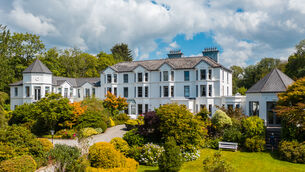
To see the city properly is to stay outside it, preferably on the adjoining hill where the wealthy families have their summer residences. Here you’ll find Parador de Toledo, built in the style of the surrounding houses, and part of the Spanish state chain of hotels in old heritage buildings.
The Toledo skyline, seen from the adjoining hills, is dominated by the cathedral and the Alcázar. No matter what the brutal past of the Alcázar is, when it is bathed in the golden glow of a setting Spanish sun it is truly beautiful. And it’s all the better if you’re watching it from the balcony of Parador de Toledo with an aperitif in your hand.
Aer Lingus operates daily flights from Dublin to Madrid, which is just 71km north of Toledo. There are high-speed rail links between the two cities.
The Paradores of Spain are represented in Ireland by MAP Travel, 36 Upper O’Connell Street, Dublin 1. For more information, log on to www.maptravel.ie or phone 01-8783111. MAP Travel can book pre-planned routes, taking in a number of Paradores in the same area, eg the Wine Route, the Castles Route or the World Heritage Cities Route.
The cost ranges between €35 and €150 per person per night. There is a wide variety of special packages and promotions available — including the five-night card for €525, with a 20% discount on the menu.
Wander the narrow streets off Plaza de Zocodover to capture the essence of historic Toledo then emerge at the cathedral, which houses two El Greco paintings, one Goya and a famous gilded monstrance.
Another great art haunt is the Museo de Santa Cruz where there are more El Grecos on display and the building itself is Arab in style, surrounding a courtyard.
The Alcázar houses a military museum as well as the regional library and is, of course, a place of considerable civil war history.
Convento Gaytanas is the place to get authentic marzipan, homemade by the nuns and be sure to stop by the statue of Miguel Cervantes for a tourist photo with the great scribe and satirist.
CONNECT WITH US TODAY



Be the first to know the latest news and updates