‘Groundhog Day phenomenon’ needs to be understood
“The sequester drama unfolding in Washington brings to mind that classic Bill Murray film, Groundhog Day,” announced the Wall Street Journal in February. “Only it is as if President Obama failed to catch the end of the movie, where the loop is finally broken.”
The WSJ article went on to explain the sequester and the difficulties President Obama faced, but the one thing it didn’t need to explain was the ‘Groundhog Day phenomenon’ — indeed, the article was illustrated not by a picture of President Obama but by a picture of the movie’s star, Bill Murray, looking lost and bewildered in a blizzard.

It’s 20 years since Groundhog Day was first released on this side of the pond, and you’d be hard pressed to think of a movie released since that has penetrated the popular consciousness in the way Harold Ramis’s film has. There have been more popular movies, films that have blown box office records apart, and movies that are more beloved than Groundhog Day.
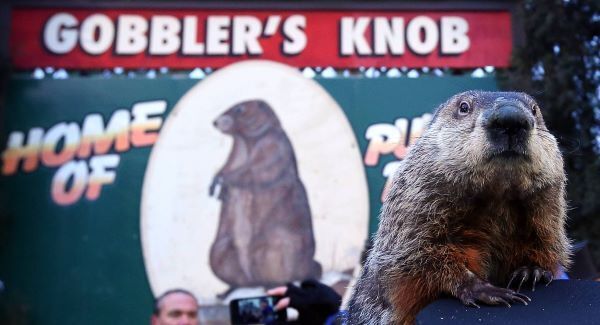
No one ever casually mentions ‘The Shawshank Redemption effect’, however; no one drops ‘the Avatar factor’ into casual conversation, safe in the knowledge that everyone else will immediately grasp the significance. It helped, of course, that Groundhog Day traded on one of those bizarre, inexplicable little events that everyone seems to experience once in a while: déjà vu. The story opens with the world-weary weather reporter Phil Connors (Murray) leaving Pittsburgh with producer Rita (Andie McDowell) and cameraman Larry (Chris Elliott) for the homely hamlet of Punxatawney. There he’ll make his annual report on ‘Punxatawney Phil’, the groundhog who emerges from hibernation every year on February 2. If ‘Phil’ sees a shadow, he retreats to his burrow and winter lasts an extra six weeks, Connors tells us, in a broadcast that barely disguises his contempt for the proceedings and his place in them.
That evening, Phil, Rita and Larry head back to Pittsburgh. A blizzard sweeps in, forcing them back to Punxatawney to stay overnight. When Phil wakes the next morning, it’s to the exact same music on the alarm-clock radio — ‘I Got You, Babe’ by Sonny and Cher — and the exact same series of events he lived through the day before. Initially bewildered, and fearing a mental breakdown, Phil soon realises that he is experiencing a rather more profound version of déjà vu, and is living through the existential horror of an endlessly repeating 24 hours.
Naturally, given that no one ever got rich in Hollywood peddling notions of existential horror, the tale is framed as a love story, in which the self-absorbed, narcissistic Phil eventually falls for the winningly naïve Rita. But that veneer of romance masks a central conceit that is even now, 20 years later, breathtakingly audacious by the standards of mainstream Hollywood filmmaking. The same scenes play out again and again, with only Phil’s actions differing in each one. It’s technically brilliant, and outrageous in terms of everything a storyteller is taught: never repeat yourself, and never risk boring the audience.
And yet it’s that very concept of boredom that lies at the heart of Groundhog Day. Phil meets the same people in the same places at the same time every day, with his reactions to them varying according to his mood. It’s a comically exaggerated version of how most people experience the daily 9-to-5 grind; subconsciously or otherwise, audiences instinctively identified with Phil’s plight.
Harold Ramis, who co-wrote and directed (and also pops up in an acting cameo), had enjoyed a very fruitful working relationship with Bill Murray prior to Groundhog Day. Ramis had written and acted in a string of successful comedies such as Meatballs (1979), Caddyshack (1980), Stripes (1981) and Ghostbusters (1984). The pair went their separate ways after Groundhog Day, however, as a result of artistic differences relating to what the movie should be about. Ramis wanted to play the story as a straight comedy; Murray insisted that the film should have a more philosophical tone.
Hindsight is always 20-20, but even so it’s difficult to understand how Ramis could have imagined Groundhog Day as no more than a straightforward comedy. It’s a dark tale at times, and one that is constantly offering philosophical conundrums. The despairing Phil attempts to commit suicide on a number of occasions, only to wake up every morning to the strains of Sonny and Cher. It’s made explicit that Phil is living through eternity when he announces to a dumbstruck Rita that he is a god — not the God, he stresses, but a god who has the power of life and death over those around him.
Once Phil accepts his fate, he begins to use his ‘powers’ of foresight to help those around him, although even these good deeds are irrelevant in the grand scheme of things. No matter how much Phil tries to feed the old tramp, for example, or take him somewhere warm, the hobo will inevitably die of hypothermia every night. The heartbreak is unavoidable, as is the growing sense that Phil Connors is a kind of contemporary Jesus Christ, albeit one stuck in a kind of Kafkaesque nightmare of pointless inconsequence.
Even so, Groundhog Day is very funny indeed. Bill Murray — whose first marriage was falling apart during the shoot — is at his deadpan best as he woos a luminous Andie McDowell and delivers his scabrously cynical lines. And even the throwaway moments are beautifully detailed: a security company has ‘Keystone’ emblazoned on its van; Phil turns up to the cinema — to see Heidi II — dressed in a Clint Eastwood-style poncho, aka The Man With No Name.
If Groundhog Day was only concerned with slapstick, quirky gags and existential questioning, however, it would very probably have been received as a charming tale and quickly forgotten. Ultimately it’s a story about personal redemption, and Phil Connors’ long and winding road to an epiphany about what truly matters in this world are good deeds for their own sake. Despite his faux-Jesus representation, Phil learns that it’s essential to tap into the deepest roots of our humanity because existence is otherwise a pointless exercise in history repeating.
It’s this realisation, and Phil’s willingness to sacrifice his own needs on behalf of the Punxatawney community, that eventually breaks the cycle. Rita falls for Phil, and the pair wake up together — to the strains of Sonny and Cher — on a brand new day. The cynical Phil is now idealistic, and decides that the best thing he and Rita can do is opt out of the rat-race and move to the idyllic Punxatawney to live.
It’s all deliciously happy-ever-after, but the film leaves a sting in the tale. As Phil and Rita step out into the pristine, snow-covered streets, and share a final kiss, Phil pauses, looks around at the idyllic town and says, “We’ll rent to start.”
Spiritual enlightenment is a very fine aspiration, that ending suggests — but let’s just check with that groundhog first, and find out if he’s seeing any shadows …