Saving Irish honey bees: ‘I was terrified of bees — now I run a beehive business’
Our native Irish honey bees are fighting for survival. Joe McNamee meets the people stepping up to save them — and preserve the food source that has sustained us for thousands of years
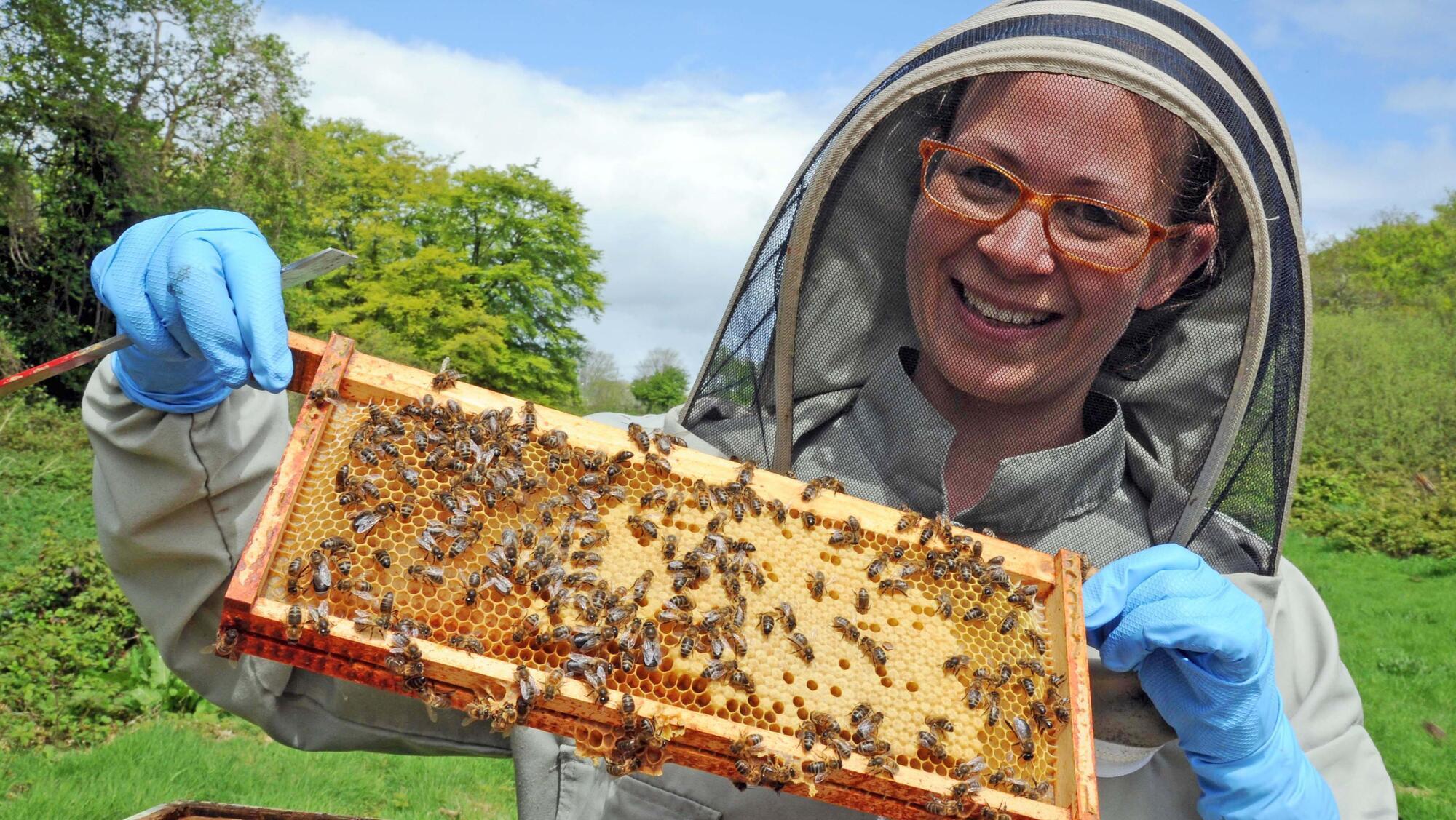
Hanna Backmo, beekeeper, holding a frame from a hive at the apiary. Picture: Denis Minihane.

Hanna Backmo, beekeeper, holding a frame from a hive at the apiary. Picture: Denis Minihane.

“I am the tear the sun lets fall” is a metaphor for honey from The Song of Amergin, an Irish poem, the oldest recorded in these islands, from around 600BC. Of all the natural wonders and precious food sources it alludes to, only honey is twice mentioned, one of our oldest native foods, especially prized.

Honey was drunk with milk, eaten pure or from the comb. It was used as a dip for bread, meat, and fish, for basting salmon and meat, mixed with lard as a condiment, the principle ingredient in mead. A section of the Brehon Laws was devoted to the ‘bee judgements’, detailing rights of various parties in the sharing of swarms, hives, nests, and honey.


Most honey consumed in Ireland today is imported. Teagasc are surprisingly vague on the byproduct of the bee, the most important pollinator of our food crops, but figures of 205 tonnes (2019) of Irish produced honey versus 4,086 tonnes of imported honey (in 2016) illustrate the imbalance.

Imported honey is invariably filtered for processing on a large scale, which can also remove natural pollen and kill beneficial enzymes and antioxidants. It also makes it harder to trace its source, a serious issue as honey is the world’s third most adulterated food, often bulked out with cheaper sugar syrups.

90% Adulterated

The EU is the second largest global honey producer after China, but only produces enough to satisfy 40% of EU consumption and much of the ‘honey’ coming into the EU is adulterated.

Last year, testing found 90% of honey on the shelves of major UK retailers was adulterated.

New EU legislation, introduced on June 14 this year, means ‘a blend of non-EU honeys’ will no longer suffice and the countries of origin now have to be listed clearly on the label, ranked in descending order according to their proportion in the blend. The percentage of each origin must be stated with a 5% tolerance for variations in the mixtures.

Raw, unfiltered, local Irish honey — as well as being an exquisite natural foodstuff — has antioxidant, antibacterial, and anti-inflammatory properties, and contains vitamins, minerals, and polyphenols. By comparison, that squeezy bottle of imported ‘honey’ on the supermarket shelf may well be little more than empty carbohydrates.

Then there are the threats to the honeybee itself. Along with climate change, are pesticides, fungicides, and herbicides, and, now, the Asian hornet, a deadly predator which has devastated colonies in mainland Europe. Yet this catalogue of chaos hasn’t deterred a fightback from one doughty bunch of Irish beekeepers. Their warrior of choice is apis mellifera mellifera, otherwise known as the ‘black bee’ or native Irish honey bee.

When Hanna Bäckmo, of Hanna’s Bees, bought her smallholding in Little Island, in Co Cork, in 2009, she was closing a circle, returning to her carless childhood on an island off the West coast of Sweden, where she and her two sisters roamed free. Everyone grew their own food, and all were utterly immersed in the natural world.

“Growing your food was definitely a part of island life,” says Hanna, who moved to Ireland in 2001, “and, because everyone did it, it didn’t seem such a big deal, but now I’m older, I’m seeing it is the quality of life, that connection with the land, the soil that feeds us.

“The allure of [her Little Island home] wasn’t the house, the location, it was the half acre and being able to grow all my own food. I planted all sorts of things but peaches made me a beekeeper. They flower really early in the year, January, February, when there are no pollinators around, so my only way of getting peaches was to get honeybees because they survive as colonies through winter and go out on good days. I got completely obsessed.”

Mark Riordan, of HiveMind, was fresh out of a conventional horticulture course when a brief internship at Ballymaloe Cookery School radically altered his thinking.

“Once I saw what the Allens were doing,” says Mark, “and what you could do with a small bit of space, even to grow fruit and veg, I got into that.”

Mark Riordan, of HiveMind, Myrtleville House, Co. Cork

Mark lives on a smallholding, in Myrtleville, Co Cork. He began with a herb garden, then a polytunnel, eventually rearing ‘sponsored’ free range pigs, three ‘investors’ to each pig, with a third share in the butchered meat for each investor.

“A swarm of bees moved into this house, high up in the wall,” he recalls. “I had done a day-long beekeeping workshop and tasted real honey for the first time so my interest was already tweaked, so I called up one of the lads on the course who had already got bees. And I was terrified of bees!”

Mark’s friend helped him capture the swarm and get a basic beekeeping kit. Mark would check the hive randomly but admits he was out of his depth, so he joined the Cork County Beekeepers Association and began attending lectures.

“That summer was good, so we got a super fill of honey,” he says.

“I borrowed a radial extractor from the association, plonked it on the counter, and just went for it.

“When I got my first splash of honey, I was like, Jesus Christ! I’d say I probably got 20 jars.”

Mark began working with another local beekeeper and returned to college, doing a masters in organic horticulture, his thesis on honeybees. By then, he had north of 30 hives. Inspired by his pig-rearing scheme, he applied it to HiveMind — hives sponsored in return for honey yielded.

“I loved that idea of community involvement because you can learn more through communication and connectivity,” he says.

The fledgling business attracted interest and he and business partner Simon Borsell took on corporate clients, beginning with Apple, in Cork, then expanding to Dublin. He was also invited to site a hive on top of St John’s College, in inner city Cork. Initially, he was less than enthused, but the resulting honey persuaded him otherwise.

As more urban gardeners turn away from chemicals in the garden, the forage was not only more varied than the countryside but also far less toxic.

Galtee gold

Aoife Ní Giolla Códa, of Galtee Honey Farm, was born into a fourth- generation beekeeping family, in Co Tipperary, where her father worked in forestry, keeping bees on the side. Eventually reaching 200 hives, he switched entirely to the bees, and focused on the conservation of the native Irish honey bee.

Galtee Honey Farm has 170 hives of honey bees sited in groups called apiaries throughout a 25-mile radius within the Vee Valley.

“In the early years, it was difficult,” she recalls. “They were getting hybridised. It was down to a couple of beekeepers importing [non-native] honey bees but he got all the beekeepers in the locality together and established the first conservation area of the native Irish honey bee because there was a real danger of losing it entirely.”

The experiment was a success and The Galtee Bee Breeding Group became the first of a wave of native Irish honey bee conservation, replicated around the whole island, and The Native Irish Honey Bee Society was founded in 2012.

OpenHive Honey is a community organisation owned and operated by Kyle Petrie — formerly an agricultural advisor in international development — teacher Mark Earley, and former Irish rugby international Jack McGrath.

OpenHive Honey is a community organisation owned by Kyle Petrie, Mark Earley, and Jack McGrath

“I’ve always wanted to keep bees,” says Kyle, “since I was a kid growing up in Churchtown, but never had space. After I got married, I began to keep bees on the kitchen roof. I started with two colonies, we now have over 150 all over Wicklow and Dublin, from the roof of Google in Dublin City, all the way down to Gorey, in Wexford.

“Mark’s wife and his family were all very big into beekeeping, and she and Mark had done a course together but unfortunately she passed away quite suddenly, so he wanted to continue that journey. Mark was teaching in Gonzaga at the time. They had an old apiary, so we started keeping bees in the middle of Ranelagh. Me and Jack had a mutual friend and he joined in 2020. Jack was having both hips done during covid, and his mother and grandfather had been beekeepers, so we met in the first couple of weeks in a cemetery in Greystones — we had bees behind it.”

“I had been given a book on beekeeping,” says Jack, “and was looking for something to take my mind off the surgery and recovery and also the whole pandemic. The bees require your whole focus, so it helped put everything else out of your mind.”

An invitation to write a beginners beekeeping column has seen Hanna grow into an informed educator, also lecturing at University of Galway on their two-year apiculture course. She was also invited to become an ambassador for the Native Irish Honey Bee, but not everyone is on the same page.

“When I became an ambassador,” says Hanna, “I received really nasty messages, images of nazis, saying, as a foreigner I should understand we need to have different types of bees, likening me to a nazi for believing the native Irish honey bee should be protected.

“But as an island nation, we need to preserve what is inherently Irish — plants, native species, insects, bees, but not everyone supports that.”

In the end, the ultimate challenge is the volatile Irish climate.

“The last two years were pretty poor in terms of honey production,” says Kyle, “Even trying to get queen bees mated during the summer can be horrible. They have a window of about a week from when they emerge. We might have 30 or 40 queens and if it rains or if the temperatures are low, they just won’t get mated, so we have to do the whole process again, but some colonies might not make it because they need a queen for the eggs.

“But commercial Irish honey producers for whom honey production is the primary motivator bring in already-mated queens from Italy way earlier in the season.

“Last year, the native dark honey bee was designated a unique ecotype, meaning it doesn’t exist anywhere else in the world. It has adapted to our climate, shorter legs, hairier.

“Unfortunately, if someone nearby has foreign bees and they mate on the wing with our bees and hybridise them, we have the potential to lose our native honey bee.”

Aoife and her father, Mícheál, are certified beekeeping lecturers, the highest beekeeping grade achievable in this country. Mícheál is also is a qualified honey judge. They are founder-members of the Native Irish Honey Bee Society.

Aoife Nic Ghiolla Coda of the Galtee honey Galtee Honey farm, in Co Tipperary, home to 200 colonies of Native Irish Black Honey Bees.

“Natives are adapted to survive with very little food when cooped up in the hive and not collecting nectar during weeks of bad weather,” says Aoife, “which means by the end of the summer, they generally have a good surplus. Non-natives aren’t as frugal and during bad weather, will consume that surplus. Over the last few years, including very bad summers with only a handful of good days, we still got a surplus.

“They are also very good at over wintering, of withstanding long periods of bad weather. If we have a very late spring, into March or even April, they come out without showing the signs of stress, such as nosema [fungus], and stress leads to disease.”

The recent arrival of the hornet in Ireland is bad news for all bees, native or imported. Mark was invited to witness efforts to track down a hornets’ nest after the sightings in Cork, in Coughlan’s pub, across the road from where his hive is sited on the roof of St John’s College. Thankfully, it was safe.

“They set up a test site in the Quaker graveyard behind the pub,” says Mark, “and had chicken in a lunchbox, because hornets crave protein, especially when feeding larvae, and they had sugary water to try and lure it. They set up a couple of these in different locations to triangulate a possible nest’s location using distances and flight times. Wasps would get into a hive and kill but they’re mostly trying to rob but the hornet wants the body of the bee for protein. They can destroy a colony in a few days.”

If you’re wondering what native Irish honey bee honey tastes like, well, OpenHive’s recent three stars at the UK’s Great Taste awards for their heather cut comb illustrates the exceptional quality.

“It shows our native Irish honey bees,” says Kyle, “when left to do what they do best, can thrive if you give them the chance.”

More in this section

Lifestyle

Newsletter

Eat better, live well and stay inspired with the Irish Examiner’s food, health, entertainment, travel and lifestyle coverage. Delivered to your inbox every Friday morning.

Cookie Policy Privacy Policy Brand Safety FAQ Help Contact Us Terms and Conditions

© Examiner Echo Group Limited