When John Kelly left a Famine-ravaged Ireland for America around 1867, he could never have envisaged that, almost 100 years later, his granddaughter would return to his home county of Mayo as a world-famous movie star and royal princess.
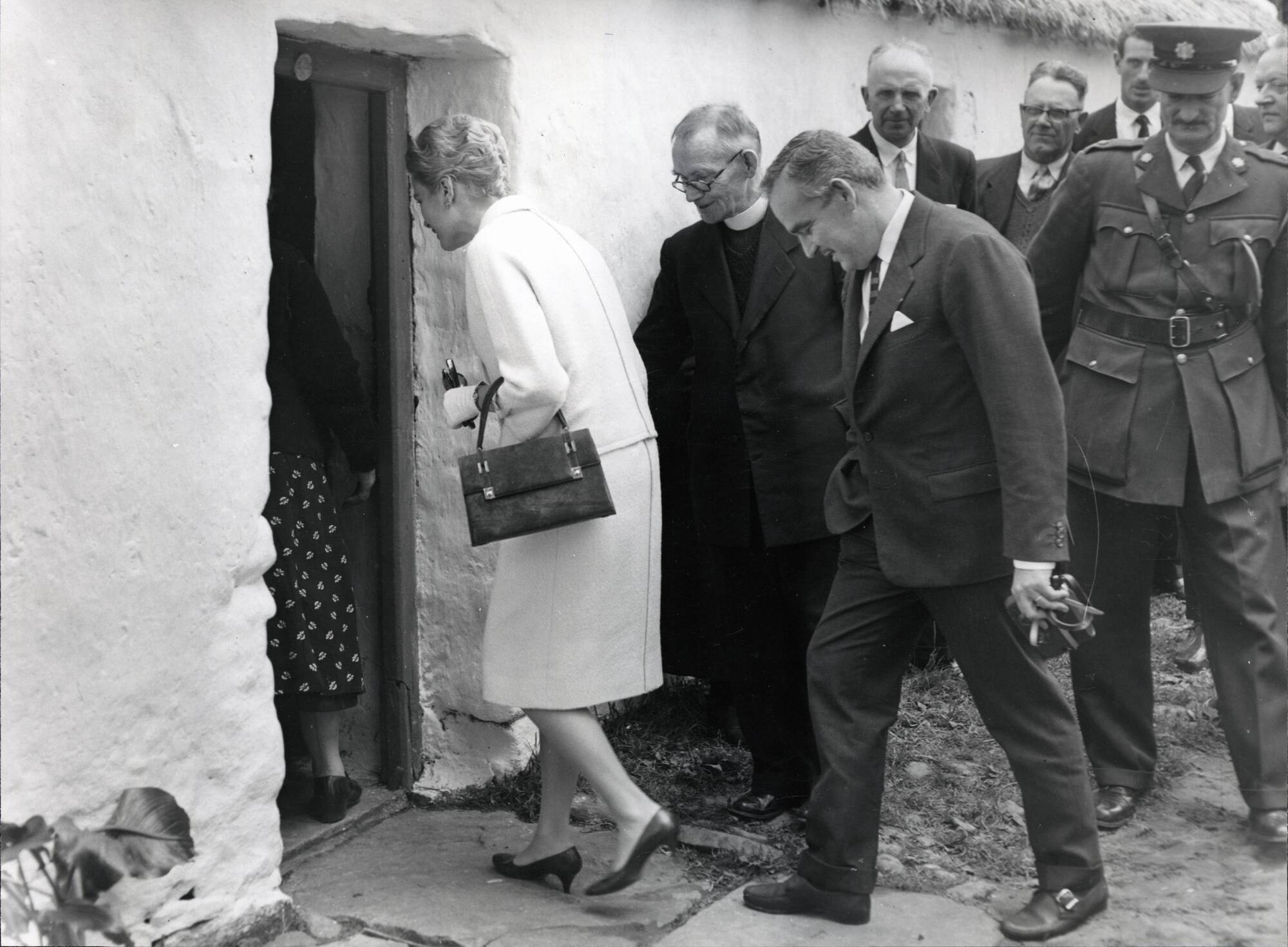
The state visit of Princess Grace and Prince Rainier III to Ireland in June of 1961 was highly significant. It mattered to Grace as it fulfilled her dream of connecting with her roots — “More than anything else in the world, I want to see Mayo, the county I think of as my own,” she’d said — and it was historically important as it marked the first ever visit by a head of state to these shores.
It put Ireland on the international map, started our enduring relationship with Monaco, and began to change our perception of the Irish diaspora — which further evolved with JFK’s visit two years later. We were no longer peasants and paupers, we were presidents and princesses.
Five years earlier, Grace’s “wedding of the century” to Prince Rainier III of Monaco on April 19 , 1956, was watched by 30m people, with the guest list of those in attendance at the principality’s St Nicholas Cathedral reading like a who’s-who of Hollywood celebrity and high-society privilege: Onassis, Hilton, Gardner, Grant.
The American movie star’s exquisite dress — designed by MGM’s Helen Rose, and handmade in that studio’s atelier over six weeks — has come to epitomise Grace’s timeless elegance and, along with the coveted Hermès bag that bears her surname, speaks to her enduring appeal.
While Grace may be remembered for her style, her luminous beauty, and her silver-screen success, it is perhaps less well-known that the Philadelphia-born actress had a cherished collection of literary works by Irish authors — including a first edition of James Joyce’s Ulysses, and a historically significant trove of Irish and Irish-American sheet music.
Grace began collecting these treasures after her 1961 visit, inspired by the connection she’d felt to Ireland and the “thrilling welcome” she’d received, as she put it afterward in a thank-you letter to then president Éamon de Valera.
Grace’s life was cut tragically short in September 1982 when the car she was driving careened off a cliff road — it is thought a stroke caused her to black out — leaving her with life-threatening injuries. She died the next day in a Monaco hospital. She was 52.
Keen to honour the princess’ devotion to her Irish heritage, a large Irish delegation attended the funeral in Monaco, headed by then president Patrick Hillery and his wife Maeve.
Since the historic state visit of 1961, Grace had visited Ireland seven more times, and had bought the land surrounding the ruins of her grandfather’s cottage in Co Mayo, hoping to build a holiday home there.
In the year after her death, Pierre Joannon, the consul general to Ireland, wrote to Prince Rainier III, to suggest that the late princess’ deep connection to Ireland could be honoured through a library that would have, at its core, her treasured collection of Irish literature and sheet music.
Rainier warmly welcomed the idea, and on November 20, 1984, the Princess Grace Irish Library (PGIL) was inaugurated by the Monegasque ruler as a tribute to his wife and her love of Ireland and its culture.
In her speech on the day, Grace and Rainier’s eldest daughter Princess Caroline said that her mother “did feel like a European, because of her Irish roots”, says Paula Farquharson, the Dublin-born director of the PGIL since 2021.
Farquharson, along with around 30,000 others, commutes daily from her home in France to work in the tiny principality whose borders encompass less than a square mile.
“It just feels like Ireland,” she says of the library, which is situated on a quiet street in Monaco’s old town, in a building that was once the home of Félix Gastaldi, a former Mayor of Monaco.
“Everybody who comes in says that, because you’re immediately struck by how personal it is and how Irish it is.”
The library, while small, is mighty, and along with its Waterford crystal chandeliers; busts of Behan, Wilde, and Joyce; and paintings by Jack Yeats and Louis le Brocquy, has many rare treasures of Irish literature among its 9,000-odd volumes, as well as modern works and children’s books — Farquharson says they’ve even had readings of Joyce for kids: “We have the French version of The Cat and the Devil, so that’s been really nice to have the younger generation meet James Joyce.”
Much of Grace’s personal collection comprises volumes once owned by Tipperary-born Count Gerald Edward O’Kelly de Gallach, which she purchased from the Irish diplomat’s estate in the 1970s.
“There are about 500 books in the Princess Grace Personal Collection, and over 1,000 music scores that she collected in the 70s,” says Farquharson. The scores were a collection she bought from Michael O’Donnell in Philadelphia, “also a Mayo man” who knew he would be “future-proofing” it by selling it to Grace.
O’Donnell’s collection gives a “wonderful fast-track history lesson” Farquharson says, the songs’ lyrics and titles tracking “the struggle for Irish independence and how that evolves in America and how America treats the Irish first wave, to the better times as the generations evolve”.
The music, which includes When it’s Moonlight in Mayo, gets played at library “sessions”, Farquharson says — “We don’t keep a quiet library all the time!”— on a piano once played by A Clockwork Orange author Anthony Burgess, a close friend of Grace’s and one of the original trustees of the PGIL.
In the 1984 edition of the scholarly periodical, Etudes Irlandaises, Burgess wrote: “One of the last public functions that Princess Grace attended was a dinner held in Monte Carlo… in connection with James Joyce’s centenary — four months before she died.
“I provided piano music for the dinner, all Irish songs, and the last memory I have of her is leaning over the piano and asking for a song about the Fighting Kellys.”
An anecdote by a friend of Grace’s, Harriett Groote, which appears in the commemorative book overseen by
Farquharson for the PGIL’s 40th anniversary, also illustrates Grace’s love for the Irish tunes.
Groote says: “HSH Princess Grace came to my house with a sheaf of music, Irish songs arranged for voice and piano. What fun for us both! We started with two songs, Rose of Killarney and My Wild Irish Rose. Her voice was lovely.”
Farquharson says of the women’s connection: “They were both American, both had their young children at the same time in Monaco. They were preparing for a family concert. So just because [Grace] wasn’t earning money at the arts or performing, it was very much still part of her.”
Grace did perform again, though. On October 18, 1979, at the invitation of the 21st Dublin Theatre Festival, she did a one-night-only recital of Birds, Beasts and Flowers. Her interest in the arts began at an early age, not least because two of her paternal uncles were prominent in that arena. Walter Kelly was a vaudeville star, while George Kelly was a screenwriter, director, and Pulitzer Prize-winning playwright.
“She really had her heart set on being in the arts and acting, because she was very young when she went to New York to study drama,” Farquharson says. Eighteen-year old Kelly’s audition piece for admission to NY’s American Academy of Dramatic Arts was a scene from her uncle George’s play, The Torch-Bearers.
After graduation, she supported herself in New York with modelling, theatre, and TV roles. Her big break, as Amy in High Noon, came in 1952, followed by an Oscar-nominated turn in Mogambo, a contract with MGM, an Oscar for The Country Girl in 1954, and a string of roles in movies that are now classics.
She wore her newly-acquired Cartier diamond engagement ring in her swan song, High Society, a remake of The Philadelphia Story. The role of Tracy Lord provided a full circle moment; she’d performed it years previously for her graduation from drama school. In 1957, she told The New York Times: “Being a princess is a role, just like any other, but this one has no curtain call.”
Grace took her royal role incredibly seriously, dedicating herself to philanthropic and humanitarian causes, becoming an active patron of the arts, culture, and education.
“[She had a] very tough role, handling multiple responsibilities,” Farquharson says. “Being a wife of a head of state, a princess, and a mother, which she took very seriously. She was very careful to keep her children sheltered from the intrusion of the press.”
In 1964, Grace set up the Foundation Princesse Grace to support cultural and humanitarian causes.
Today, the library operates as a non-profit under its aegis.
In her tenure to date, Farquharson has opened the PGIL’s “doors wider”, and brought it into the digital age, which, she says, “has allowed us to have a lot more exposure and across the world because lots of people still love Princess Grace”.
The library, is “a platform” for Irish “writers, actors, and musicians” regularly hosting lectures and recitals. Twice a year, courtesy of the Ireland Funds Monaco, a bursary affords an Irish writer a month-long residency.

“They’re free to concentrate on their work and free to be inspired by their surroundings and have access to all the books,” she says. “And we, of course, try to integrate them into the community in Monaco so that they can really get a feeling for where they’re living and be inspired by that, because so many writers and artists have come down here over the years.”
Cork-born writer Flor McCarthy’s residency coincided with last year’s 40th anniversary celebrations of the PGIL. Her book, The Presidents’ Letters, includes correspondence between de Valera and Grace following Dev’s 1962 gift of an Irish pony.
“Babbling Brook is very happy in her new surroundings and Caroline is learning very quickly to ride her,” Grace wrote, while her eldest daughter sent an accompanying note written in childish scrawl, “Dear Sir, thank you, Love Caroline”.
McCarthy honed in on these letters, Farquharson says, and through her collaboration with the actors of the Monaco-Ireland Arts Society, contextualised them and brought them to life in a performance at the library.
“There’s something about the Irish,” she says. “And when you’re in that room, it’s very natural and easy-going.”
Grace “transmitted that love and attachment to Ireland to her children,” Farquharson says, remarking that Prince Albert II was in Ireland “for the rugby before St Patrick’s Day”.
The current head of state “has been really supportive” of the PGIL.
“He has very close friends who also have connections to Ireland — Michael Flatley being one of them,” Farquharson says. For Bloomsday 2024, Flatley loaned the library his collection of Joyce memorabilia.
Sixty years on from his parents’ historic state visit, Prince Albert II returned to Ireland for a three-day trip, unveiling a frieze in the Long Room of Trinity’s College’s Old Library in recognition of his €1m donation towards the library’s restoration.
“We’ve had collaborations with the library with Trinity,” says Farquharson, herself an alumna of the Dublin university.
“The best bit is that I’m able to facilitate other people to do their job and to excel and produce. It’s a knock-on effect — they go on to write books, they go on to write music, and they then make other people very happy.”
Grace would surely approve.
See pgil.mc
CONNECT WITH US TODAY
Be the first to know the latest news and updates