Skymatters: The astronomy behind The Grand Auld Stretch
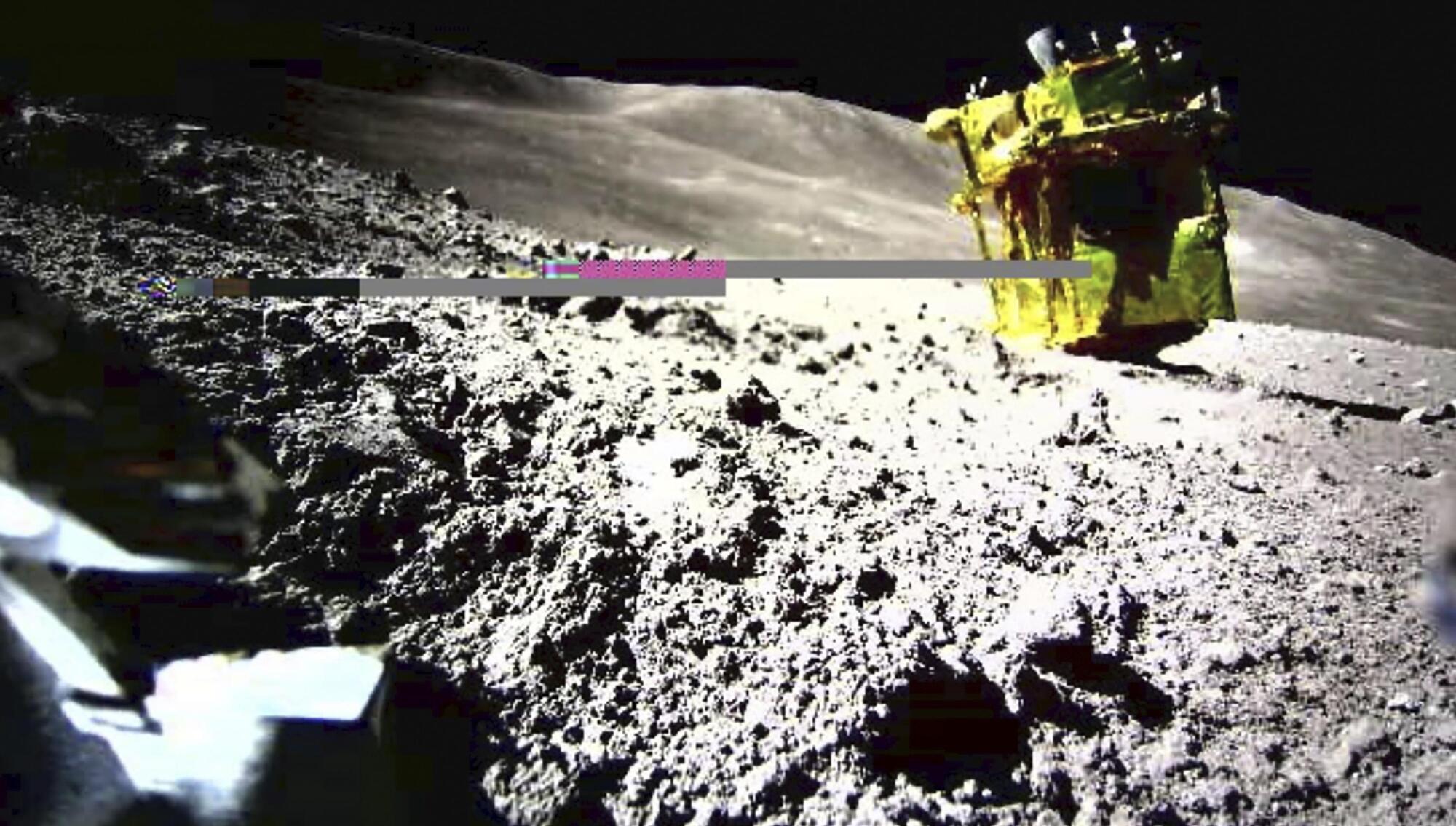
An image taken by a Lunar Excursion Vehicle 2 (LEV-2) of a robotic moon rover called Smart Lander for Investigating Moon, or SLIM, on the moon. A Japanese moon explorer is up and running Monday, Jan. 29, after several tense days without the sunlight it needs to generate power. Pic: JAXA/Takara Tomy/Sony Group Corporation/Doshisha University
Much to all our delight there is a discernible increase in the length of the day this month.
On February 1, daylight lasts for nine hours and six minutes. By the end of the month, it grows to 10 hours and 52 minutes. That’s quite a change.
The “grand old stretch in the evenings” that we might have imagined since December 22 starts to become more of a reality this month.
This change in the number of hours of daylight results from the Earth’s axis being tilted by 23.5 degrees. By contrast, the Moon’s axis is tilted by only 1.5 degrees.
One consequence of this is that the number of hours of daytime on the Moon remains pretty constant throughout the year, as does the number of hours of nighttime.
There is another consequence — there are no seasons. Instead, the movement of the Sun across the lunar sky repeats and repeats, day after lunar day.
There is no solstice, no moment when a lunar inhabitant might celebrate the coming of ‘spring’.
Every day is an ‘equinox’, where the lunar day lasts 29.5 Earth days and the lunar night follows suit.
Only at the lunar poles would a traveller have the chance to experience something different. At the northern lunar pole, there are mountain peaks which are high enough to be continuously in sunlight (accompanied by a stultifying temperature of 120 degrees centigrade or thereabouts) while in the southern polar regions, there are craters that are deep enough to remain in permanent shadow with temperatures reaching -160 degrees centigrade.
Perhaps not the sort of ‘different experiences’ that would encourage one to fuel up a lunar rover and set out on the lunar equivalent of a road trip on Route 66.
The Moon is devoid of an atmosphere, but if it did have one it would have weather patterns, though not quite the ones we’re familiar with.
The massive temperature difference between the daytime side and the nighttime side, coupled with the slow rotation of the Moon over 29.5 days, would make the sorts of extreme weather conditions that we’re presently facing on Earth a permanent — and much more violent — feature.
A lunar atmosphere thick enough to make the Moon habitable, far from making it an idyllic place to live, would make it challenging.
When looked at in the round, the Moon isn’t and never will be a replacement for the Earth. Another reason for us to treat our home planet with the greatest of kindness.
Given the scorching temperatures across the Moon, it’s not surprising that it’s devoid of water — well, almost.
Those permanently shaded craters at the south pole are now known to contain water ice.
This was almost certainly brought by asteroids or comets as far back as millions or billions of years ago. To a lunar inhabitant, they would represent the frozen equivalent of the Nile in terms of their importance in supporting life.
One could imagine the most expensive real estate on the Moon being on the edge of a frozen, permanently shaded crater with its incredibly rare reservoir of ice water.
And indeed, this is why planned lunar missions with human crews are looking so closely at just such regions.
In January the Japanese SLIM mission landed on the lunar surface. The primary objective of the mission was to test technologies that would enable future astronauts to land within a few tens of metres, perhaps less, of their target.
The rationale is clear. If water is critical to a mission, and it will be, then landing as close as possible to a shaded crater whilst avoiding boulders or hillocks will be vital.
In that regard, SLIM was a major success, even if it did land upside down.
Impacts from space killed off the dinosaurs, leaving the way open for us humans to take over.
Impacts from space left the Moon pockmarked with craters which, although born out of destruction now offer the greatest sanctuary for humans.
It’s a funny old universe.

Subscribe to access all of the Irish Examiner.
Try unlimited access from only €1.50 a week
Already a subscriber? Sign in
CONNECT WITH US TODAY
Be the first to know the latest news and updates