Buy Dracula writer Bram Stoker's desk - yours for a blood-curdling €575k

Robert Hume looks at the weird, wild and wacky writing habits of some of the world’s most renowned authors
Buy Dracula writer Bram Stoker's desk - yours for a blood-curdling €575k

The brilliantly refurbished Dracula desk, up for sale at £500,000 (incollect.com).

On 26 May 1897, Bram Stoker (1847-1912) from Clontarf published his world-famous Gothic novel, Dracula.

Since the centenary of his death in 2012, fans have marked this day by dressing up as vampires, holding Dracula movie marathons, and visiting castles in Romania. Some even choose to read the book.

After painstaking restoration, the table on which Bram Stoker penned his masterpiece has recently gone back on the market.

“With no drawers and legs, it really could not be called a desk,” laughed Belgravia art dealer Andrew Lamberty, when he bought it at auction over 10 years ago. Master furniture artist Mark Brazier-Jones agreed to give it a major revamp.

The top has been inlaid with dark brown leather, given a gold leaf border, and decorated in the corners with bronze flowers and vines. Four richly ornate legs have been added. One carries bronze skulls, the others bronze claws, each holding a different coloured crystal.

Four vintage drawers have been lined with crimson velvet and flaunt creepy handles — one taking the form of a bat, another a griffin.

Fancy buying it? It’ll set you back £500,000 (€575,447). Enough to waken the undead!

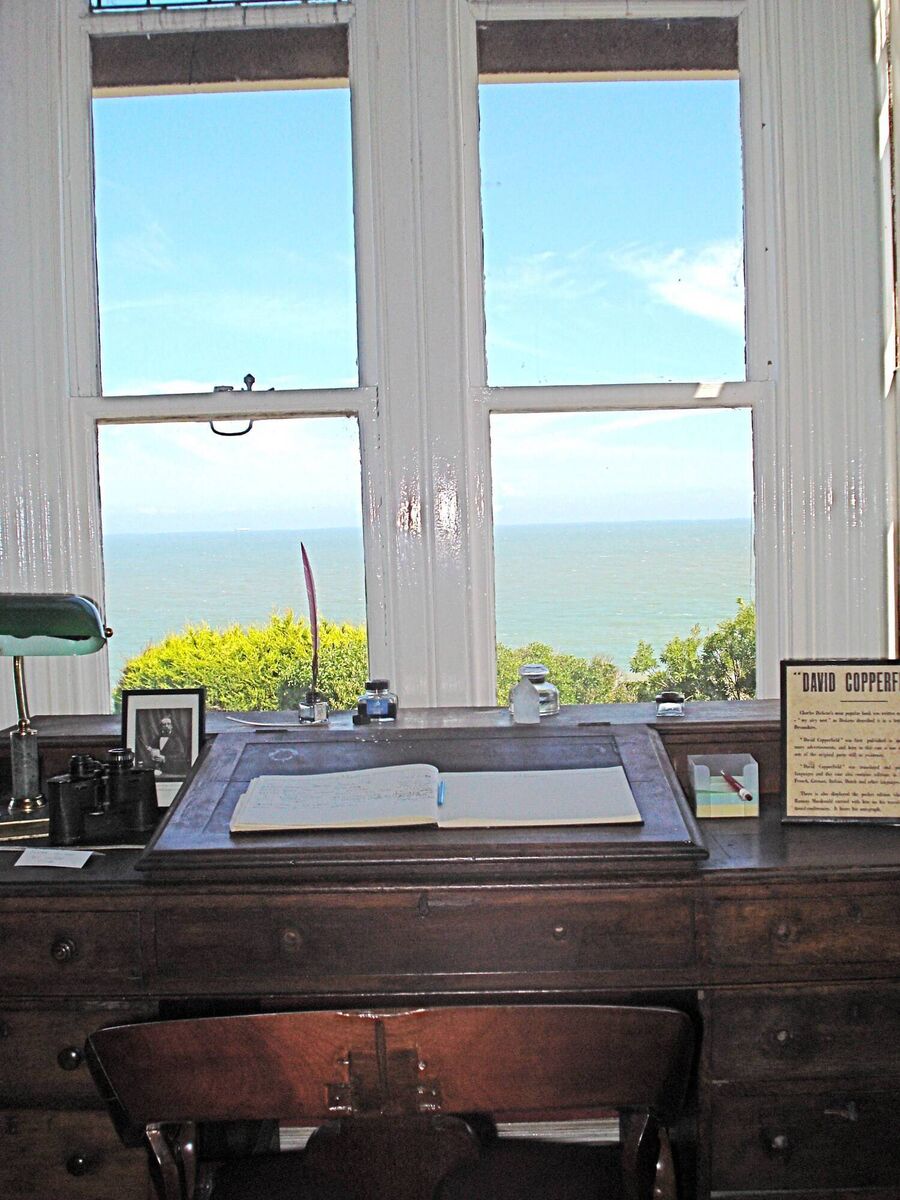
Charles Dickens’s desk at Bleak House, Broadstairs, Kent (photo, Annamaria Pinazzi)

Most famous writers — and, of course, millions of completely unknown ones besides — have also preferred to use desks for their work. The late Hilary Mantel’s sold in July 2022 for a modest £4,200.

In Bleak House, Broadstairs, Kent, jutting out high above the English Channel, you can still see the desk Charles Dickens sat at to write David Copperfield.

The choice of a specific environment seems to be crucial to authors. But tastes vary. Some have opted for less orthodox solutions to working at desks, spurning even such an unconventional specimen as Bram Stoker’s.

In the nude

At the start of most working days, French novelist Victor Hugo (1802-1885) stripped off and handed his clothes to a servant, who locked them away in a chest until he emerged from his quarters with a completed chapter. 

That way he wasn’t tempted to go for a walk in the streets of Paris.

His wife, Adèle Foucher, recalled in her memoirs that — as a once off — to write The Hunchback of Notre Dame, Hugo purchased “a huge grey knitted shawl, which swathed him from head to foot”, but claimed he wrote best when completely starkers.

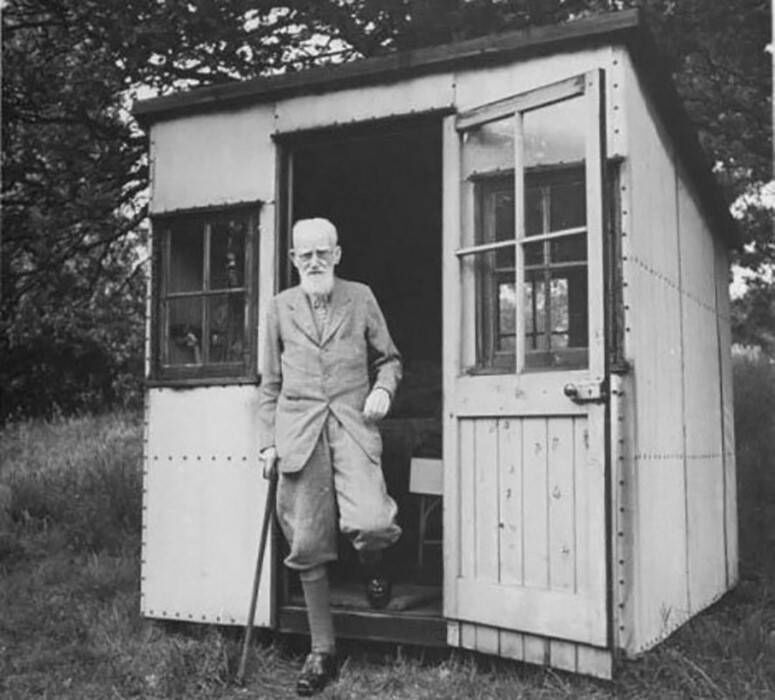
George Bernard Shaw's eco-den in his garden at Ayot St Lawrence, Hertfordshire (British Pathe, 1946).

Cocooned in the first eco-cabin

Dublin-born George Bernard Shaw (1856-1950) penned his plays inside a rotating shed in the garden at Ayot St Lawrence, Hertfordshire.

Preferring to work in the daylight whenever possible, he designed the contraption with castor wheels and a circular track, so he could move it full circle from the inside to keep his work area constantly bathed in sunlight. 

He fitted a bunk so he could take naps, and installed a telephone for emergencies, such as ordering lunch.

Shaw named the hut ‘London’. When unwanted guests asked where he was, his servants could respond to queries with the honest answer: “in London”.

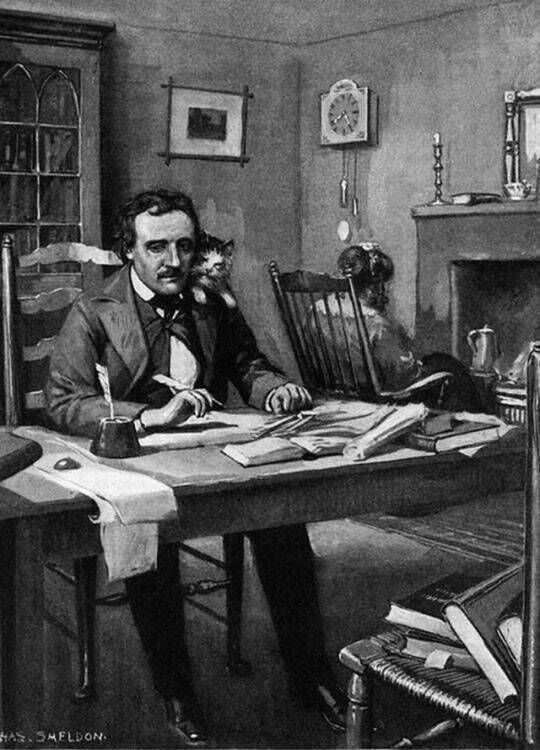
Horror writer Edgar Allan Poe, with his cat, Catterina, perched on his left shoulder (lithograph, Charles Mills Sheldon).

While shouldering a cat

American horror writer Edgar Allan Poe (1809-1849) used to compose his stories with Catterina, his beloved tortoiseshell Siamese cat, perched on his left shoulder.

A visitor to Poe’s home in Philadelphia observed the cat, which lived until at least 13, “purring as if in approval of the work proceeding under her supervision”.

Feline-friendly Poe favourably compared “the unselfish and self-sacrificing love of a brute” with “the paltry friendship and gossamer fidelity of mere Man”.

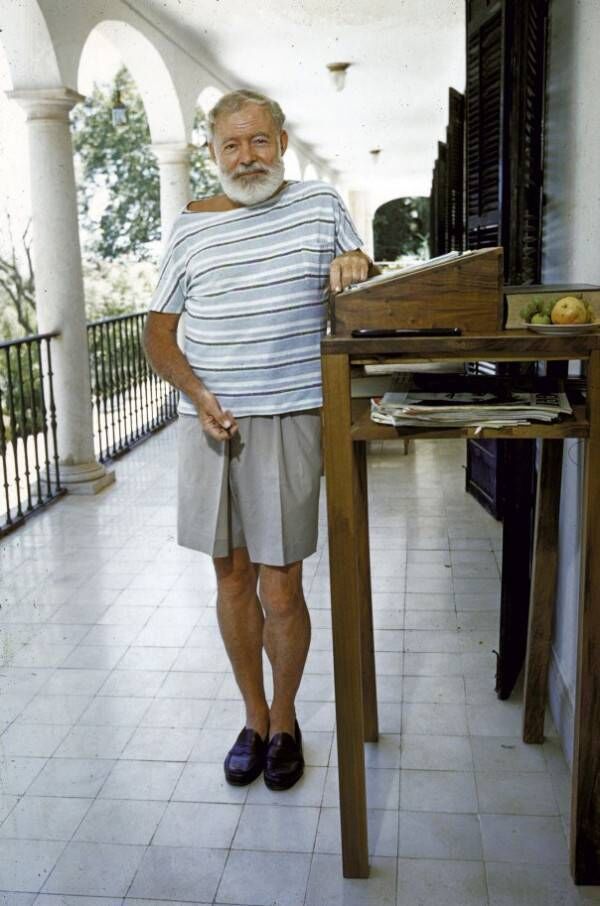
Ernest Hemingway at his standing desk (Life Magazine, 1 Jan. 1960)

Standing tall

In her 20s, Virginia Woolf (1882-1941) worked standing up at a 3ft 6in-tall desk with a sloping top. Apparently, she chose this way of writing so as not to be outdone by her sister, artist Vanessa Bell, who always stood to paint. 

Woolf’s nephew, Quentin Bell, quipped that her choice had “set matters on a footing of equality”.

Later in life, Woolf switched to a low armchair with a plywood board across her knees.

Ernest Hemingway, Winston Churchill and Lewis Carroll also wrote standing up, and Charles Dickens used a ‘standing desk’ when residing in his house in London.

In the bath, munching an apple

Agatha Christie (1890-1976) dreamed up her stories while immersed in her bath, studying photos of murders.

“I got my plots in the tub”, she told the New York Times in 1966.

And not any old tub but a large Victorian one, with a decent-sized rim. 

Before renovating ‘Greenway’, her house near Brixham in Devon, she told architect Guildford Bell: “I want a big bath”, and “I need a ledge”, not only to rest a pencil and notebook on, but “because I like to eat apples”.

When bath designs changed, she was forced to ditch the habit: “Nowadays they don’t build baths like that”, she regretted, “so I’ve rather given up the practice”.

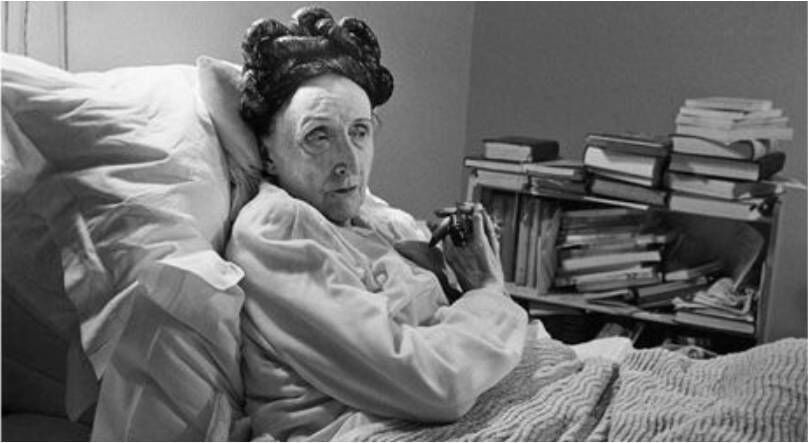
Dame Edith Sitwell in 1962. She allegedly climbed into an open coffin to write (Getty Images).

From inside a coffin

Many writers have admitted to following daily rituals — starting at first light, wearing a certain jacket to write in, using a favourite pen, and so on. But some routines are truly bizarre.

Before beginning her day’s work, poet Edith Sitwell (1887-1964) is supposed to have climbed into an open coffin — just like Dracula — and laid down. 

Perhaps it was the smell of the mahogany — deep, rich, with a touch of spice — or maybe the soft, luxurious feel of the blood-red velvet lining, that provided inspiration for her macabre writing and posing before the camera as a corpse.

Bram Stoker would surely have approved.

x

More in this section

Lifestyle

Newsletter

The best food, health, entertainment and lifestyle content from the Irish Examiner, direct to your inbox.

Cookie Policy Privacy Policy Brand Safety FAQ Help Contact Us Terms and Conditions

© Examiner Echo Group Limited