Celebrating Paddy's Day abroad? Check out these Irish pubs
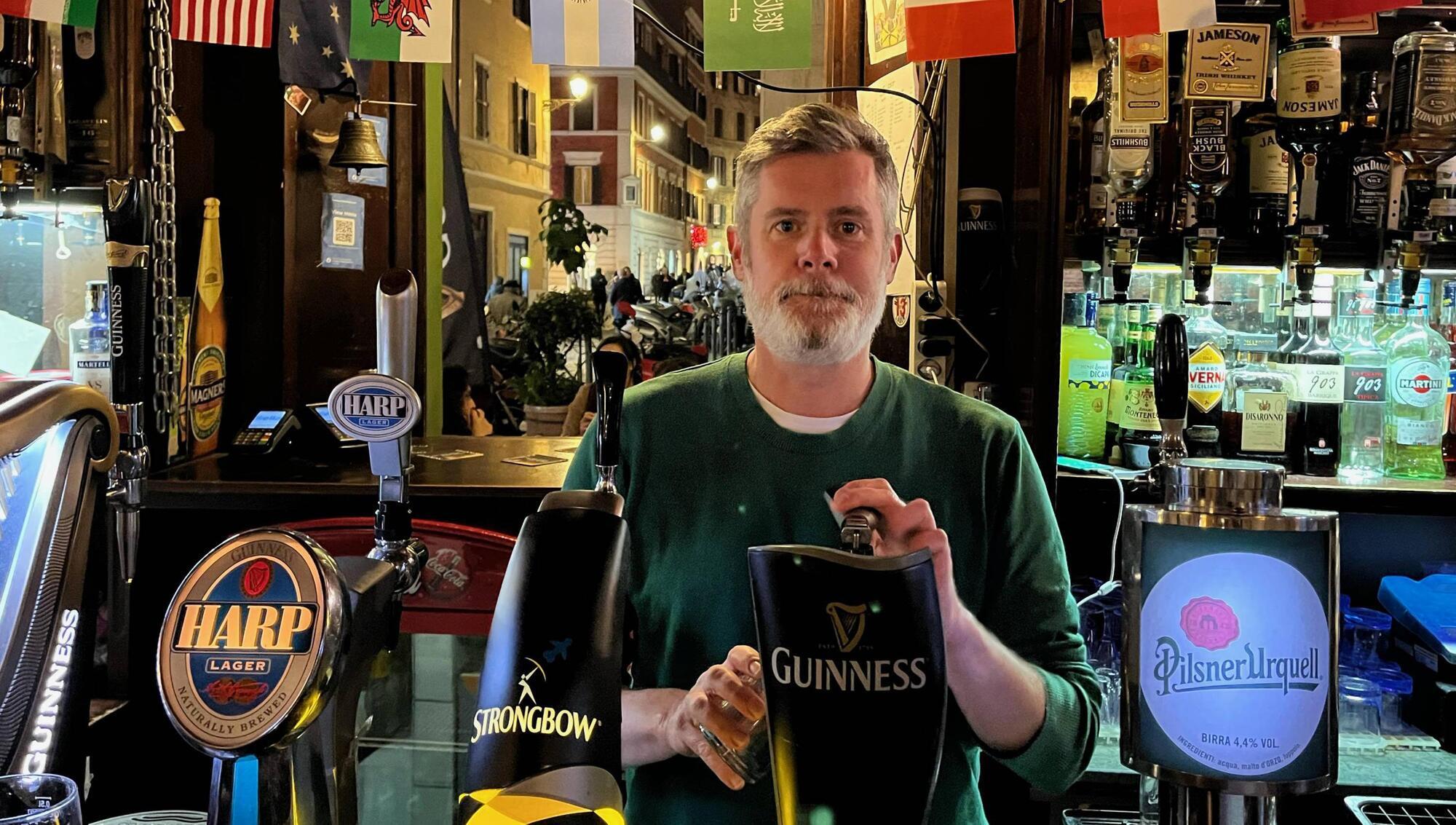
Michael Burns at Finnegan's, in Rome
Michael Burns sits outside his home in the Italian countryside drinking coffee and surveying his worldly goods. His six chickens peck at the ground in their coup while in front of him his two dogs, Orla and Shea mooch around near his feet. It’s March and the Umbrian sunshine is already giving off the gift of its heat. In a few days, Mickey will catch the train to Rome to swap the peace and tranquillity of his life in the countryside for the madness that is St Patrick’s Day in his city centre Irish pub, Finnegans.
“There will be a big crowd,” says the Belfast native. “There always is on Patrick’s Day. I’ll be playing and singing Irish ballads myself with a friend Paul Rossi which is great because it keeps me out of having to work the bar. We will have the full staff in on the day. All nine will be in and there’ll be someone doing the door too.”
This will be Micheal’s twenty-ninth St. Patrick’s Day in the Eternal City. Having spent the summer of 1993 “taking pilgrimages around Italy to see holy sites” for Joe Walsh Tours, Michael returned to Belfast to resume life as normal.
“The Troubles were still on,” he recalls. “The tension that went with it was always normal. Then, when I spent that summer in Italy, I found out it wasn’t normal. It wasn’t like that in other places. I got my old job back in a pub and I thought to myself I don’t really like it here anymore. I’ll just go and live in Italy. So it wasn’t very difficult to move here.” During his stint with Joe Walsh, Michael had built up some friendships and contacts in Rome. He soon found himself behind the bar at the famous Druid’s Den where his affable manner and love of all things football and Glasgow Celtic brought in big crowds of locals and ex-pats. The footfall didn’t go unnoticed.
“I remember I was on my dinner break and the two owners of another pub came to speak to me about buying the third owner out,” says the 50-year-old. “I said yes straight away. I could see the potential. They asked me how much money I had and I pulled about thirteen-thousand lira out of my pocket. I was skint.”
Funding issues were not going to stand in the way of this new business idea. The partners knew what they wanted and Michael was keen to join them. Between the jigs and the reels, he managed to cobble the money together, and in July 1999, he took over as manager and part owner of Finnegan’s.
After a few years of enjoying the life of a young bar owner, Michael settled down and had a family with his long-term partner, Polly. While they both loved their lives in Rome, it became apparent that the hustle and bustle of the capital was not the ideal spot to raise children.
“We moved out to the countryside two years after we had our first son Rian,” says Michael. “Rome is a great city but we are happy out here. The boys are both in their teens now, going to school here and doing well. I go down to Rome three, sometimes four nights a week and help out. But most of my time is spent here and I love it. It’s great.”

Ruairi Curtin still lives for the commotion of his adopted city. The Cobh native first arrived in New York at the age of twenty-three when he was offered a job straight out of college by Enterprise Ireland.
“It is a great city,” says the 46-year-old. “There are great opportunities. It can be hard. It’s gritty and it can be ruthless but at the end of the day I think it’s a friendly town and every single day that you’re here, you can do something different. That’s what keeps me here.”
Ruairi worked with Enterprise Ireland for seven years before he took his first steps into the pub trade.
“We opened our first pub, Bua, in September 2004,” he says. “I was always entrepreneurial and always wanted to work for myself. I had to navigate the visa waters along with my business partners and figure our way through that before we opened the business. That can be long and arduous.” Nineteen years on and eight pubs later, Ruairi and his business partner’s public house empire continues to grow.
“We are opening a new place called Albert’s Bar very soon,” says Ruairi. “It’s named after Albert Quay in Cork. But it’s also just a friendly name, an old-world name that marries well with our general inspiration for the space. It’s in midtown which was where all of the stars from the fifties and baseball players hung out. Over the decades, a lot of the old buildings came down and it lost some of that charm so we’re just trying to bring that back into the neighbourhood.”
While Ruairi’s bars are all Irish-owned, Irish-run, Irish-staffed and stocked with many Irish products, they are not what you might call classic Irish pubs. There’s not a signpost, shamrock, or shillelagh in sight. Ruairi says that Irish bars in New York are now trending that way. While the days of Plastic Paddy pubs are not quite numbered, there are bar owners like Ruairi who are moving towards a modern take. Modern or not, he fully expects his bars, particularly the new addition to be thronged come Patrick’s Day.
“I’ll have my sleeves rolled up in Albert’s,” he says. “We are going to be busy. We are just a block from Grand Central Station. We will have a new staff and new bar to look after so it’s just making sure that things run smoothly and that we sell as many pints of Guinness as we can.”

Thousands of miles away in Haarlem (in the Netherlands, not Harlem), Paul Tierney will be getting stuck into his Patrick’s Day trade too.
“Haarlem is not Amsterdam,” says Paul. “We don’t get any stag parties. Most of our clientele are regulars and any tourists we get are more cultural tourists, here to see the city. We’ll open early on Patrick’s Day and because it’s a Friday we’ll get more families in for food in the afternoon and then we’ll have live music in the evening. Closing times here are four in the morning so it’s a long old day. But it will be busy so it goes quickly.”
The Limerick man moved to the Netherlands in 2002 after some time spent working in pubs across Europe. In 2009 he opened his first pub in Haarlem and today he is the proud owner of two thriving hostelries. Paul says there is a good Irish community in the small town. It has been bolstered in recent years by four children of his own. He has wasted no time introducing them to the trade and his two eldest are now working with him.
“This is a nice place to live,” he says. “You’re fifteen minutes to Amsterdam by train, fifteen minutes to the beach on your bike. There’s no hassle. There’s no fighting in bars or on the street. When you live in places like London, there’s nothing but 'stagro'. Here, your kids can cycle to the movies on their own when they’re nine or ten. Everyone gets around on bikes. They’re not overly friendly but they’re not intrusive either. We’ll be here for a while. It’s a nice relaxed atmosphere.”