Santa Claus: The man, the myth, the legend, through the years
As we look forward to Santy's visit this Christmas Eve, Robert Hume trawls through the archives to find Father Christmas has been making the headlines for many years
Santa Claus: The man, the myth, the legend, through the years

Generations of children have waited patiently for Santa Claus 
Once upon a time

While today’s Father Christmas is regarded with admiration and wonder, his forbear “was not treated with much respect”, writes Professor Ronald Hutton, being generally considered “a burlesque figure of fun”.

PRESENT AND CORRECT

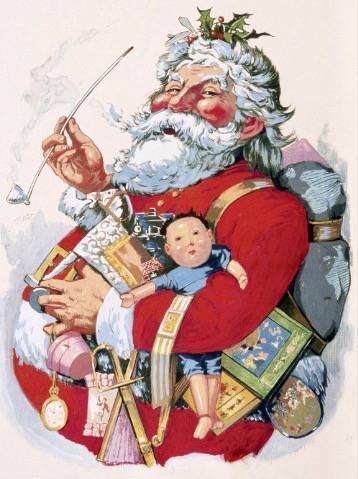
Washington Irving was the first to spot Father Christmas riding over the roofs of houses and “rattling down the chimney” to fill children’s stockings with sweets and small gifts.

 Colour version of cartoonist Thomas Nast's 'Merry Old Santa Claus', Harper's Weekly, 1 Jan. 1881
Colour version of cartoonist Thomas Nast's 'Merry Old Santa Claus', Harper's Weekly, 1 Jan. 1881

In 1821, another American writer, Clement Clark Moore, noted Santa’s flying reindeer and sleigh, and described him as a “right jolly old elf”, with twinkling eyes, a “merry dimple”, and a beard “as white as snow”. His fur coat, which was clean when he left the Noth Pole, had become spattered with soot. Instead of arriving on the day dedicated to his worthy role model St Nicholas (December 6), he now showed up on Christmas Eve.

‘Santa Claus is coming to town’

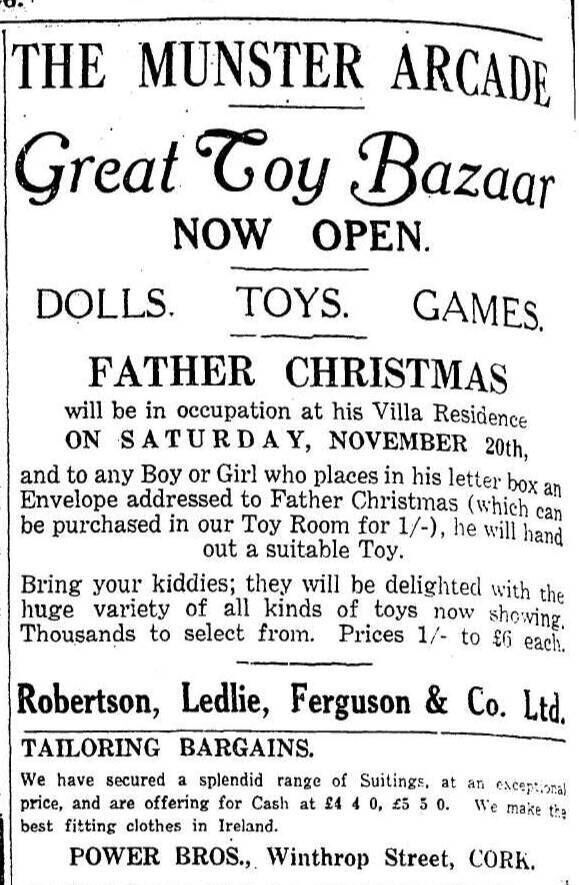
Santa's first recorded visit to an Irish shop, handing out toys to children in the Munster Arcade Cork. (Cork Examiner, 26 Nov. 1926).

The first place in Ireland where children could visit Father Christmas seems to have been Robertson, Ledlie and Ferguson’s emporium in Munster Arcade, Cork. 

In 1926 the Cork Examiner announced that Santa “will be in occupation at his Villa Residence” on Saturday 20 November. 

“To any Boy or Girl who places in his letter box an Envelope addressed to Father Christmas (which can be purchased in our Toy Room for 1 shilling), he will hand out a suitable Toy” (Cork Examiner, 20 November 1926).

Think again if you imagine that Father Christmas could be found in a red velvet chair, doling out presents, or that he was merely a celebrity turner-on of Christmas lights: “My Dear Children”, he wrote in 1935, “I will come down the chimney at 4 o’clock at Golden Bros [Westport] and have all the latest kinds of Toys in my bag”. 

He went on to list motorcars and aeroplanes, cats and dogs, bears and elephants, building bricks and mouth organs.

“I will shake hands with every child”, he promised, “and give them a free run in my Fairy Motor Car”.

By supplying a name and address, parents could have him visit their home on Christmas morning (Mayo News, December 14, 1935).

A taste for the high life

Santa’s antics didn’t stop there: “Come and see Father Christmas on the house top”, invited Madden the chemist, who had a shop in The Square, Skibbereen (Southern Star, December 12, 1931).

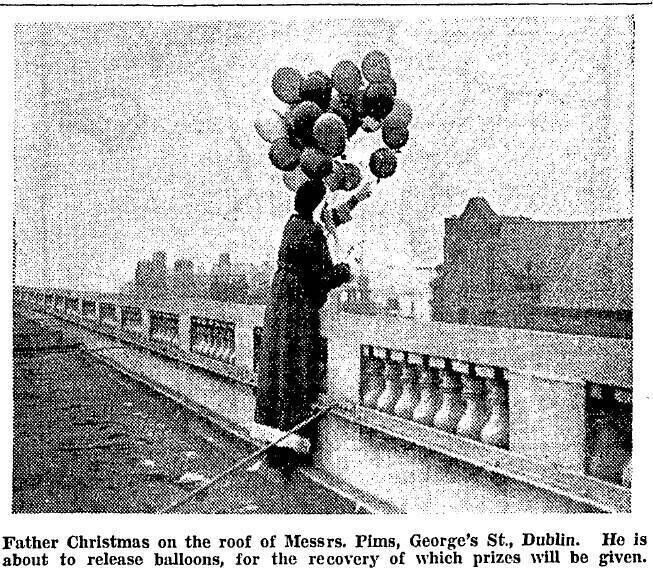
From 1932, Santa also appeared annually on the roof at Pims Bros, George Street, Dublin, “releasing a cloud of gas-filled balloons”. 

 Santa releasing his prize balloons from the rooftop of Pimms, George's Street, Dublin (The Irish Press, 15 Nov. 1932)
Santa releasing his prize balloons from the rooftop of Pimms, George's Street, Dublin (The Irish Press, 15 Nov. 1932)

Some bore lucky number tags, which entitled the fortunate child who found one “to visit the Venetian Gondola” and receive a Christmas gift.

The dawn of the Space Race offered still more exhilarating possibilities. On December 28, 1957, the Western People announced: “Father Christmas Comes By Sputnik”.

Crowds of children awaited Santa’s arrival as he descended by rope to a rooftop in Foxford, Co. Mayo, from the world’s first artificial satellite, launched two months earlier by the Soviet Union.

Home deliveries

Generations of children have waited patiently at home until the big day. Author Bridget Haggerty recalls how on December 5, her brothers and sisters put their freshly polished shoes on the hearth.

Then they’d write letters to “Santy” and toss them into the fireplace. “My dad said Santy could read our wish-lists in the smoke that came out of the chimney”.

Next morning they raced downstairs to find their shoes filled with nuts and sweets.

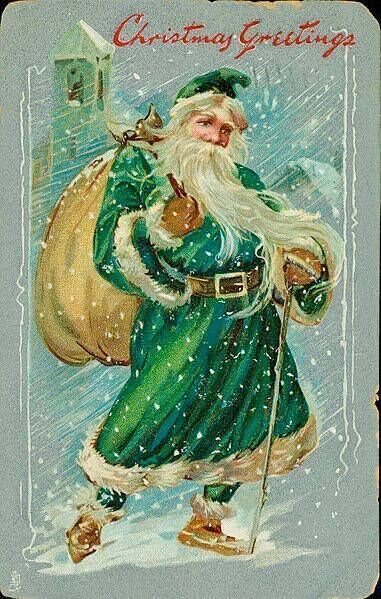
Christmas postcard with Santa Claus wearing green robes, carrying full sack, with "Christmas Greetings." Color postcard by Raphael Tuck and Sons, Saxony, ca. 1909. Missouri History Museum Photographs and Prints Collections.

A common practice was for children to “call up the chimney” to Father Christmas – perhaps for an electric toy car, or a sixpenny slab of Fry’s chocolate (Cork Examiner, November 30, 1927).

Another was to pin a wish-list on the fireguard that protected you from spitting embers, then go off to bed, dreaming of toys and dolls, pink sugar mice and large boxes of candied fruits (Leitrim Observer, December 9 1961).

THE TRUE SPIRIT OF ST NICHOLAS

Over the years, Father Christmas also had to face his critics. In 1966, the editor of the Billygilbert Messenger complained that Santa is too generous and encourages children to be greedy, and shopkeepers and manufacturers “avaricious”.

This is not at all in the spirit of the 4th century Bishop St Nicholas, who gave gifts to the poor and needy.

A little girl, who penned a poem called ‘Father Christmas’ during the First World War, would certainly have agreed. If she were Father Christmas: “I would not go where plenty was reigning over all, and where I’m always welcome, but give the poor a call” (The Liberator, Tralee, 23 Dec. 1916).

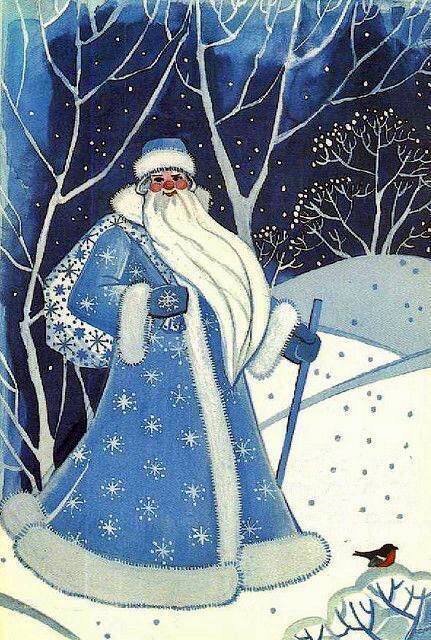
 Russian Santa (Ded Moroz) may sport a classic long white beard but his heel-length coat is blue
Russian Santa (Ded Moroz) may sport a classic long white beard but his heel-length coat is blue

Still, who would deny Santa his annual tipple? 

In many countries, drink still features heavily among gifts left out for Father Christmas. In USA it’s milk, in Sweden hot coffee.

In Ireland, it’s stout, in Australia, a glass of cold beer, and in England, sherry. 

Meanwhile, back at the North Pole, Mrs Claus has whiskey ready for Santa on his return home, well sloshed, and millions of times over the legal limit! Merry Christmas!

Six stocking stuffers

  • Father Christmas once wore green. In Russia he often wears blue. The German Christmas Museum claims he only switched to a red coat after Coca-Cola started cloaking him in its company colours in the 1930s.
  • Santa has the fastest vehicle ever. To reach the world’s 2.1 billion children, he must make 842 million stops on Christmas Eve. Allowing for different time zones, his magic sleigh must travel at an average 1,800 miles per second.
  • Rudolph was not one of the original reindeer. When fog threatened deliveries one Christmas, Santa spotted his bright red nose glowing in the gloom and asked him to join the other eight in the team to lightthe way.
  • The US government gave Santa a helping hand in 1927 by issuing him a pilot’s licence, air maps and a promise to keep runway lights on. So, if there’s insufficient snow for his sleigh, he can still deliver presents on time by plane.
  • One theory goes that St Nicholas, who inspired Father Christmas, may be buried in Ireland. A gravestone in Newtown Jerpoint graveyard near Thomastown, Co. Kilkenny, features St. Nicholas with the heads of two crusader knights who supposedly brought his remains from Italy.
  • After many years as a bachelor, Santa married. His wife stitches his clothes, cares for his reindeer, and joins the elves preparing toys. In 2013, the Canadian government presented Mr and Mrs Claus with passports. Santa keeps his in a pocket in his belt, safe from snow and soot.

x

More in this section

Lifestyle

Newsletter

The best food, health, entertainment and lifestyle content from the Irish Examiner, direct to your inbox.

Cookie Policy Privacy Policy Brand Safety FAQ Help Contact Us Terms and Conditions

© Examiner Echo Group Limited