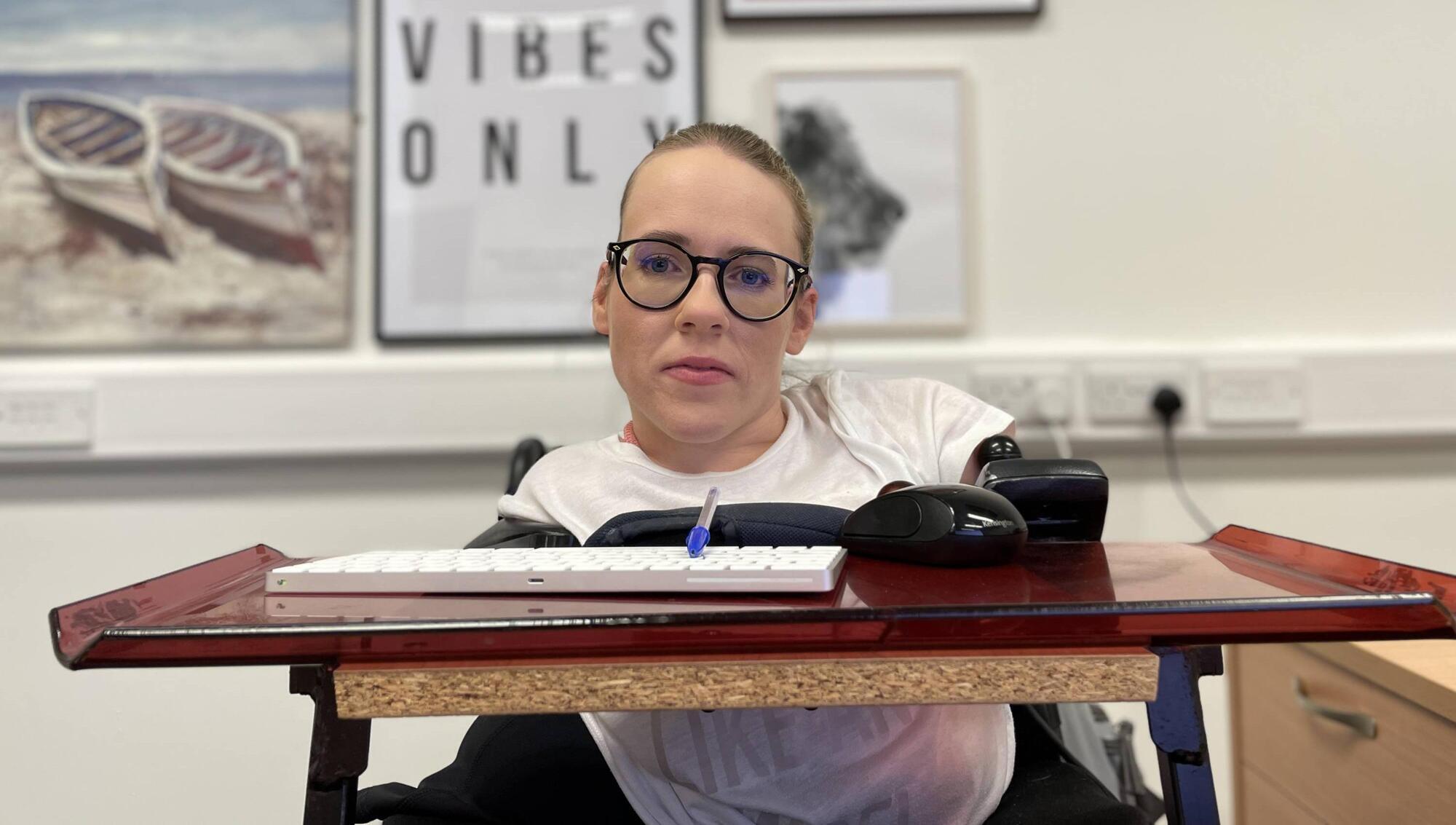
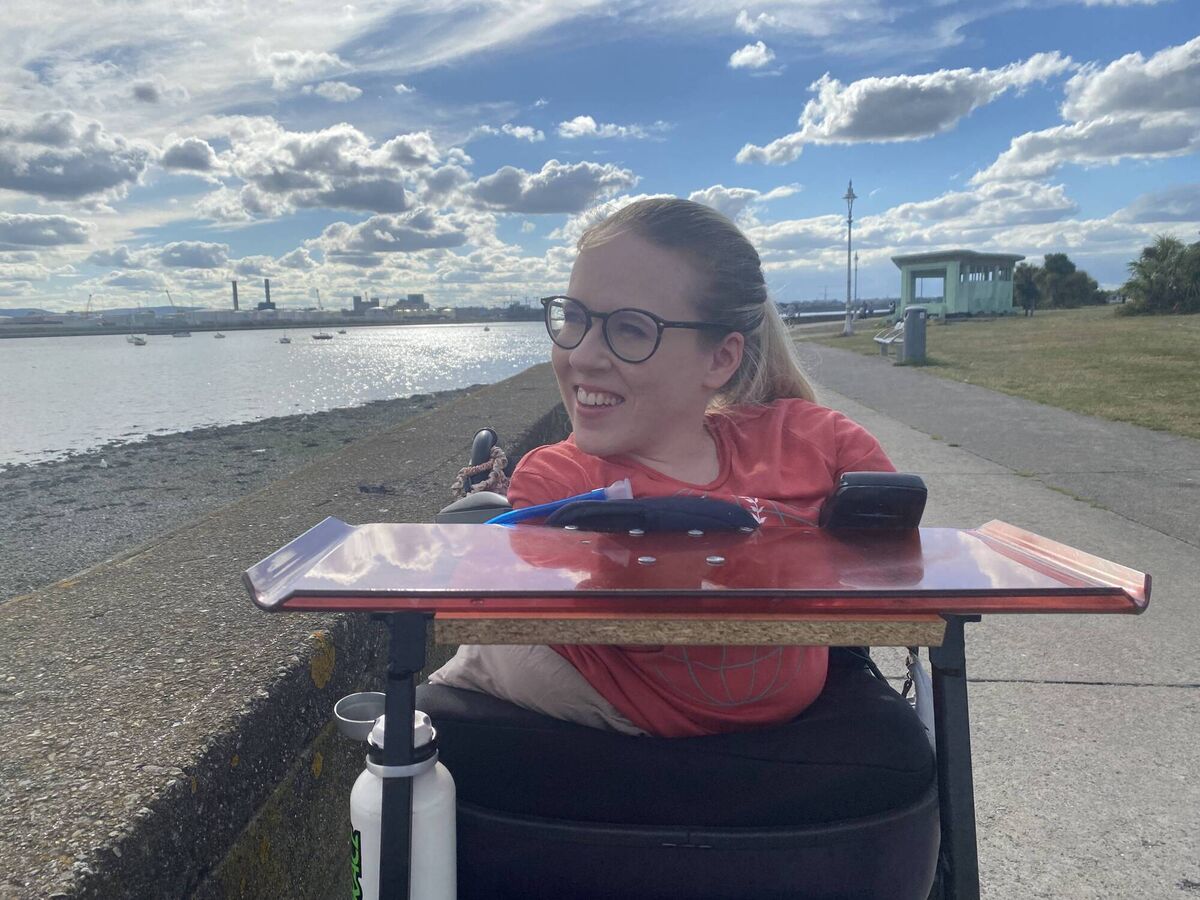
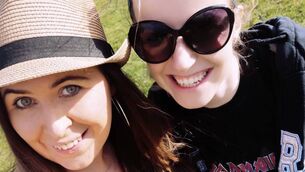
Joanne O’Riordan was about six or seven, she remembers watching a match with her dad. It was Cork v Kerry in Fitzgerald Stadium but it may as well have been the final challenge in Squid Game. With just a few minutes to go, Cork scored, meaning a replay was in order. The O’Riordan household was euphoric.
“My dad picked me up out of the chair and threw me up in the air. So, there’s just a random picture at home of a limbless girl being hurled into the air.”
Sports were taken very seriously in the O’Riordan household in Millstreet and having no limbs was not going to prevent Joanne from earning her stripes. She grew up watching all kinds of sports from GAA to soccer, tennis, and athletics but it wasn’t until she was in college that she really became aware of the dearth of opportunity for women in sport.
Just as she challenged Enda Kenny about his failed promises to bolster disability funding, Joanne wants to challenge the status quo in women’s sports. Her new documentary, A Sporting Chance dives into the lives of female athletes and professionals from football and rugby international, Hannah Tyrrell to boxer Amy Broadhurst.
The recent Irish soccer team’s win just goes to show how much can be achieved when the resources are funnelled into women’s sports, she says.
“The women’s soccer team had a strike. They weren’t getting a fair share, they had to change in public toilets, share kits with the underage boys. It just goes to show what investment from the FAI actually can do, how far they have come since then.” The negative press around the dressing room rebel chant shouldn’t overshadow their achievements, Joanne says.
“Context is everything and I don’t think the context was to offend. I did have a giggle to myself though when [Sky] asked about needing education.” The poster boys of Joanne’s youth were Damien Duff and Roy Keane but it wasn’t until she was in college, that she really sunk her teeth into women’s sports. She said it almost felt like “searching the dark web” trying to find stations that were broadcasting women’s sports.
“I can remember after the World Cup, my friends and I wanted to watch the National Women’s Soccer League over in America. We had to do really dodgy live streams to try and watch the games. The commentary wouldn’t be good. The camera angle wouldn’t be good.”
The nation needs to get behind its women athletes, says Joanne. Funding is absolutely critical, and we can’t expect elite athletes to function on partial subsidies. Just last year, Derval O’Rourke highlighted the fact that some of the country’s top athletes would make more money drawing the dole. Joanne’s neighbour has been to three Olympics and has had to partially pay her way every time.
“When they don’t come home with a medal, people ask ‘why isn’t the athlete performing? You have to understand a lot of these people have to work another full-time job to get an income... There’s nothing wrong with the amateur athlete going to the amateur coach — going to the Olympics and it’s a lovely feel-good story. But instead of it being a feel-good story, we have to ask ourselves, why are we relying on volunteers?” As one of only seven people in the world with Tetra-amelia syndrome, Joanne is a trailblazer in the disability community and has always fought for equal opportunities and access across the board.
“If we give these women an opportunity, and literally a sporting chance, then 99% of the time they grab it with both hands and they achieve spectacularly.” While stigma around the menstrual cycle is beginning to lift, not enough provisions are made for women’s hormone health in relation to sports, says Joanne. I’m shuddering internally thinking of the propaganda fuelled by sanitary towel companies and the ads feeding us the lies that hang gliding was a great idea, even with a heavy flow.

In the documentary, Joanne spoke to a doctor and a nutritionist about the impact of hormones on athletic performance and recovery from injury, especially in relation to the anterior cruciate ligament or ACL.
“It’s a season-ending injury and they’re now looking at whether certain hormones affect you and make you more susceptible to injury and if so, whether they should be adapting training to accommodate for this.” She mentions how tracking periods was a key strategy in the success of the US women’s soccer team in the 2019 World Cup.
“They managed to sync all the women’s periods. This is just the start of it. The first women’s team I ever heard of doing it was Chelsea who tailored their training according to their player’s periods.” Joanne was shocked when she discovered that both the LGFA and the Camogie Association did not have as much access to doctors as the GAA.
“One thing that completely blew my mind was at intercounty women’s training sessions, they would be very lucky to have a doctor on the sidelines. Whatever your gender, irrespective of the money that you have, a doctor should always be made available on site. Christian Eriksen died for 120 seconds at the European Championships. If that happened on a women’s team, the situation would be much blurrier.”
We’re so conditioned towards men’s sport being the default sport, we now almost expect women to increase their own visibility, says Joanne. She references Dr Stacy Sims whose Ted Talk 'Women Are Not Small Men' illustrated the different needs of the female physiology when it comes to injury, recovery, and training.
“In society, we’ve come to expect more and more from women. As an athlete, they shouldn’t have that onus to speak out on issues.” The responsibility isn’t on athletes to make their voices heard, says Joanne but people like Derval O’Rourke and Anna Geary who have carved a career in the media are role models for up-and-coming athletes. She also mentions the pivotal role played by the only two women who served on GAA boards — former Cork chairperson, Tracey Kennedy, and former chair of Tyrone, Róisín Jordan.
Joanne was a speaker at The Shine Festival in conjunction with The Shona Project where she encouraged young people to get involved in sports. As the youngest of six kids, she always found a way to muck in and play with her siblings.
“I want to show women you do not have to be kicking the ball around to be part of the team. You can get involved in so many different ways.” It’s patently obvious that Joanne thinks outside the box and she wants girls to know that there are other ways to get involved in sports from PR to journalism, on boards and committees or as photographers or videographers.
“There’s so many opportunities and avenues and untapped potential. It’s good to see that there are more females out there on the boards and committees.” One team that Joanne encountered that has recently turned professional is the Irish women’s cricket team.
“They’re the second only professional team in Ireland but in the global sporting body, they’re one of the last few to turn pro.” Although the team is currently ranked 10th in the world, Joanne admits that she knew very little about the team until hosting the documentary. Previously associated almost exclusively with men, boxing is one sport that has begun to attract more women, spearheaded by role models like Katie Taylor and Kellie Harrington.
“I don’t know what’s more wild — that the association for boxing barely has any women — or that our two greatest boxers — Katie and Kellie — are women. I wouldn’t put my face into a boxing ring. But more power — girls should be afforded the opportunity. I’m all for it.”
- A Sporting Chance (Loosehorse Productions) premieres on RTÉ October 27 at 10.15pm
No obligation. Ts&Cs apply.
CONNECT WITH US TODAY
Be the first to know the latest news and updates