The day Cork policemen resigned to help fight for the Pope 

Pope Francesco has strongly appealed to politicians to make every effort to preserve peace in the world. But some of his predecessors regularly enlisted men to fight their wars
The day Cork policemen resigned to help fight for the Pope 

Pope Pius IX (Giovanni Maria Mastai Ferretti), the longest-serving pope, who lost the Papal States when Italy was unified in 1870 
Hundreds of Irishmen, including dozens of serving policemen — 20 from Cork — flocked to Italy in 1860 to protect Pope Pius IX against the insurgent nationalist forces of Cavour and Garibaldi.

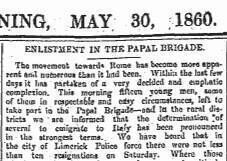
The Munster News reported in May 1860 that some 6,000 of the Irish Constabulary in Cork, Clare, Kerry and Limerick were ready to quit their posts in order to “join the cause of His Holiness”. All who actually tendered their resignations and sailed for Italy were Catholics, passed over for promotion by the British government, and “not, generally speaking, the most contented individuals in the world”, commented The Cork Examiner (30 May 1860).

Any man over five-foot-seven inches tall could enrol in the infantry of the Papal States, which covered the modern regions of Lazio, Marche, Umbria, Romagna and parts of Emilia. The establishment of a cavalry brigade of “tall, muscular young Irishmen” was also under consideration.

Headline in The Cork Examiner, 30 May 1860, announcing the exodus of young men from Cork to join the Papal Brigade in Italy

About 1,300 young men left Ireland, many giving up “comfortable homes” and resigning from “lucrative employments” to become unpaid soldiers. Apprentices broke the terms of their indentures, and factory hands left their employers. Standing shoulder to shoulder with the sons of farmers, lawyers and doctors, they eagerly waited to board ship at Cobh to “rally round the Chair of Peter”.

HISTORY HUB

If you are interested in this article then no doubt you will enjoy exploring the various history collections and content in our history hub. Check it out HERE and happy reading
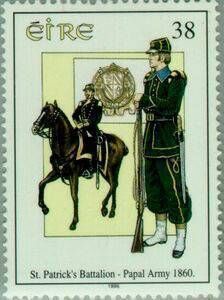
The recruits would receive green uniforms with caps incorporating a shamrock motif, and were assured of both military fame and the “highest promises of future prosperity”. Known as the Battalion of St Patrick, the ‘Irish Brigade’ would be supported by donations to the Catholic Church in Europe and America. As soldiers of God, they would fight under the protection of “a kind and benevolent ruler”, whose dominions they would safeguard “against the attack of his unscrupulous assailants”, Italy’s nationalist armies, the soldiers of the Devil. But the English press claimed the Irishmen were mercenaries, motivated solely by “pay and plunder”.

As they stepped into the unknown, would the willing recruits find fame and fortune; or were they destined to return to Ireland in disappointment? Travelling furtively in small groups of 20-40, some calling themselves pilgrims, they reached Rome late in June. There they joined soldiers of eight more nationalities — including Italians, Austrians, French and Belgians — who didn’t know one another’s languages.

Furthermore, the promised uniforms had never been made, and they were issued instead with surplus Austrian kit prior to receiving some rushed training from Louth-born Major Myles O’Reilly. Disillusioned, several Irishmen returned home.

 Irish postage stamp (1995), showing a splendidly dressed Irish papal bodyguard (Zouave) in 1860
Irish postage stamp (1995), showing a splendidly dressed Irish papal bodyguard (Zouave) in 1860

During the next few months, under the overall command of General Christophe Lamoricière, the Papal Brigade faced “a desperate struggle against overwhelming odds”, reported The Cork Examiner (5 November 1860). Although only Garibaldi and his redshirts were expected, the Pope’s army came up against the full Piedmont-Sardinia forces.

The Irish always fought “like lions”: On 13 September, Patrick Clooney of Waterford and his men inflicted serious casualties on the Piedmontese in the narrow streets of Perugia, Umbria, and criticised their commander, General Schmidt, for surrendering so soon.

Four days later at Spoleto, the Irish Brigade managed to defend the gatehouse for fourteen hours. Their only weapons were two cannon, sixty rifles, and obsolete muskets that became so hot when fired that the men had to wrap their handkerchiefs around the barrels. So successful at first were Irish riflemen that a Sardinian captain praised their ‘sharpshooting’. But the numbers were stacked against them, and their Italian comrades in arms supposedly “ran away from their posts as soon as the engagement commenced”.

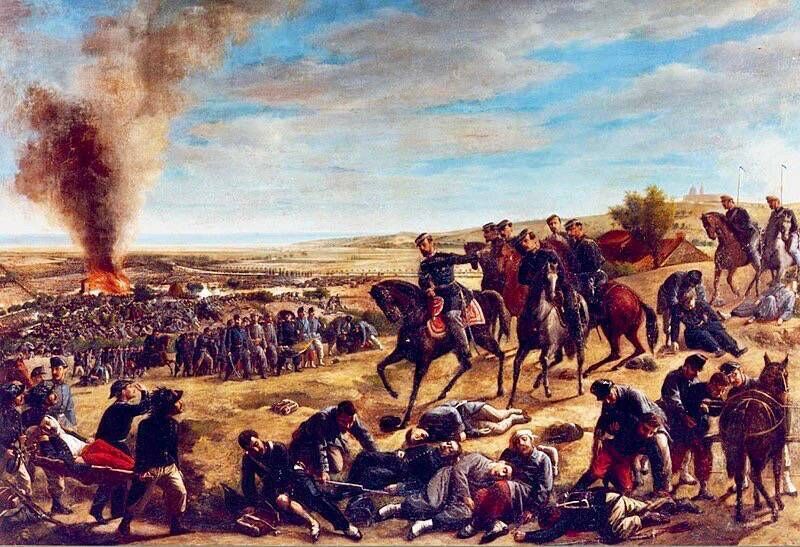
On 18 September, at Castelfidardo in Marche, 105 Irishmen put up a spirited defence under the command of Roscommon’s Captain Martin Kirwan. However, the 39,000 Sardinians quickly overwhelmed the 10,000-strong Papal Brigade.

 Battle of Castelfidardo, 18 September 1860, by Giovanni Gallucci
Battle of Castelfidardo, 18 September 1860, by Giovanni Gallucci

In the final encounter at Ancona, Irishmen apparently defied surgeons and went back to their posts within a couple of days of being injured, “so eager was their anxiety to return to the fray”.

Rounded up and disarmed, they were marched to Genoa, all the while being insulted “in every possible way”, spat upon and jeered at.

Fears arose that they were to be transported to Malta to serve in the British Army. Therefore they were relieved to hear that a vessel had arrived to take them to France. In Paris they were treated like heroes: gentlemen presented them with shirts, and women are said to have asked for a button from their uniforms as a souvenir.

On Saturday 3 November 1860, about 960 of the Irish Papal Brigade arrived back in Cobh to a warm and hearty reception, with temperance bands striking up “Cheer boys, cheer” and “Patrick’s Day”.

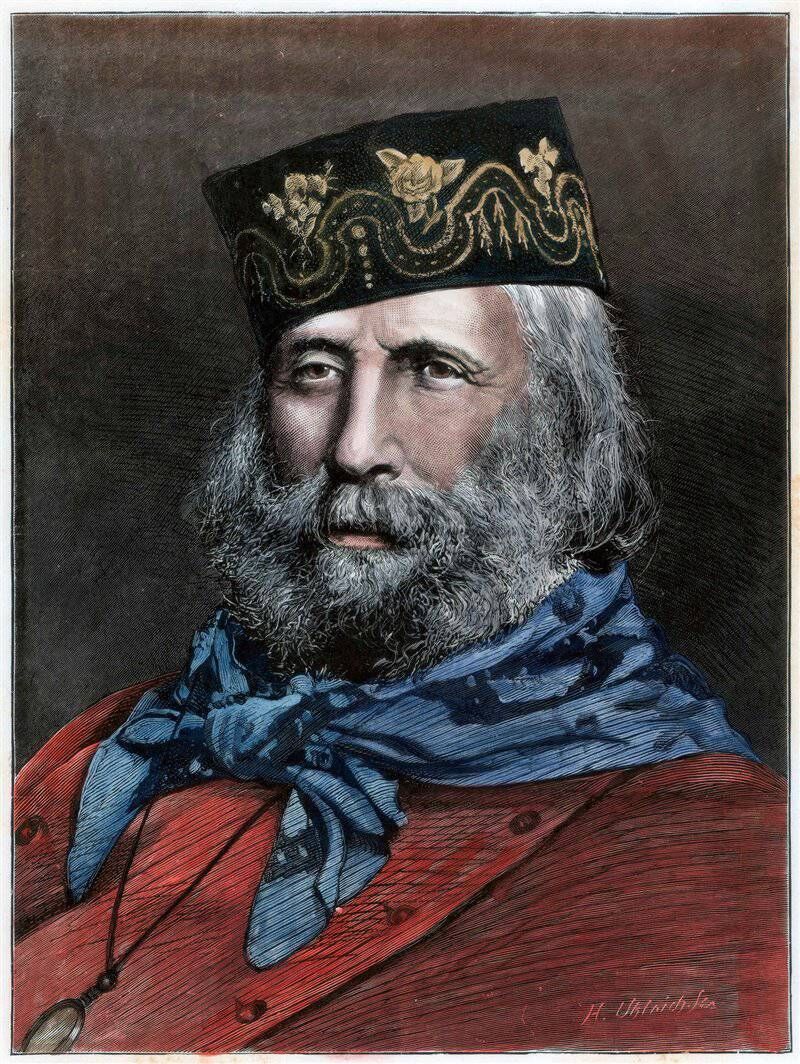
Giuseppe Garibaldi, 1807-1882, who worked for the unification of Italy by conquering Sicily and Naples 

Locals turned out in crowds to greet them, and the cliffs were “thickly dotted with groups of men, women and children”, cheering enthusiastically and waving handkerchiefs. Vessels at anchor in the harbour sounded their whistles, and several ladies and gentlemen were heard cheering on the balcony of the Victoria Baths Hotel, where they had hoisted a green flag. Navvies building the Cork and Youghal Railway threw down their shovels and pickaxes, “and shouted and waved their hats most vehemently”.

John Francis Maguire, M.P., founder of the Cork Examiner, praised the men for abandoning their homes and friends, and risking their lives to fight for the Holy Father. All were awarded a commemorative service medal in recognition.

With the exception of one — who had particularly suffered at the hands of the Sardinians — the men were in “good health and buoyant spirits”. They were given a “substantial and comfortable breakfast” of bread and ham, and large mugs of coffee. After that, each man received a new suit of clothes made by Cork City tailors and paid for by public subscription.

None had dreamt of getting such an enthusiastic reception: “I would sooner have that welcome than if they gave me twenty pounds”, declared a former police constable.

Had he and his comrades returned from the Pope’s wars, weary and disappointed? Not one bit of it. 

“We will fight for him again tomorrow” shouted one soldier.

More in this section

Lifestyle

Newsletter

The best food, health, entertainment and lifestyle content from the Irish Examiner, direct to your inbox.

Cookie Policy Privacy Policy Brand Safety FAQ Help Contact Us Terms and Conditions

© Examiner Echo Group Limited