Munster In 30 Artworks, No 3: Night’s Candles are Burnt Out, by Seán Keating
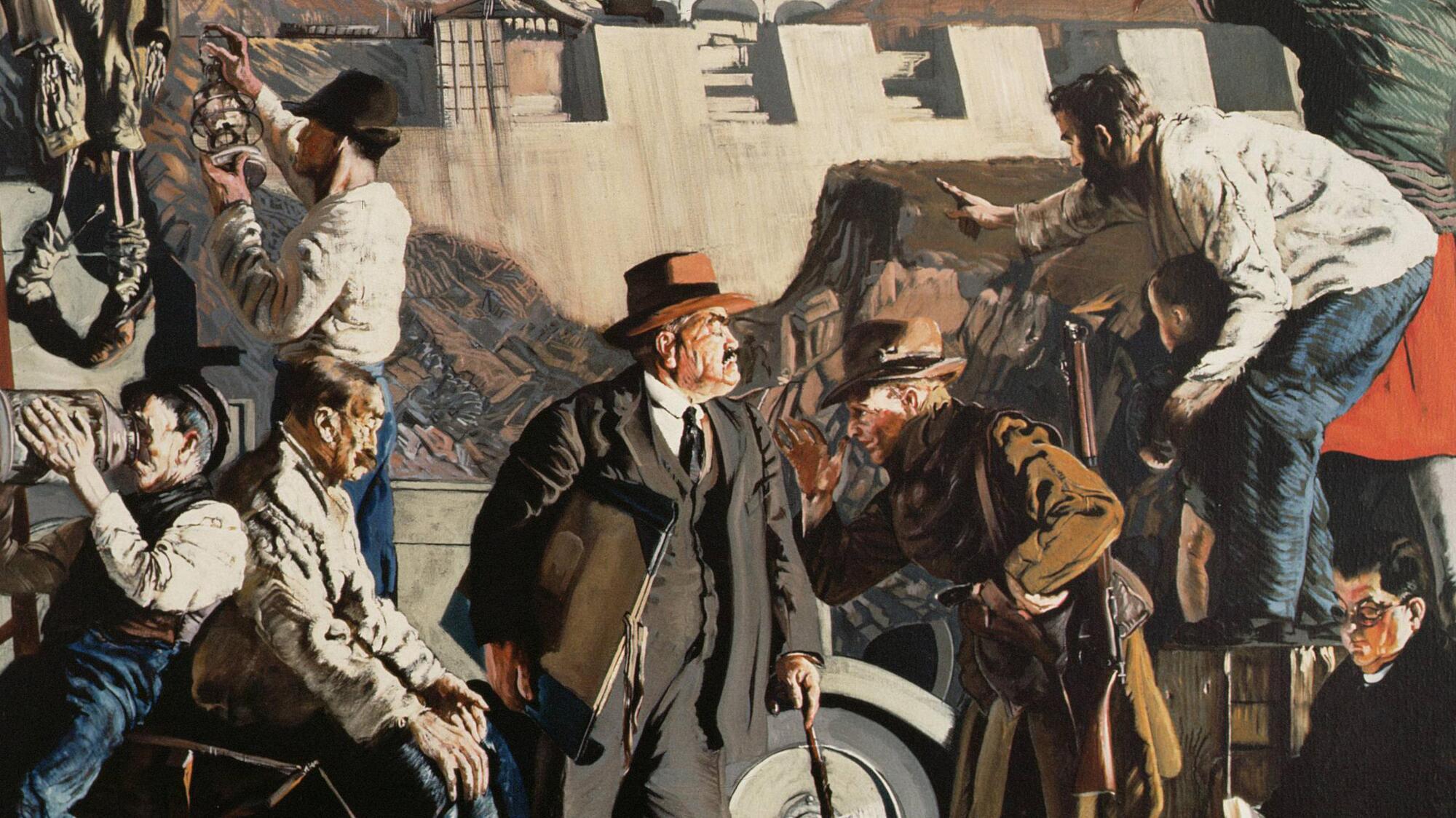
A detail from Night’s Candles Are Burnt Out by Sean Keating. The painting is currently on loan to the Hunt Museum in Limerick from Gallery Oldham.
The construction of the hydro-electric scheme at Ardnacrusha, Co Limerick was one of the most important projects undertaken by the nascent Irish Free State. Between 1925 and 1929, thousands toiled on the enterprise, which centered on damming the mighty River Shannon. The Shannon Scheme was not without controversy; many thought it was an appalling waste of expenditure that might otherwise have been spent on social housing and job creation.
But Ardnacrusha also had its champions. Among them was Seán Keating, the artist and social commentator, who saw it as heralding the future Ireland, an industrial nation that could be the equal of any other on earth.

Born in Limerick in 1889, Keating had trained under William Orpen at the Dublin Metropolitan School of Art, and had taken on a teaching position there himself in 1919. He often worked to commission, painting portraits, but he was also responsible for socially engaged works such as Men of the West and Men of the South, which celebrated Irish nationalism.
Keating was so taken with the construction work at Ardnacrusha that he painted a whole series of works on site in 1926 and ’27. A few years later, he would complete Night’s Candles are Burnt Out, another painting inspired by the project, which is now on display at the Hunt Museum in Limerick, on loan from Gallery Oldham in Manchester, UK.
It is often reported that Keating’s Ardnacrusha paintings were commissioned by the ESB, in whose collection most of them reside, but in fact Keating made them on his own initiative. This is just one of many misconceptions dealt with by the art historian Dr Eimear O’Connor in her biography of the artist, Seán Keating: Art, Politics and Building the Irish Nation.

“Keating went down to Ardnacrusha because he knew that the construction project was emerging history,” says O’Connor. “It was all happening around where he was born and raised. The machinery was going to carve up this landscape that he saw as ‘a medieval dungheap’, that was how he described it in later years. And this was a metaphor for him, the whole thing was all about Ireland moving forward into modernity.”
Night’s Candles features the dam at Ardnacrusha, but also includes a group of figures in the foreground, all of whom represent different aspects of what Keating saw as the Ireland of the day. “When he showed it at the Royal Hibernian Academy in Dublin, it was called ‘the problem painting of the year,’ which Keating thought was hilarious. They couldn't get their heads around this idea of what he was trying to do at all.”
What Keating was trying to do, according to O’Connor, was reflect upon a country on the cusp of change. “It was in those years, in the 1920s, that the term ‘gombeen man’ came into being. We all know that it means the kind of businessman or politician who's making money off the backs of everybody else. And that's the gombeen man in the middle of the painting. I think it’s quite clear that Keating’s hope was that modernity, as represented by Ardnacrusha, would end all that stage Ireland paddywhackery that had prevailed for years.”
Keating himself appears in the painting twice. “That’s him on the left, holding the lamp up to the skeleton. He was portraying himself as the truthsayer, if you like.” He can also be seen on the right, along with his wife May, pointing towards O’Brien’s Bridge in the distance. “And there at his feet is his eldest son Michael. I say in my book that they’re pointing to their future, as May was expecting their son Justin, who was born the following January, after the painting was shown.”
For O’Connor, the most interesting figure in the painting is the myopic priest reading by candlelight in the bottom right-hand corner. “It tells you an awful lot about Keating and his attitude to the Church at the time. Like many others in the cultural sphere in Ireland, he was disappointed with post-Treaty Ireland, with successive governments and the Church, who were in cahoots, if you know what I mean. He knew well that the whole country was tied up with them, and with that kind of organized religion that was deeply conservative. And Night’s Candles is very much an expression of that disappointment, I think.”
The popularity of Keating’s Ardnacrusha paintings contributed greatly to his success as an artist. In 1950, he was elected president of the RHA, a position he held for several years. “As president, he clashed with the Arts Council, which had just come into being, because they had a blacklist of artists they wouldn’t buy for their collection. He wrote to newspapers under the name Macalla, giving out stink about them. Keating was always very opinionated, but he was very clear that he wanted you to have your opinion too. And he really had no respect for you if you didn't.”

In his later years, Keating continued painting in the realist style he had learned from his mentor Orpen, long after it had fallen of favour. He railed against modern art, and came to be seen as a deeply conservative figure, though O’Connor insists he was anything but.
“His wife May was very active politically, and they were both very socialist in their thinking. They were personal friends of Dr Noel Browne, and the Mother and Child Scheme was effectively run out of their house."
O'Connor says despite not always following the trends of his time, Keating was very modern in his thinking. “The fact that he chose to use an academic style of painting as his way of expressing his engagement with modern life is a reflection on how he was trained. One of his master talents was his ability to produce an allegorical painting such as Night’s Candles, something that was both a metaphor and a statement on contemporary Ireland.
“Nearly 100 years after it was painted, Night’s Candles still speaks to people, it’s perennially popular. It took great talent to produce such a painting, something that was both a metaphor and a statement on modern Ireland; it’s a sign of how good a painting it is that it still has so many admirers.”
- Further information: https://www.huntmuseum.com/