Appliance of Science: What life is like on the International Space Station
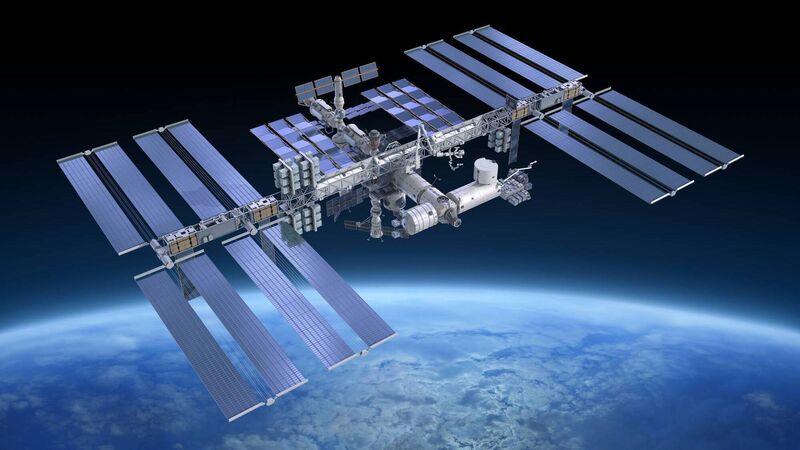
The first residential crew arrived on the International Space Station on November 2, 2000.
The International Space Station (ISS) is a residential research unit, orbiting approximately 400 kilometres above the surface of our planet. It took 10 years to build and involved the collaboration of five different space agencies, representing 15 different countries. It took more than 40 missions to transport and build the station as it exists today.
The ISS is the largest single structure humans have ever put into space. The living and work quarters alone are the equivalent of a six bedroom house, complete with two bathrooms, a gym and a 360 degree viewing area.
The space station is 109 metres long; for comparison, the pitch at Croke park is 145 metres long. The habitable area is 388 cubic metres.
The station is powered by solar panels, an acre (4,046.9 square metres) in total. The reflection of the Sun off the solar powers can make the ISS more easily detectable from Earth. At dusk or dawn the station can be visible without the use of binoculars, it is just a matter of knowing where, and when, to look.
The first residential crew arrived at the station on November 2, 2000. The original three-person crew consisted of Cosmonauts Yuri Gidzenko and Sergei Krikalev and Astronaut Bill Shepherd. They stayed onboard for 136 days. The ISS has had uninterrupted human presence ever since.
To date, 242 people, from 19 different countries, have visited the ISS. Some staying for short visits and some stay for record breaking periods, like astronaut, Scott Kelly, and cosmonaut Mikhail Kornienko, when they spent 340 consecutive days aboard the station.
The ISS travels at a speed of almost eight kilometres per second, that’s 28,000 kilometres per hour. At these speeds the ISS circles the Earth every 90 minutes, completing 16 orbits of our planet every 24 hours. In terms of distance, that equates to a journey from the Earth, to the Moon, and back, in just one day.
The crew of the ISS spend most of their time performing experiments or maintenance on the station. Some of their work brings them outside the space station too; to date there have been 232 space walks carried out for the purpose of construction, maintenance and research.
Some of the experiments that the crew carry out include themselves as the test subjects, increasing our knowledge and understanding of the effects of microgravity on the human body.
Life in space can take its toll, affecting muscle tone, bone density, the cardiovascular system and vision. The effects on the eye-sight of astronauts and cosmonauts is of particular concern as the issues, in some instances, can be long lasting. It is though that an increase in intercranial pressure in a microgravity environment, can causes cerebrospinal fluid to push on the back of the eyeball, causing it to deform slightly, resulting in impaired vision.
To counteract some of these potential health problems, the crew usually dedicate at least two hours of their day to vigorous exercise and personal care. A number of applications are being tested to help prevent the potential issues to the crew’s vision; one option being explored is the use of negative-pressure clothing, worn while sleeping, to reduce internal pressure on the back of the eyeball.
The year-long expedition by Scott Kelly provided additional information about the effects of microgravity on the human body, as Scott had a twin brother, Mike, as a comparative study sample, back on Earth.


CONNECT WITH US TODAY



Be the first to know the latest news and updates