Thinking about growing your own food? Here's my polytunnel diary
Fuelled by a growing desire for a self-sufficient lifestyle and minimal environmental impact, Ellie O’Byrne installed her first polytunnel this year, she writes.
Thinking about growing your own food? Here's my polytunnel diary

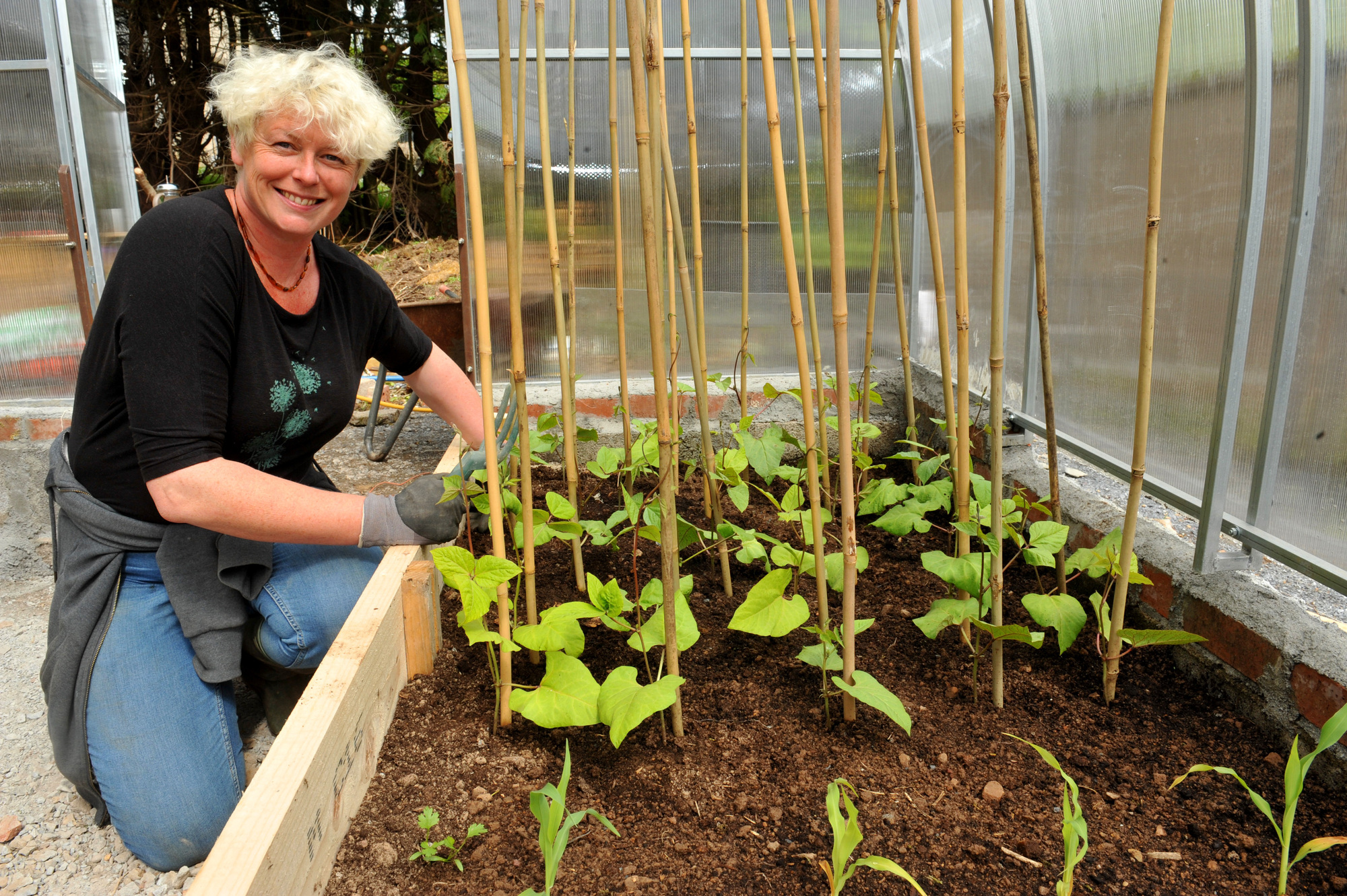
Going green: Ellie O'Byrne and her polytunnel in Cork. Pics: Larry Cummins

In early February of this year, when we were ordering a polytunnel for our vegetable garden, a news story broke that scientists in the field of “plant nanobiotics” had taught spinach to send emails about substances the plants could detect in the soil.

“No, no, scientists, you idiots,” I muttered to myself when a friend and fellow gardener sent me a link to the story. “The reason I like plants is exactly because they never send me emails.”

Amidst the chaos, confusion and digital overload that was the Covid crisis of 2020, with the tech giants cashing in at an obscene and unheard-of rate, everything was Zoom and email and so-called “online learning.” And the garden became my respite.

Waking at daybreak, I would silently make myself a cup of tea and slip out the door to the birdsong and the plants. I raised my mum’s old outdoor beds with the aid of scaffolding boards and tonnes of our own compost, and in them I grew kale, mange tout, potatoes, salads, spinach, chard, and, in my mum’s small greenhouse, a bumper crop of tomatoes and chilis.

CLIMATE & SUSTAINABILITY HUB

I was lucky enough to grow up with a mother who always gardened. I have early memories of sowing seeds, being offered tastes of fresh-picked delicacies, having the natural world – how the robin waited for you to turn a sod and then flit in for a worm, what conditions different plants thrived in - pointed out to me.

So it was probably always there, but over years of insecure rental accommodation, with the time pressures of being a single working parent, it was very much in the background. I didn’t have anywhere to sink my roots.

In 2019, my two children and I moved back in with my parents, as a temporary respite from our housing woes: I was struggling to pay Cork city’s astronomical rents alone, even on two freelance jobs. Then came Covid. My income took a sickening nose-dive and any hopes of being able to move on again receded rapidly.

So starting in spring, I sank all my anxiety and frustration into my parents’ vegetable garden. Those silently thriving plants, who never sent me emails, became my greatest allies, a source of not only peace, but also delicious bounty.

I also started a food sustainability podcast, www.greenbites.ie. I interviewed an array of inspirational food producers, growers, chefs and food activists, and it cemented in me the awareness that, when it comes to sustainability, cutting yourself out of the consumerist loop as much as possible is the most important thing you can do if you are worried about the state of our environment, our biodiversity and ecosystems.

I believe you should buy from as many small, local producers, makers and growers as possible, and you should repair and barter whenever you can.

Sustainability has become a buzz-word, a marketing ploy. But if someone tells you the answer to reducing our impacts on the planet comes in the form of buying more consumer goods, be suspicious.

I wanted to reduce my consumption as much as possible, to get my reliance on supermarket imports down to the occasional treat. But sometimes you have to speculate to accumulate: for the long-term gain of reducing reliance on imported foods, would a polytunnel to extend our growing season and the range of what we could produce make sense?

Ellie O'Byrne: putting in the hard yards in her polytunnel.

In September, surrounded by the bounty of the season, I took on Kerry food activist Lisa Fingleton’s 30-day Local Food Challenge, eating only foods grown in Ireland.

In late autumn, I dug out spent tomato plants and mulched beds with seaweed, all the while fantasising about the extended season a polytunnel brings the Irish veg gardener. Over winter, I mounted an extensive propaganda campaign against my parents, citing homegrown organic veg, all donkey-work done by me. They agreed to dedicate a sheltered, south-facing area of their garden to our first ever polytunnel.

The tunnel

Ellie O'Byrne's polytunnel: more plastic for less plastic?

It sounds paradoxical, but in order to buy less plastic, we bought more plastic.

The only qualm about polytunnel gardening I have is the tunnels’ polythene skin: technically recyclable, but recyclable and recycled are two different things, especially when it comes to plastics. Polythene gets damaged and torn, and will need replacing eventually. Some guides suggest every five years, in line with what friends told me, while others said with care, the life expectancy could be seven years or more.

Instead, we opted for a double-walled polycarbonate tunnel, 8 metres by 3.3 metres, from mygreenhouse.ie, based in Co Kildare. With a minimum life-span of 10-15 years, and with care, I hope this is the only plastic I’ll be buying for my tunnel.

The soil

A tomato plant climbs up hanging twine.

Of all of the bizarre impacts, Covid had, one of the strangest I encountered was while trying to source compost for the tunnel.

On my perennial one-woman mission to make everything as complex and labour-intensive as possible, I decided that the tunnel would contain raised beds. This would both make the rather low tunnel higher, and make care of the plants and beds easier.

But this also meant filling the beds. We produce a couple of tonnes of organic compost ourselves, but I knew this was going to be nowhere near enough. To avoid plastic packaging, I didn’t want to go to a garden centre and buy bags of compost off the shelf, so I set about finding a good bulk supplier.

I called Envirogrind in Donegal and was told that, as much of their feedstock was normally sourced from hotels, which were closed due to Covid, they were having trouble filling orders. But Living Green, another Donegal company and the only certified organic compost made in Ireland, could deliver. I ordered a one and a half cubic metre bulk delivery: this, mixed with topsoil and a cubic metre of rotted horse manure from the excellently named Gee-Up in Blarney, would make a fertile growing medium.

The installation

Ellie O'Byrne: standing amid her handiwork

What the hell was I thinking, and why didn’t I know that building is a skillset I just don’t have?

Having decided to raise our polytunnel, we ordered it to self-install, and set about using reclaimed cement blocks that had been lying around for years following the demolition of a shed to build a two-foot exterior wall, then anchoring the crossbars of the polytunnel into the wall with cement.

What’s mixing cement by hand like? Endless, sweaty backbreaking work. I don’t know how many loads that my son, 21, and I mixed, under the occasionally exasperated tutelage of my former builder dad. Builders of the world, I salute you. You’re heroes.

Can I make walls in straight lines? Kind of. How much did I add to our workload through inexperience? I probably doubled the duration of the build, which felt endless as it was. Towards the end, it was made more urgent by the greenhouse’s precious burden of seedlings, gradually becoming pot-bound as we laboured to finish cementing, building wooden inner walls to the beds, and filling them with an endless succession of wheelbarrow-loads of compost, topsoil and manure.

The result

A 'young' tomato plant growing in the polytunnel.

The biggest challenges in life are the biggest rewards. The tunnel is rapidly becoming a haven, the place for my morning cup of tea.

And with the horrible start to the season we’ve just had, with outdoor crops variously drowned, battered by winds and hail, and burned with late frosts, it’s been awe-inspiring to see the growth advantage the tunnel plants have. I’ve planted edamame, runner and french beans. 

I’ve planted squash and corn and cucumbers, basil and coriander, chili peppers and sweet peppers, and the most ridiculous array of tomatoes: 22 plants of eight different varieties. Hit me up for some come harvest, because the glut is going to be insane.

Whether or not it’s an outdoor summer, we’ll be reaping the harvests of the labour we’ve just undergone for years to come, and hopefully lighten the load on the planet at the same time.

x

More in this section

Lifestyle

Newsletter

The best food, health, entertainment and lifestyle content from the Irish Examiner, direct to your inbox.

Cookie Policy Privacy Policy Brand Safety FAQ Help Contact Us Terms and Conditions

© Examiner Echo Group Limited