Vet and former rugby player Elise O'Byrne-White: 'You feel sick. These cases stay with you'

The Shelter DSPCA Picture Conor McCabe Photography.
I catch Elise O’Byrne-White on the phone just as she’s finishing up surgery at the Dublin Society for Prevention of Cruelty to Animals (DSPCA).
“It was just a routine castration, 20 minutes – a big Rottweiler, 40kg,” says the former Ireland rugby player, who’s been working with the DSPCA as a veterinary surgeon for 18 months, and who assures me the Rottweiler’s recovering well.
Elise’s work at Ireland’s oldest, largest welfare charity – DSPCA marked 180 years in 2020 – comes under the spotlight with a new six-part RTE TV series starting this Friday. The Shelter: Animal SOS is an up-close-and-personal look at the work of the dedicated veterinary team who fight to rehabilitate sick, abused or neglected animals every day.
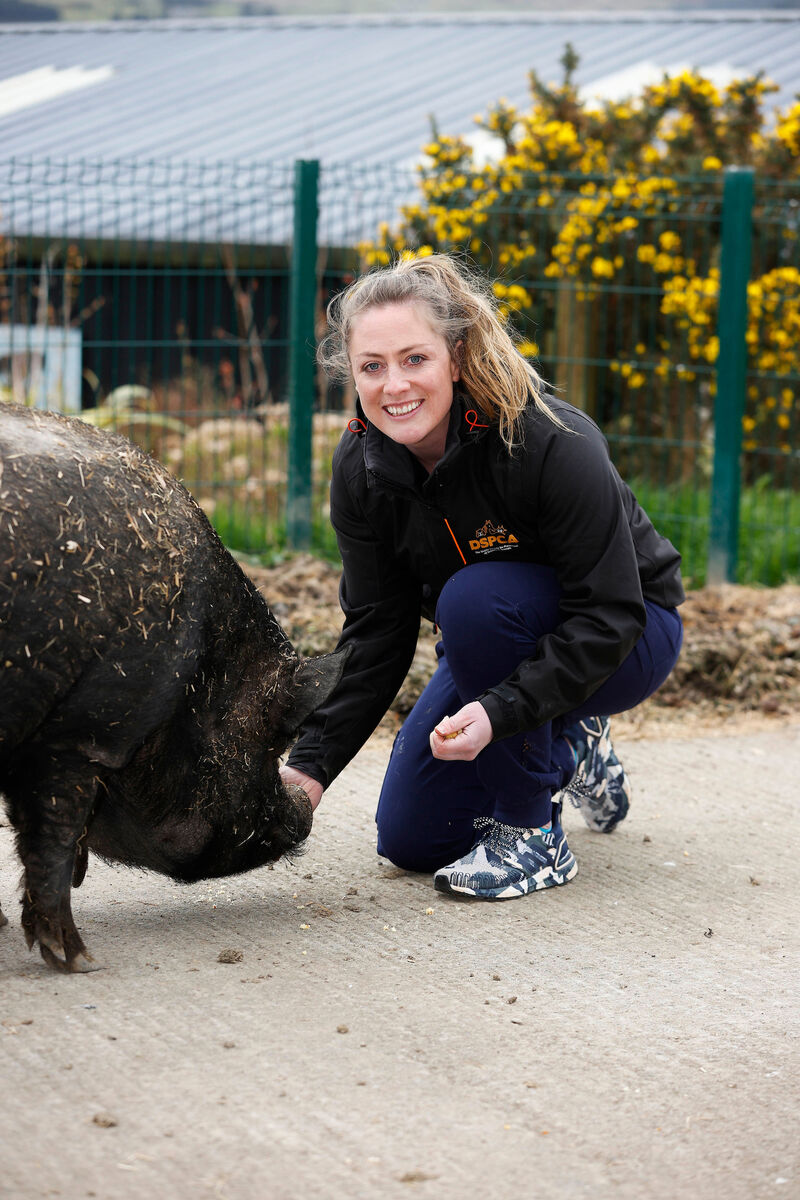
On the day we chat, Elise started work at 9am. During the short commute from her home in Leopardstown, she was thinking about Peppa the pig, how she’d need to give her meds for a sore elbow joint. “She’s a lovely pig. We’ve had her a few years. I always look forward to seeing her.”
Every year, the DSPCA re-homes over 2,500 animals, they perform 3,000 neuter/spay operations and they provide ongoing veterinary support to 300+ animals in the charity’s foster programme. A recent difficult case involved Paul, a bulldog/Staffordshire with a large abscess on his leg, “so big we didn’t know was it a tumour”. The wound had been there so long, the skin around it had died. “It was tricky to manage. The timeline to get something like this right is weeks,” explains Elise, adding that Paul’s done so well he’s heading to a foster home this week.
The DSPCA fights for the lives of domestic and wildlife animals. One morning Elise found a deer in the consult room. They get hedgehogs and foxes. “We’ve a beautiful young fox at the moment. He has mange and a skin infection and he’s underweight – he’ll be with us four to six weeks.” What’s interesting about foxes, she says, is they’re smaller than you’d think. “Sometimes they weigh the same as a cat. And you have to be careful – they can have a [bacterial infection] called leptospirosis, which people can catch.”
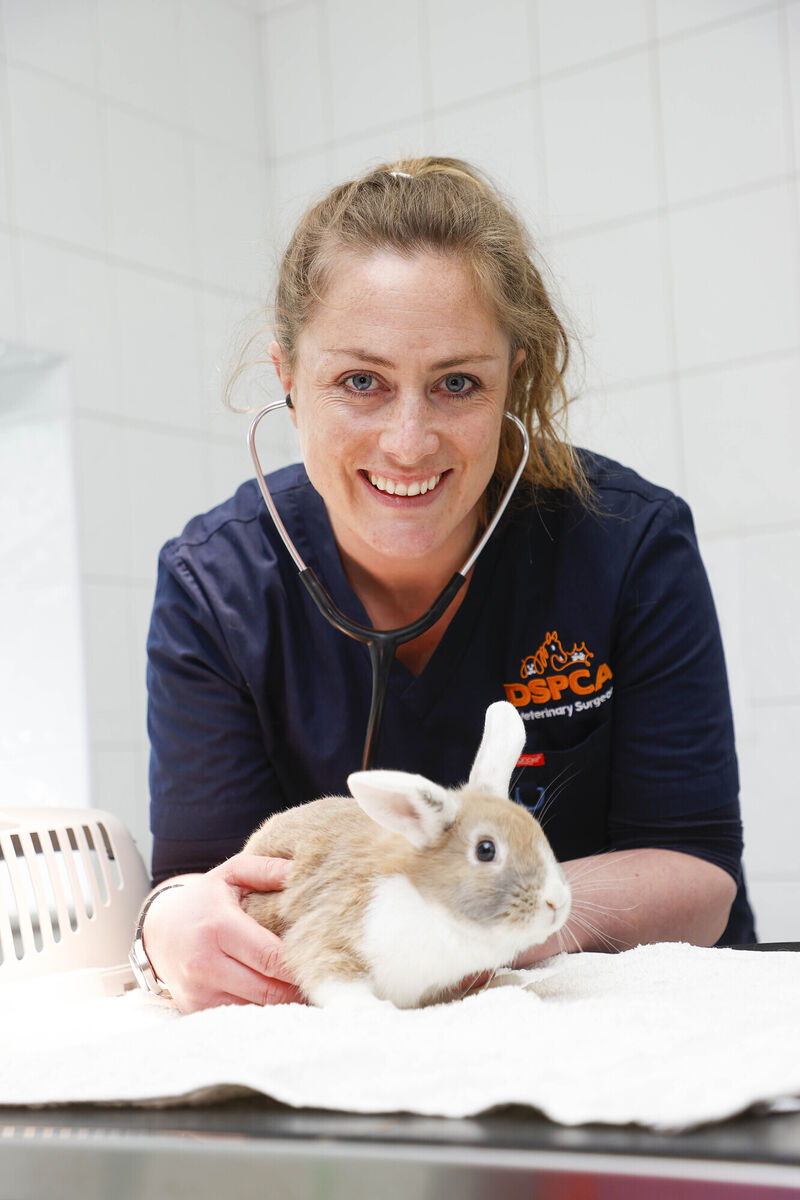
They get quite a lot of swans. “There are a lot in Dublin and along the canals. People feed them all sorts of rubbish, they get hit by cars, some are attacked by dogs.” Their swan patients have included Swanathan and Patrick Swanze (“we have fun with the names”) and, more mundanely, Alan, who had to have a wing amputated. “He can’t fly so he’s on a lake in Mullingar now. We sent a companion swan down to him – they’re living the good life.”
Kittens are currently the primary concern at the DSPCA. It’s ‘kitten season’ and 35 came in over the last week – stray newborns, so vulnerable they need frequent checking, and slightly older ones very sick with cat flu. “They’re always keeping us busy but they get on so well once they leave,” says Elise who doesn’t have a pet, though her mum, Mai, has a rescue cat called Pitch.
A week earlier they’d had “a very bad case, a horse that had to be put to sleep”. He had a broken leg. He was emaciated. “You feel sick. These cases stay with you.” At the same time Elise insulates herself against the heartbreak, by remembering the best thing she can do for the animal is to do her job well. “They come to the DSPCA and this is the point at which I get to step in and help. It’s a very privileged position. Once they get to the DSPCA they’re going to be safe. From here on they’re going to be looked after, rehabilitated, get a new home. There’s a lot of hope at the point I see them.”
The DSPCA has dedicated, trained animal welfare inspectors to investigate complaints of cruelty/neglect and to initiate prosecutions for offences. “This requires me to do my job well too – to write a very good case report so it can go to court.”
Being a vet was never on the cards, not even as a General Science student in Trinity College, where she specialised in Zoology. Her grandfather, Albie O’Hagan, was a well-known vet in Manorhamilton. “He was an old-school farm vet. Back then they had no mobile phones – all the calls came through the main house phone. He’d head out to a farm – if another call came in they’d be trying to catch him before he left the farm.”
After qualifying she spent two months in Indonesia, bird-catching (“we’d catch them, ring them, get data on them – the project found a new bird species”) and documenting reef ecology. “We were diving twice a day, seeing turtles, octopuses – a whole new beautiful world underneath.”
Staying in local villagers’ houses, they’d get up at 4am in the dark. “We’d travel in the backs of trucks down dirt roads. Slowly you’d see the sun rise. It was pure peaceful. It was a Muslim community and you’d hear the praying. One day we trekked eight hours into the jungle – it felt we couldn’t be more remote. The next minute the praying started – you realise you’re never that far from humanity.”
She loved zoology but felt she hadn’t found a job that suited her. “Somebody suggested working in a vet’s practice, so I did and realised this could be the perfect job – I applied to get on a UCD graduate programme.”
Elise was 30 last October (“I got a facial, had dinner in a hotel with my mum”). She plays rugby with Leinster. “There’s been nothing going on with Leinster since Covid, and no plans for anything so far. And OMG I do miss it. Sometimes it’s a bit of a drain, training twice a week, but when you can’t do it you realise what a staple it is in your life.”
Surprisingly, she doesn’t like exercising alone. “It doesn’t appeal. I like playing the game, the team element. A lot of girls on the rugby team love running, swimming, doing triathlons. I don’t want to run laps – it’s not my cup of tea.”
Elise made her international debut in 2016 against Wales in the Six Nations. “I love the Six Nations. I was delighted to see how the girls did against Wales – the best Irish performance in a long time.” Speaking before the Ireland/France game, she predicted a “very big challenge” for the Irish team. “But it’s the sort of game they need – they’ll gain valuable learning.”
Her other love is sailing, which she learned in Adrigole, West Cork. “I was raised on the sea. My parents sailed a lot in Glenans on Bere Island. There are pictures of me in a nappy on a boat.” Her dad passed away during her final year at college and she inherited his boat. “It’s on the water in Schull at the moment. That’s my plan for the summer – to go down to West Cork.”
- The Shelter: Animal SOS was filmed at the 32-acre DSPCA facility in the Dublin Mountains over the course of a year. It begins Friday, April 23, 8:30 pm, RTÉ One. https://www.dspca.ie/

CONNECT WITH US TODAY



Be the first to know the latest news and updates