Secret Teacher: We need our education system to change with the times
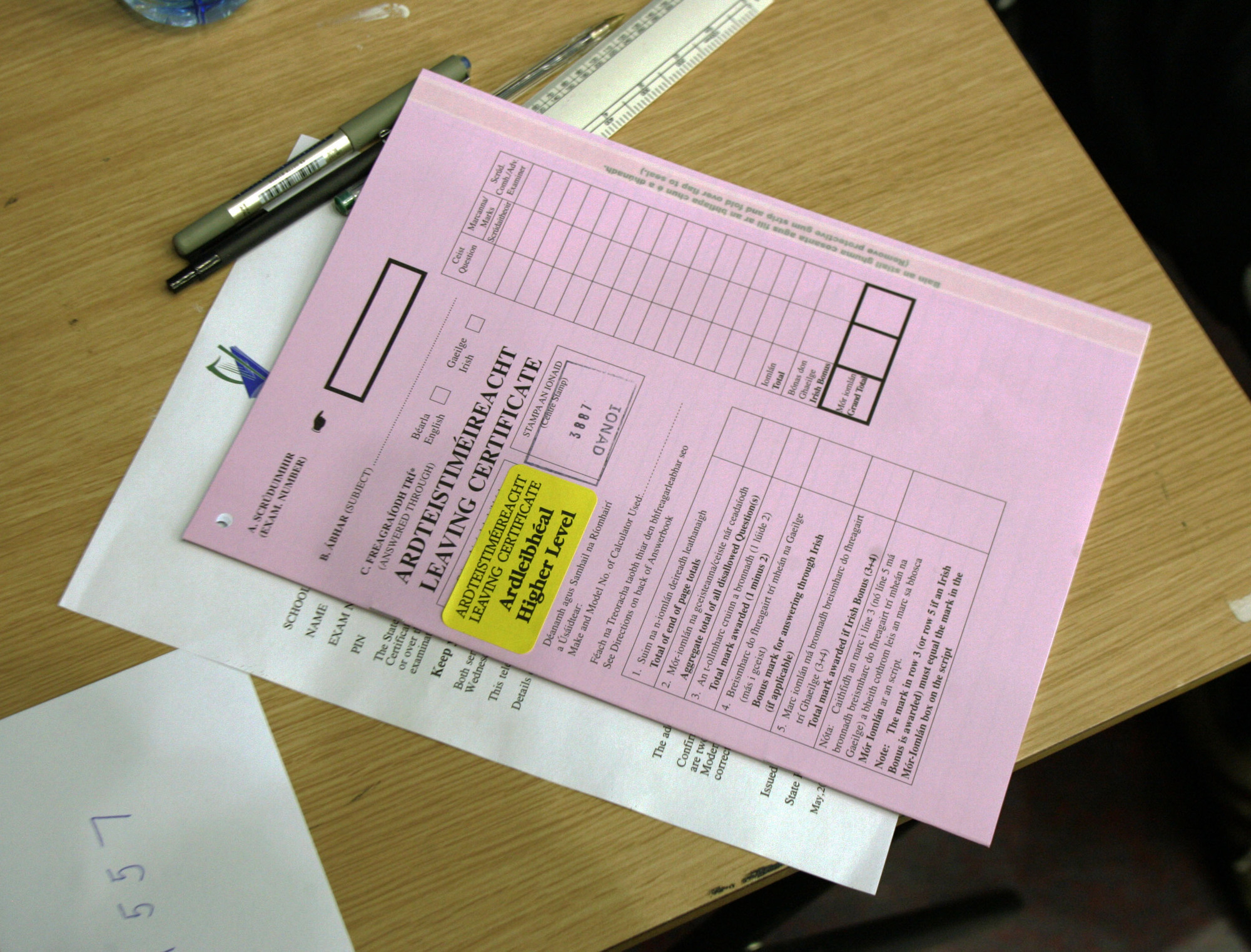
The Leaving Certificate exams are a remnant of a turbulent past, but change is happening. Photo: Mark Stedman/RollingNews.ie
‘First they ignore you, then they laugh at you, then they fight you, then you win.’
This is Norman Crowley speaking, an innovative Cork-born businessman, dubbed Ireland’s Elon Musk. Crowley and his company Crowley Carbon are changemakers. Crowley has a passion for building electric cars. He’s creating Irish jobs and championing Irish enterprise. He also wants to save the planet.
We need a ‘social foundation of wellbeing that no one should fall below, and an ecological ceiling of planetary pressure that we should not go beyond.’
This is economist Kate Raworth, speaking about doughnut economics, the model being adopted by Amsterdam, espoused by our President, Michael D Higgins. A model that rejects a nation’s GDP as the measure of its success. A model that considers the health our planet and our citizens first and foremost.
Change is happening.
Our students deserve to see it in their classrooms and in how they’re being assessed. My column last week about shelving the Leaving Cert was received positively. A lot of us want it gone yesterday, but like Crowley and Raworth, we need to think about its replacement.
The most important and initial step is revising how we talk about education. We must decide what the purpose of education is. Is it a means to an end, a fixed destination, evaluated by income and status? Or is education a lifelong journey, different for every individual learner?
As a young state, Ireland had to start with the former, and with good reason. Ireland had been brutalised for generations. Life was tough for most, unbearable for many. We existed under the boot of invading forces, poverty, and dogma. For generations, life was about basic survival and education was for the privileged few, characterised by a need for economic growth.
The Leaving Cert made that growth more possible, as did the Free Education Act of 1967. Fifty years ago, we changed with the times for the good of our country, our collective future.
We need to do the same thing now. But the truth is – and this might not make for a very compelling headline – our value system needs to change first.
Many European countries have diversified education in secondary schools, countries like France and Germany, streamlining students into specific buildings and different exam cycles, based on their preferences. What happened? A stigma developed around less academic options. It was assumed that disadvantaged kids would go there. In Germany, anything other than the Gymnasium was viewed with snobbish disregard.
We cannot have that in Ireland. It is not what we’re about. We cannot start splitting kids up into separate schools dependent on their choices, unless we pay equal regard and provide adequate funding for all choices.
As Ken Robinson wrote, too often people in the world believe ‘that there are really two types of people: academic and non-academic; smart people and non-smart people. And the consequence of that is that many brilliant people think they’re not, because they have been judged against this particular view of the mind.’
We need to respect the child who wants to become a plumber or a beautician, as well as the child who wishes to become a doctor or an engineer. Why? Because we need them.
We need people to be good at their jobs and to enjoy them.
If we no longer view our nation’s success in terms of our GDP, if we no longer strive for economic growth and seek to protect our planet, I think this is possible.
With a new mindset, we can have different routes and schools for children when they reach sixteen. Or we can reduce subjects as they do in the UK.
All students could receive a comprehensive range of subjects for years, without feeling the pressure of a terminal exam. With only three core subjects for their final two years, they might have more time during their school day for study and research. They could be assessed in these three subjects for their Leaving Certificate. Or they might receive a general certificate for completing the course, marked by continuous assessments, enter third level, and face specialised assessments at the end of that first year.
Our current system isn’t working. Students are choosing courses for the wrong reasons. According to the most recent reports, one in six third-level students (approximately (6,200) are dropping out of courses during their first year. Perhaps an open entry system would help?
But a value shift must happen first. The why is more important than the how, for now at least. Children will naturally go in a myriad of directions if they’re no longer drip-fed a capitalist perspective. Private education will also seem less meaningful in this new atmosphere, as will any talk of a points race, private grinds, and Easter study schools. The focus will not be on a competitive sprint, a rise to the top, a period of exponential growth. No. Education will be about sustaining an enjoyment of a subject or course over time. For its own sake. At no planetary cost.
A value shift is needed. As our great President says ‘A more equitable and sustainable way of life is biologically possible and culturally attainable: we can change our course.’
And then we’ll change our future.
CONNECT WITH US TODAY



Be the first to know the latest news and updates