Are brent geese becoming city geese?
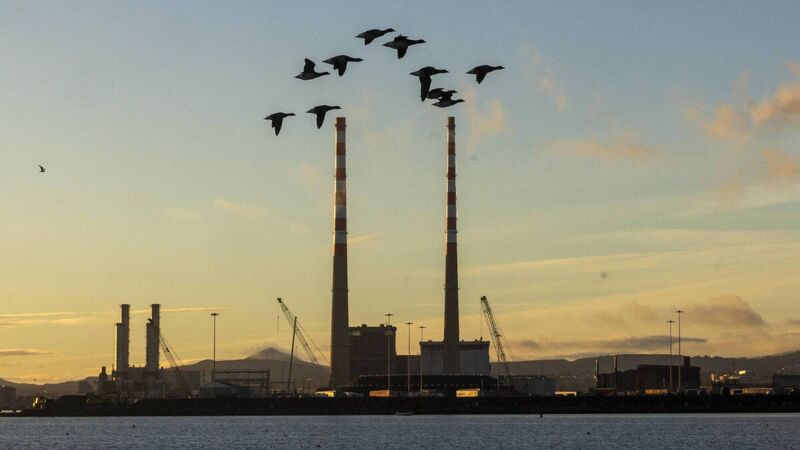
Brent geese flying in Dublin Bay. Picture: Tom Honan
Brent geese arrived late on the North Dublin coast this winter. They normally show up in October but only odd stragglers were present by early December. Small flocks joined them later in the month. Then the main 'goose army' arrived. Soon almost every grassy sward near the coast had a flock.
In shades of ‘back to the future’, this used to be the normal arrival pattern here: 50 years ago, no self-respecting brent goose would be seen off Malahide or Portmarnock until Christmas week.
‘Brent’ comes from Old Norse, meaning ‘burned’; these small grey-and- white geese resemble lumps of charred wood. Arriving from Arctic Canada in the autumn, they converge on Strangford Lough, to gorge themselves on eelgrass and green algae. When food stocks begin to be depleted there, they move on to estuaries all around Ireland. The delay in doing so was long-established. "In Dublin Bay, the great increase does not seem to take place until January or February" wrote Richard Ussher and Robert Warren in 1900. "It is evident that their numbers have greatly diminished," they also noted.
Brent, although scarcely edible, could be shot legally. With fewer than 6,000 of them remaining by mid-century, prospects for their continuing to ‘winter’ in Ireland seemed grim. But the worry was unfounded; geese are resourceful creatures. Following legal protection, their numbers recovered. Between 30-40,000 of them spend the winter in Ireland nowadays.
The pale-bellied brent goose, probably the world’s most northerly breeding bird, nests on remote uninhabited islands in Arctic Canada. Arctic foxes wolves, and the occasional polar bear, are the only mammals a gosling is likely to encounter. With large gulls also on the prowl, parents must keep a tight rein on their youngsters.
At the first signs of approaching winter, families join together in flocks and prepare to migrate southwards. In the first leg of a great journey, they cross Baffin Bay to Greenland. They can then head over the mountain spine of Mr Trump’s great ‘lump of ice’, or fly on down to Cape Fairwell, its southern tip a thousand kilometres away. On rounding the Cape, geese face a 900 kilometre crossing of the Greenland Sea to Iceland, where a welcome stopover awaits them. The final leg of the journey will take them on to Ireland, a further 800 kilometres across the turbulent Atlantic Ocean.
Devoted brent parents believe in education. They chaperone their youngsters throughout the journey, teaching them the migration route. Juveniles will stay close to the parents during their stay in Ireland. The return migration flight is a revision course.
White-fronted geese and whooper swans winter in remote locations, devoid of people. You might expect that brent, raised in most God-forsaken places, would do likewise. But they don’t necessarily. Many frequent cities. The constant presence of people, dogs, and cars fails to upset them. Flocks flying over central Dublin are now a familiar sight. Geese loaf in city parks sports pitches and golf links, often several kilometres from the coast.
Patty Hearst famously joined her captors. Hostages taken during an attempted bank robbery in Stockholm in 1973, bonded with their captors. Are city-frequenting brent, rubbing shoulders with us their traditional persecutors, suffering from a wildlife version of Stockholm syndrome?
CONNECT WITH US TODAY



Be the first to know the latest news and updates