January is the best month for astronomy — here's what to look out for
Our own galaxy, the Milky Way, is on a collision course with the Andromeda Galaxy. But, for now, and for the next 4.5 billion years, there is no threat
The skies in January are amongst the best for viewing all year and January 2026 is no exception. From occultations to close encounters, there is much to encourage us to step outdoors, away from the enticing warmth indoors.
Throughout the month the constellation of Orion rides high to the south, easily discernible by the three bright stars in the Hunter’s Belt.
To the top left of the belt, the planet Jupiter shines brightly with a yellow tinge.
To the top right is a close-knit group of stars called the Pleiades or Seven Sisters
It used to be said that you could test your eyesight by counting the number of stars visible to the unaided eye — a count of seven means you actually have better than average eyesight — but to make it a fair test you need to give your eyes about 15 minutes to adapt to the dark. The best nights to try this are around January 19 when the Moon is new. The skies will be particularly dark then and the stars will pop out from behind the black depths of the surrounding sky.
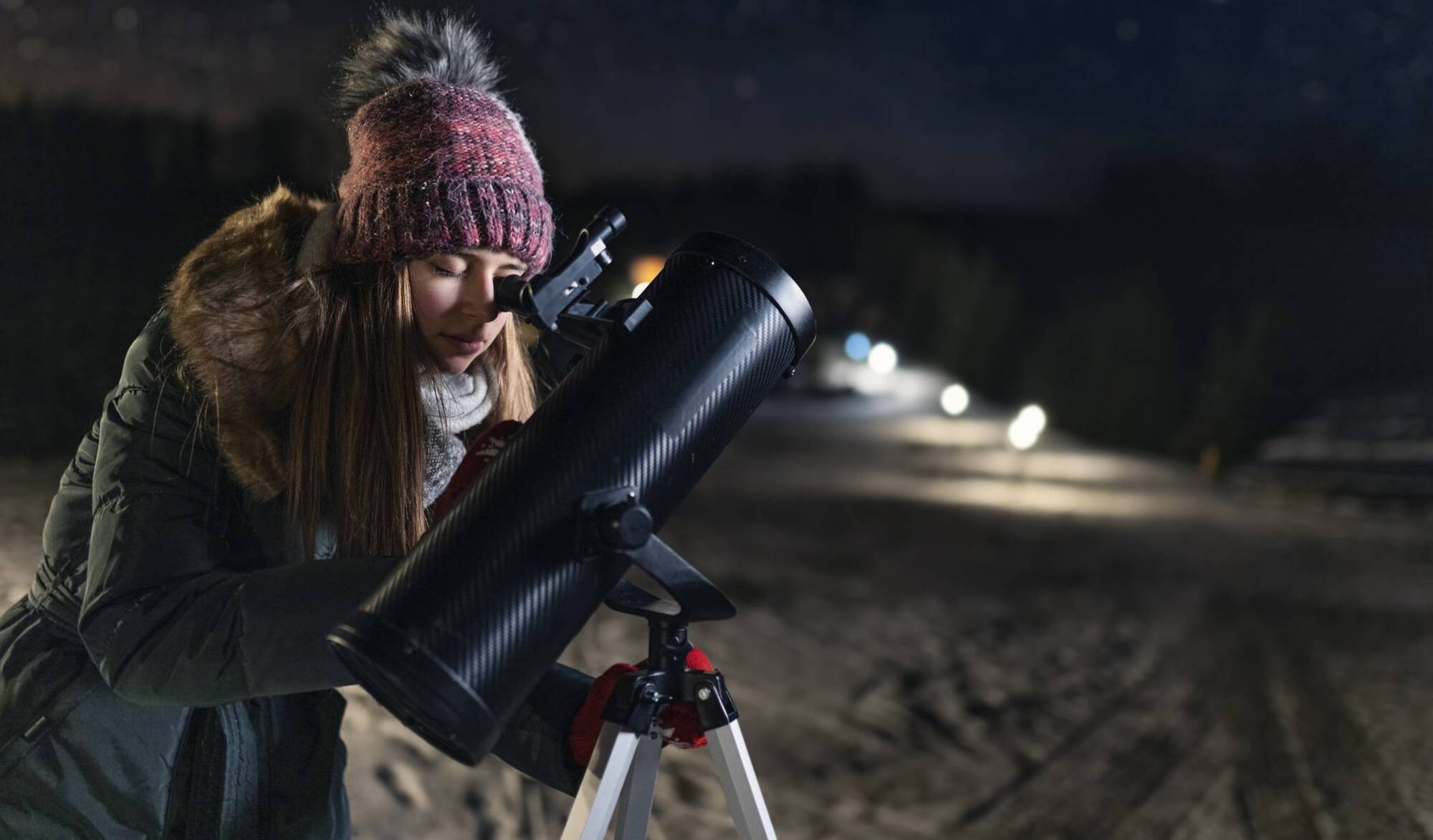
On January 27 the Moon will pass in front of some of the stars in Pleiades. This will be visible with just your eyes, but a pair of binoculars on a tripod or a small telescope will enhance this particular event.
We sometimes forget the Moon is constantly moving against the background stars as it orbits the Earth, and while the movement is relatively slow it’s appreciable when it passes in front of groups of stars such as the Pleiades.
This type of event is referred to as an 'occultation' and because the Moon has no atmosphere the stars in the Pleiades will seem to very suddenly 'disappear' behind the Moon. If the Moon had an atmosphere the disappearance would be proceeded by a slow dimming of the star. This is a technique that we can use whenever a distant planet is occulted by its parent star as a means to indicate the presence of an atmosphere, or not.
As the Moon continues its motion across the sky, it will make a close encounter with Jupiter on January 30 and 31. Well, at least it looks like a close encounter, but we know that Jupiter is actually 630 million kilometres away in early 2026, compared to the Moon’s distance of approximately 0.38 million kilometres. This should make for a very pleasant spectacle and a sure way to remove any doubt that you’re looking at Jupiter and not some bright star!
- We will catch previously undetectable stars exploding in distant galaxies, shining billions of times brighter for a few weeks before fading into permanent obscurity from our vantage point on Earth.
- We might detect the new elements forged in the last moments of the lives of these dying stars and wonder whether they will be building blocks of new planets in the distant future and perhaps provide a home to the life which might evolve there.
- We will measure ripples in the fabric of the universe resulting from the merger of black holes or neutron stars.
- We will watch what appear to be imperceptibly small changes as galaxies collide, knowing that for some stars and planets the collision will result in their destruction or ejection out into the cold space between the galaxies.
- We might spare a thought for our own galaxy, the Milky Way, which is on a collision course with the Andromeda Galaxy. But, for now, and for the next 4.5 billion years, there is no threat.
Whatever 2026 brings for us on Earth, somewhere out in the inky blackness of space are events that will surprise, enthrall and challenge us on so many levels.
- Niall Smith is head of research / head of Blackrock Castle Observatory, Munster Technological University, Cork