International project aims to decode whale communication
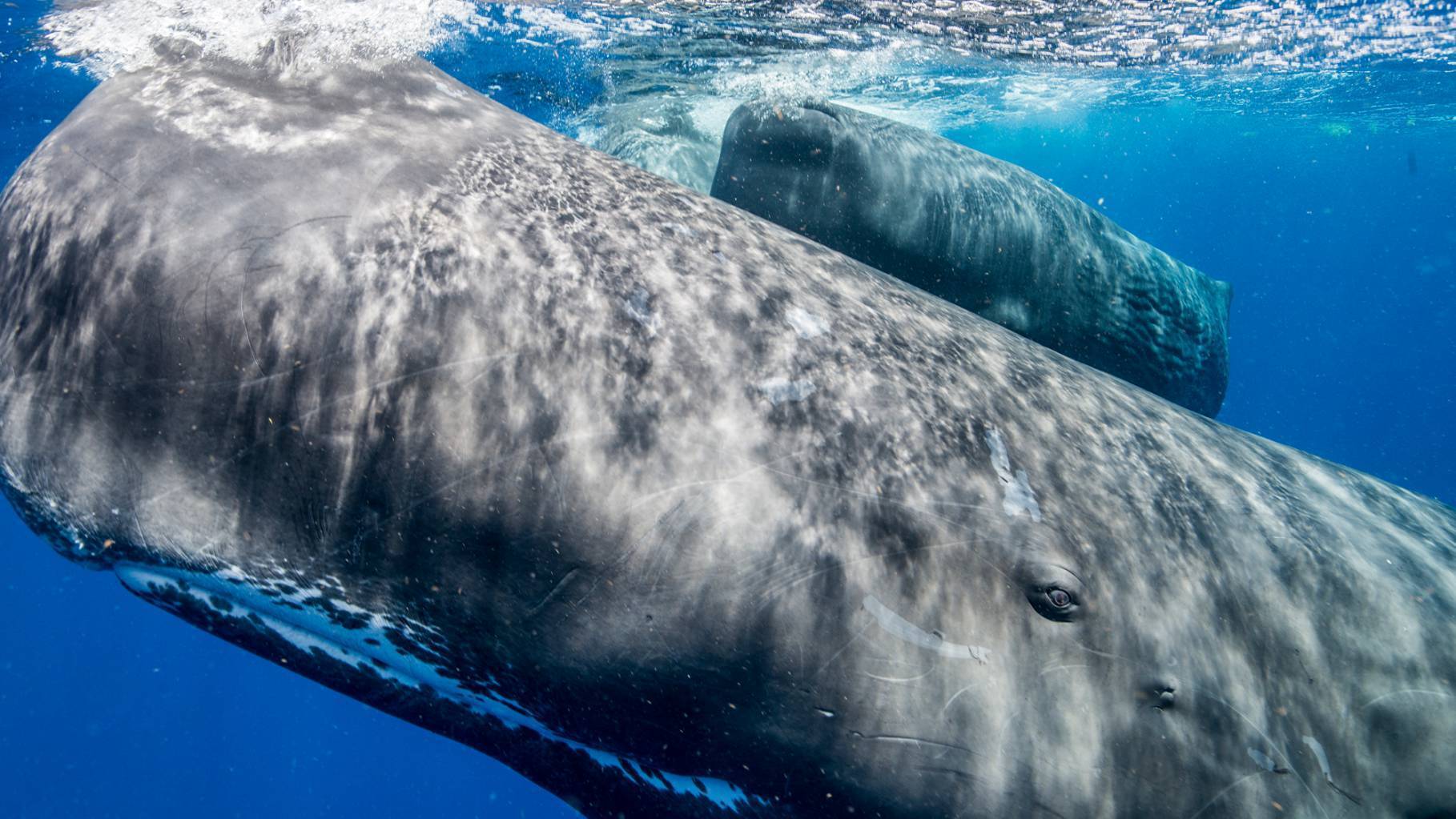
Sperm whales swimming off the coast of Dominica. The marine mammals have a complex communication system that scientists are working to decode. Picture: Amanda Cotton / Project CETI
Whales live in a world of sound. Not only are whales the largest animals on the planet, they’re also among the loudest.
Because seawater is much denser than air, sound travels both faster and farther underwater. Light fades quickly at depth, leaving visibility poor, so whales effectively 'see' with sound — reliant on clicks, whistles, pulses, and low-frequency calls to navigate, hunt, coordinate group behaviour, and maintain social bonds. The calls they emit can travel extraordinary distances through the ocean. Vocalisations are often complex and species-specific, much like birdsong, though resonate at far deeper pitches.
Humpback whales are especially famous for their long, patterned songs and mesmerising melodies. First recorded 50 years ago, recordings of whale song were a major factor motivating the global movement to ban whaling and begin ocean conservation initiatives to prevent the extinction of several endangered whale species.
But now we are beginning to understand how sound is the basis of sophisticated cetacean communication systems, far from being limited to immediacy of survival such as hunting and navigation.
Biologists studying the intricacies of the vocalisations of whales and other marine mammals are learning that their communications carry information about the species and their social context, the environment, the emotional state of the individual or the group, news about the world, and other meaningful exchanges of information between kin and community. As with us humans, language may be the basis of their culture.
For example, humpback whales in any given region have specific songs comprising of a patterned sequence of calls lasting 10 to 20 minutes, repeated again and again — sometimes for an entire day. Different social groupings have different songs, and differing approaches to courtship and social organisation. The nuances of what whales might be saying to each other is still in the realm of the unknown.
But imagine a future in which we could understand non-human animal communications. Where listening to animals’ perspectives, with technological assistance, could potentially transform how we understand the world, and as a result, how we behave toward non-human animals.
This is the remit of a developing field of scientific research called ‘Non-human Animal Communication Technologies’ or ‘NACT’. In the same way that large language models, otherwise known as AI, can write and translate human language, work is underway to record, analyse, and potentially translate animal communications.
Researchers have been applying pioneering techniques from disciplines that include ecology, marine biology, linguistics, AI and cognitive psychology to listen in to the sounds that whales make; search for and identify patterns; and discover the basic components of their communications.
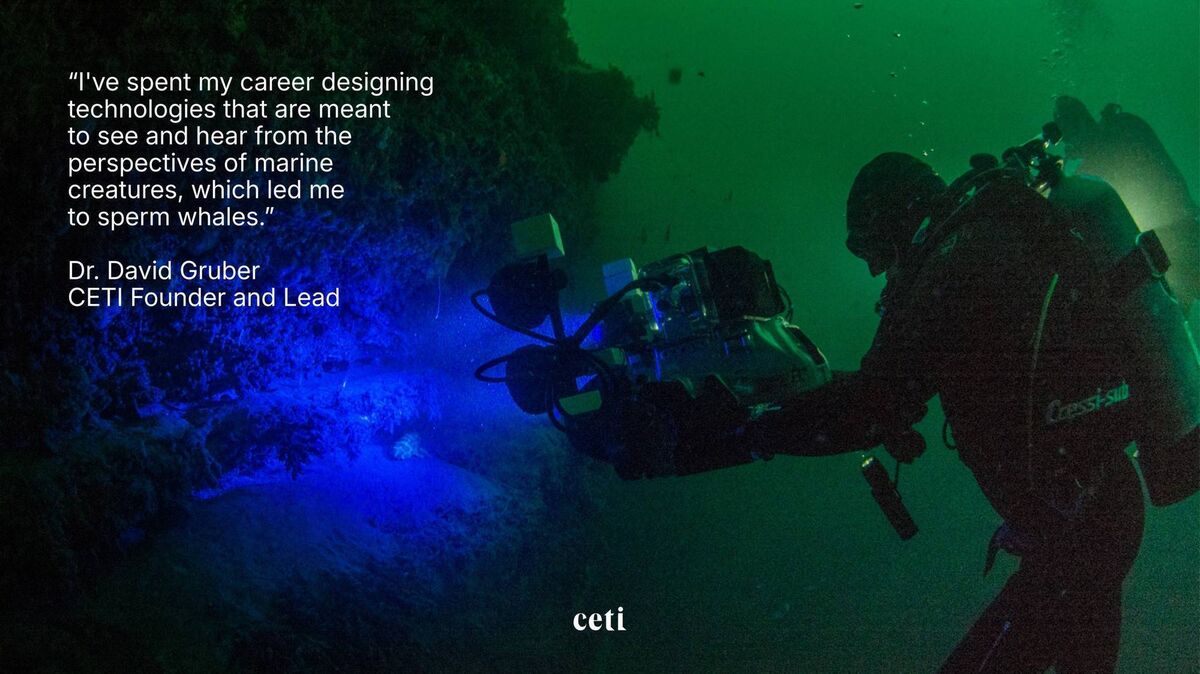
Pioneering in this endeavour is a non-profit research group called ‘ Project CETI’, incorporating several universities including The University of Oxford in the UK and Harvard and Berkley in the US. The current focus of the 50 leading scientists involved is to decode sperm whale communication.
Sperms whales are far less musical than humpback whales. They use a system of clicks that has been revealed to be a kind of phonetic ‘alphabet’ that sperm whales use, somewhat similar to morse code, in which sounds akin to vowels in human speech appear to form the basis of language structures for sperm whales. In November, further insights were published that reveal new levels of intricacy in their vocalisations, furthering our understanding about how vowels are exchanged in conversation, with variations of rising and falling frequencies which perhaps add nuance to the meaning of vowel combinations.
This is one of several recent findings revealing just how complex vocal communication in non‑human animals can be.
Across certain primate, whale, and bird species, researchers have uncovered vocal patterns and structural features once thought to be unique to human language. These discoveries are prompting scientists to rethink what truly sets human language apart — and even to reconsider how the very concept of 'language' should be defined. Some hope that this might ignite a new momentum in the global movement to protect both terrestrial and oceanic ecosystems, recognising that we humans are far from being the only intelligent species.
Some observers in the field predict that the capacity and technology to understand and talk back to non-human mammals will be developed by the end of the decade, just a few short years away.
But there are also enormous risks associated with NACT... for example exploiting animals for research, for tracking their prey, for other as yet un-thought-of commercial purposes in the realm of tech startups or military technologies. Understanding animals has significant ethical ramifications, both positive and negative. Being able to understand, end even potentially communicate with non-human populations could cause huge harm to long-established social structures, culture and behaviour, for example.
Grappling with the risks, an interdisciplinary team in New York University has developed a set of principles to guide the ethics Non-human Animal Communication Technologies. This guide has just been published by the More-Than-Human Life (MOTH) Program based in the New York University. It is a suite of legal and ethical principles is to ‘help us listen to our animal kin and reconnect with the more-than-human world’ within a framework that aims to ensure that these technologies do not instead become instruments of further harm.
Everything is to play for. As our ability to communicate with whales and other non-human animals develops, we will better understand the risks and potential benefits. But will we interpret our animal kin with characteristic arrogance and self-interest, using such technologies to enhance our capacity to exploit and annihilate? Or will we proceed within carefully considered ethical frameworks?
If approached with care and empathy, there is hope that NACT could bring us to understand alternative perspectives about the life around us and our place in the world. It presents opportunities for restructuring our relationships with the non-human animal world and might even bring us closer to a less destructive and more harmonious co-existence.

CONNECT WITH US TODAY



Be the first to know the latest news and updates