A beach walk with a little more — explore your shore
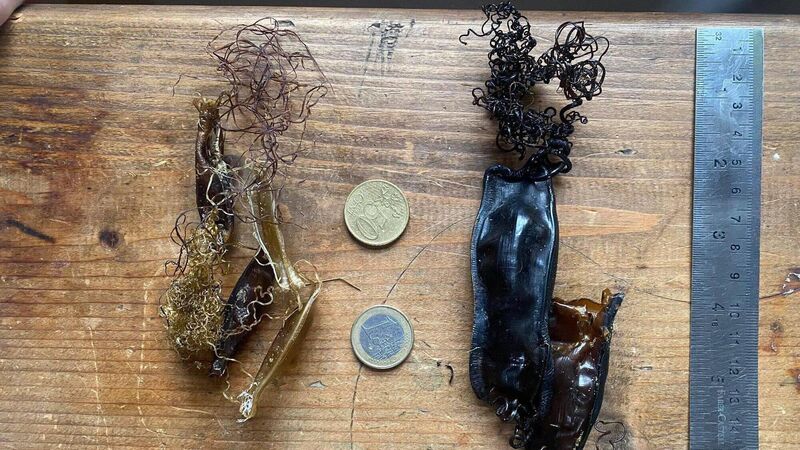
Two types of mermaids purses found on Kilcoole Beach in Wicklow by Brían McGloinn — photographed for logging with citizen science survey ‘Purse Search Ireland’
One of the real gifts of the silly season is the chance to take a little time out from the daily routine. In the gap between Christmas and the New Year, we are granted a little window of reprieve, an opportunity, perhaps, to spend a day exploring the outdoors.
Because I don’t live by the sea, I especially adore excursions to the coast. I find that seascapes tend to induce a reflective frame of mind: watching the textures and colours of sky, sea, and sand changing as the moments morph, patterns appearing and disappearing with perspective; intriguing flotsam and jetsam appearing along the way.
And with winter storms, all sorts of intriguing oddities and oceanic treasures can get dislodged from the seabed and washed ashore: gleaming shells, impressive fronds of sugar kelp, rare ‘sea beans’, plastic debris, and the soggy bodies of seabirds. Such curiosities offer glimpses into some of the wondrous creatures that live out at sea, lives governed by salty waves, worlds beyond the scope of our terrestrial everyday.
This winter, records of your beach finds are sought by the ‘Big Beach Biodiversity Survey, ‘Explore Your Shore!’ — a national citizen science survey run by the National Biodiversity Data Centre.
Everyone visiting an Irish beach this winter is invited to participate by recording marine species found cast up on the beach by tides and storms.
Top 100 Explore Your Shore! species - #57 - Variegated Scallop / Cluaisín Garbh / Chlamys varia is found cast ashore on beaches or in nooks and crannies on the lower rocky shore. Shore: sandy or rocky. Distribution: all coasts. https://t.co/OZBWhasHZR pic.twitter.com/SA7x5TUyPh
— Biodiversity Ireland (@BioDataCentre) December 23, 2025
Apart from the personal satisfactions of finding things and then deciphering what kind of creature they might come from, the Big Beach Biodiversity Survey collates the information in a way that makes it useful for scientists to better understand the ecosystems beneath the waves.
By receiving good data from around the country, marine experts can map the distribution of oceanic species around the Irish coastline and find out what species might be where at different times of year. Over time, this can even assist in monitoring changes in the distribution and occurrence of marine species linked to climate change and water quality.
In practical terms, participating in the Big Beach Biodiversity Survey simply requires that you go to a sandy or cobble beach about one or two hours before low tide, and particularly in the days after a storm. You can take a printout of the survey form to help you keep track of the information you collect. Walk the beach with an eye out for shells, seaweed, and marine creatures, whether dead or alive, and your phone camera ready to photograph your finds. Using an item such as a coin will help record scale. In this survey, commonly occurring species are just as welcome as rarities, whether it’s a dead crab, some seasnails, or an assortment of seaweed fronds.
You don’t have to be able to identify the species, but do take good photos and measurements. I always enjoy looking up new finds in my old trusted (By Lucy Taylor and Emma Nickelsen, Collins Press) which contains everything from fish to crabs to seashells to most of the seaweeds you’re likely to find along Irish shorelines too.
Pearly white oyster shells are fairly ubiquitous, though you can look more closely to see if the oyster shell is of a pacific oyster, a native or even a saddle oyster. Banded wedge shells, carpet shells, Icelandic Cyprine, smooth artemis and tellins are all bivalve shells that look similar, though each has its own characteristics to examine for.
Similarly, while common mussels are, as their name suggests, common, the similar looking larger shells of horse mussels are seen less often, as this species is in decline around Irish coasts. Reefs of horse mussels are easily destroyed when fishing gear is dragged along the seafloor.
Just today a friend sent me photos of some mermaid’s purses he had found on a walk along an east coast shingle shore, curious about what species they might belong to. Mermaid’s purses are small, leather-like pouches, egg cases laid by members of the shark family, which includes sharks, skates, rays and catfish. This group of animals have many different birthing techniques — some species give birth to live young; others lay eggs in egg cases that protect the developing embryo inside. When washed ashore, we know these egg cases as 'mermaid’s purses'.
The egg cases of each species are distinctive and recognisable, as with bird’s eggs. Some have curly tendrils at each end, others are edged with smooth straps with which the mother shark, skate or ray attaches the mermaid’s purse to some kelp or other anchor on the seafloor.
Pouches can be just a few centimetres long or larger than a human hand, again depending on the species. Finding a mermaid purse indicates the presence of nursery habitat for Ireland’s egg-laying sharks, skates and rays offshore, of which there are more than 50 different kinds in Irish waters.
Many species of skate and ray are now endangered in Irish waters, a result of fisheries bycatch and destruction of their nursery habitats by bottom trawling. Thus, logging any mermaid’s purses you find makes a valuable contribution to conservation science, helping gain a better understanding of where nursery areas are in order that they can be protected from bottom trawling and other damaging activities.
To log your find, go to Purse Search Ireland — Explore Your Shore!
What a wonder to be able to discover so much from simply strolling along the shore, looking out for clues of the life all around, and contribute to marine conservation, even in the midst of stormy winter weather.
- Anja Murray's most recent book also features information on sharks, skates and rays and their electrical senses!