Tercentenary of the father of modern geology coming up in 2026
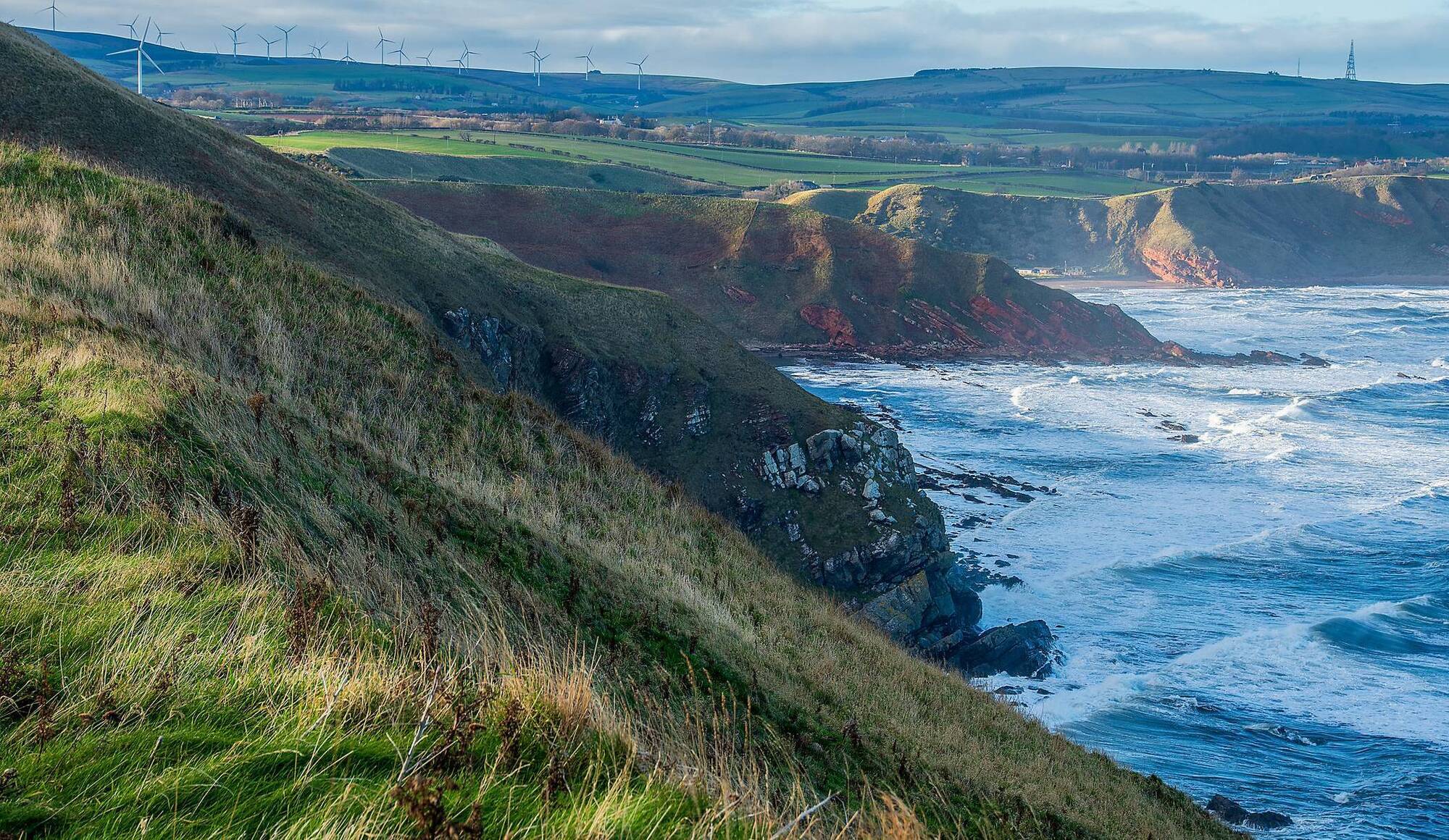
View of cliffs and water of the Firth of Forth from the Siccar Point in Berwickshire, Scottish Borders. Siccar Point is famous in the history of geology for 'Hutton's Unconformity' found in 1788, which James Hutton regarded as conclusive proof of his uniformitarian theory of geological development
‘We find no vestige of a beginning, no prospect of an end’ — James Hutton,
Which great naturalist will we celebrate in 2026?

One who flourished during the Scottish Enlightenment comes to mind. June 3 next will be the 300th anniversary of the birth of James Hutton, ‘the father of modern geology’.
Hutton was born in Edinburgh of well-to-do parents. Having studied law and medicine, he became a modernising farmer. He never married but fathered a son whom he supported financially, though not emotionally. An appallingly bad writer, he was deemed to have been ‘entirely innocent of rhetorical accomplishments’. Ironically for a celebrated geologist, stones in the bladder led to his death.
During the late 18th and early 19th centuries, Edinburgh became ‘the Florence of the North’. The great Scottish philosopher David Hume ‘awakened Immanuel Kant from his dogmatic slumbers’ and Adam Smith penned . In the presence of such luminaries, Hutton’s contribution to the Scottish Renaissance can easily be overlooked.
Aristotle thought that the world was eternal. Aquinas, whose doctrines would become the unofficial party-line of the Catholic Church, inherited this idea. We know, ‘the angelic doctor’ taught, that the universe had a beginning in time only because divine revelation told us so.
The Bible was still the authority on Earth’s chronology in Hutton’s day.

Having worked through its chapters two centuries previously, James Ussher, Church of Ireland Archbishop of Armagh, decided that God had begun his creation on October 23, 4004 BC. Rocks, therefore, must all date from then. To challenge the Genesis account of creation amounted almost to blasphemy.
The ‘Catastrophists’ thought that the Earth was the product of cataclysmic events interspersed by long stable episodes.
The ‘Vulcanists’ held that the planet had been shaped by volcanic eruptions.
‘Neptunists’ argued that it had crystallised from the rising and falling of ocean levels. Fossils found high in mountains confirmed this. Were they the remains of creatures which drowned during Noah’s Flood? Had they been planted by the Devil to lead us astray, or by God to test our faith?
William Buckland, the first person to describe a dinosaur, tried to reconcile biblical chronology with the new geological evidence, but the planet was clearly much older than the Genesis narrative allowed.
But how old was it and how had it come to exist?
Examining the landscapes of his native Scotland, Hutton concluded that rock formations could not be static; they changed slowly over immense periods of time.
In 1788, he took a boat trip at Siccar Point, a rocky promontory on the east coast of Scotland. Marine sandstones there, which we now know are 440 million year old, had been overlain by terrestrial sandstones 65 million years later. For Hutton, here was proof that the Earth was the product of gradual change taking place over ‘deep time’. His ‘Uniformitarianism’ led to his being called ‘the Discoverer of Geological Time’.
Although Hutton believed that fossilised creatures has remained unchanged since their creation, his uniformitarian geological doctrines would influence biology even more profoundly. In the hands of Lamarck Russel-Wallace and Darwin, evolution would prove to be one of the most revolutionary notions of modern times.
- Scottish Geology Trust is aiming to build a 'Deep Time Trail' at Siccar Point to celebrate James Hutton and one of the most important geoheritage sites in the world. Donate to the Crowdfunder here.