Are we prone to contagious urination and have we inherited peeing behaviours from chimpanzees?
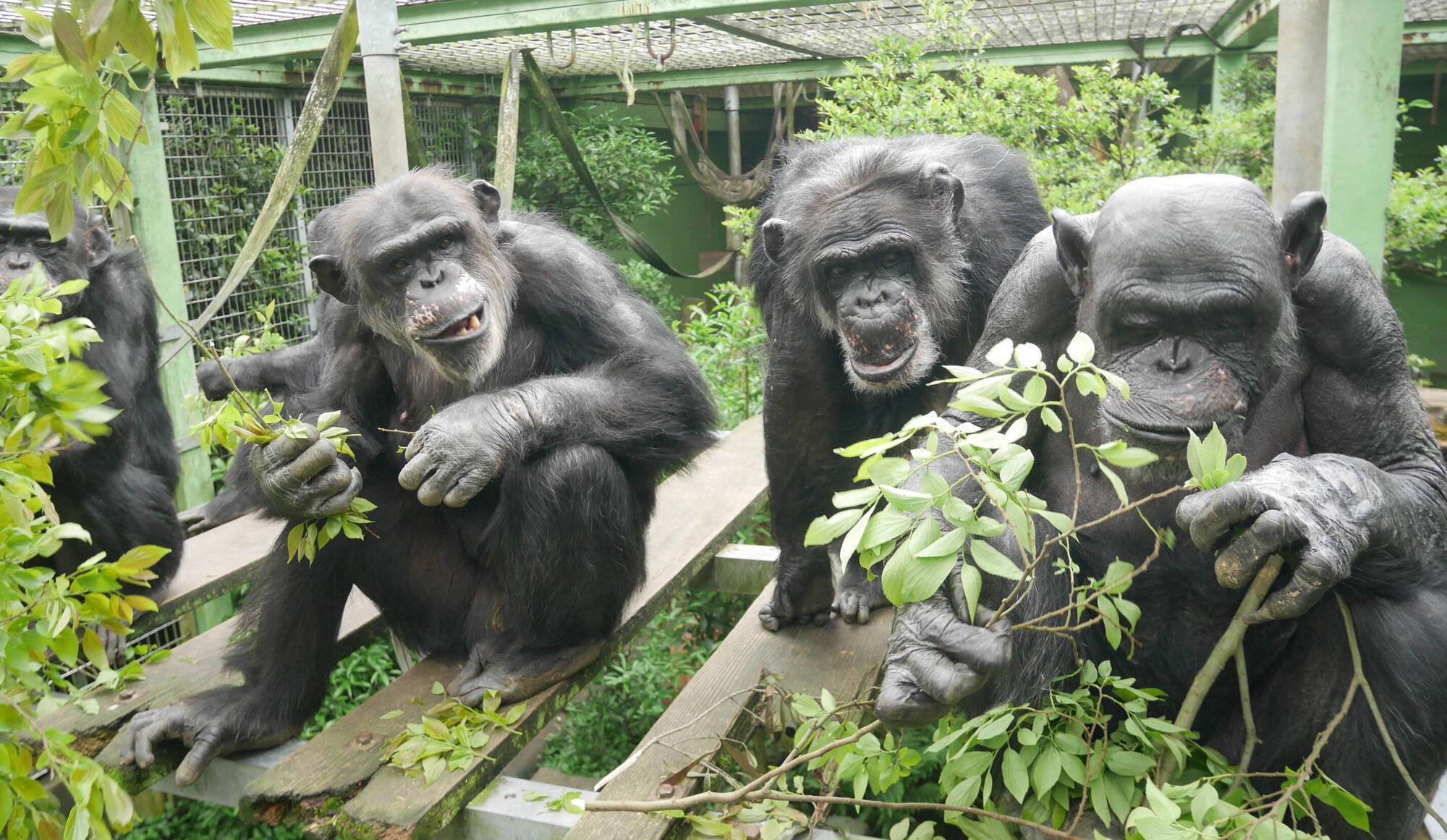
We shared a common ancestor with chimpanzees, our closest animal relatives, around six million years ago. Could we have inherited such a tendency, now dormant, from our primate forebears? Picture: Onishi et al.
Seeing someone yawn makes you want to yawn too. Laughing, sneezing, and scratching can also be socially triggered. But are we prone to what behavioural scientists call ‘contagious urination’?
It seems unlikely that we are... what purpose could peeing at the same time as somebody else serve? Urine carries valuable social information but we humans lack the nasal sophistication to unlock its secrets.
Synchronised peeing may be of little direct benefit to us, but do social excursions to the loo have a grapevine role? Do they offer a convenient excuse for sensitive gossipy exchanges, especially as members of the opposite sex are not present. Things can be said, under such license, which couldn’t be aired at the dinner-party table.

Film-makers know this. They love close-up double-image ‘takes’ of ladies applying their lipstick while exchanging juicy gossip in front of bathroom mirrors.
In the male cinematic equivalent, men are depicted facing the wall side-by-side at urinals, bowed as though expecting a coup de grâce bullet to the back of the head. During these Greek-chorus-style moments, conversations reveal hidden aspects of the plot to the movie audience. What is said in the course of such visits, at least in films, has an authenticity absent from the restrained comedy-of-manners chatter of the dinner table.
‘In vino veritas’, declared Pliny the Elder. Wine not only reduces inhibition, it stimulates the urge to urinate, thereby revealing hidden truths.
Dogs don’t pee upon seeing other dogs do so, but they have alternative urinary triggers. Raising the leg at lampposts is a doggy addiction. Your pet craves his daily 'who’s who update', access to the latest tail-wagging, rather than tongue-wagging, gossip, on his street equivalent of the internet.
Nor are dogs, cats, and polar bears the only pee-sniffing animals. Such behaviour is widespread among mammals. Contagious urination enhances information flow.
We shared a common ancestor with chimpanzees, our closest animal relatives, around six million years ago. Could we have inherited such a tendency, now dormant, from our primate forebears?
A new study shows that peeing is contagious in chimpanzees, making it “the first study to investigate contagious urination in animals, including humans,” says Shinya Yamamoto, an animal behavior scientist.https://t.co/psP1z7isR1
— Science News (@ScienceNews) January 24, 2025
Ena Onishi, of Tokyo University, monitored the behaviour of 20 captive chimps at Japan’s Kumamoto Sanctuary. During more than 600 hours of observation, over 1,300 urination sessions were logged. Those taking place within 60 seconds of each other, she deemed to be ‘contagious’. In a paper just published she and colleagues reveal the results of the experiment.
They show that peeing by chimps tends to be triggered ‘slightly more frequently’ by seeing, or hearing, another individual pee.
Also, the closer a chimp was to a urinating companion, the greater the likelihood that it too would pee.
Chimp society, like our own, is hierarchical. Individuals low down in the social pecking order are prone to imitating the peeing behaviour of their betters higher up.
The experiment shows that primates exhibit contagious urination. It seems possible, therefore, that we humans have inherited such a tendency from our animal ancestors. Onishi is cautious, however, about her findings — she concedes only that "our results suggest that contagious urination may be an overlooked, and potentially widespread, facet of social behaviour".
CONNECT WITH US TODAY



Be the first to know the latest news and updates