Islands of Ireland: Ballingarry — scene of sieges, slaughter and imprisonment
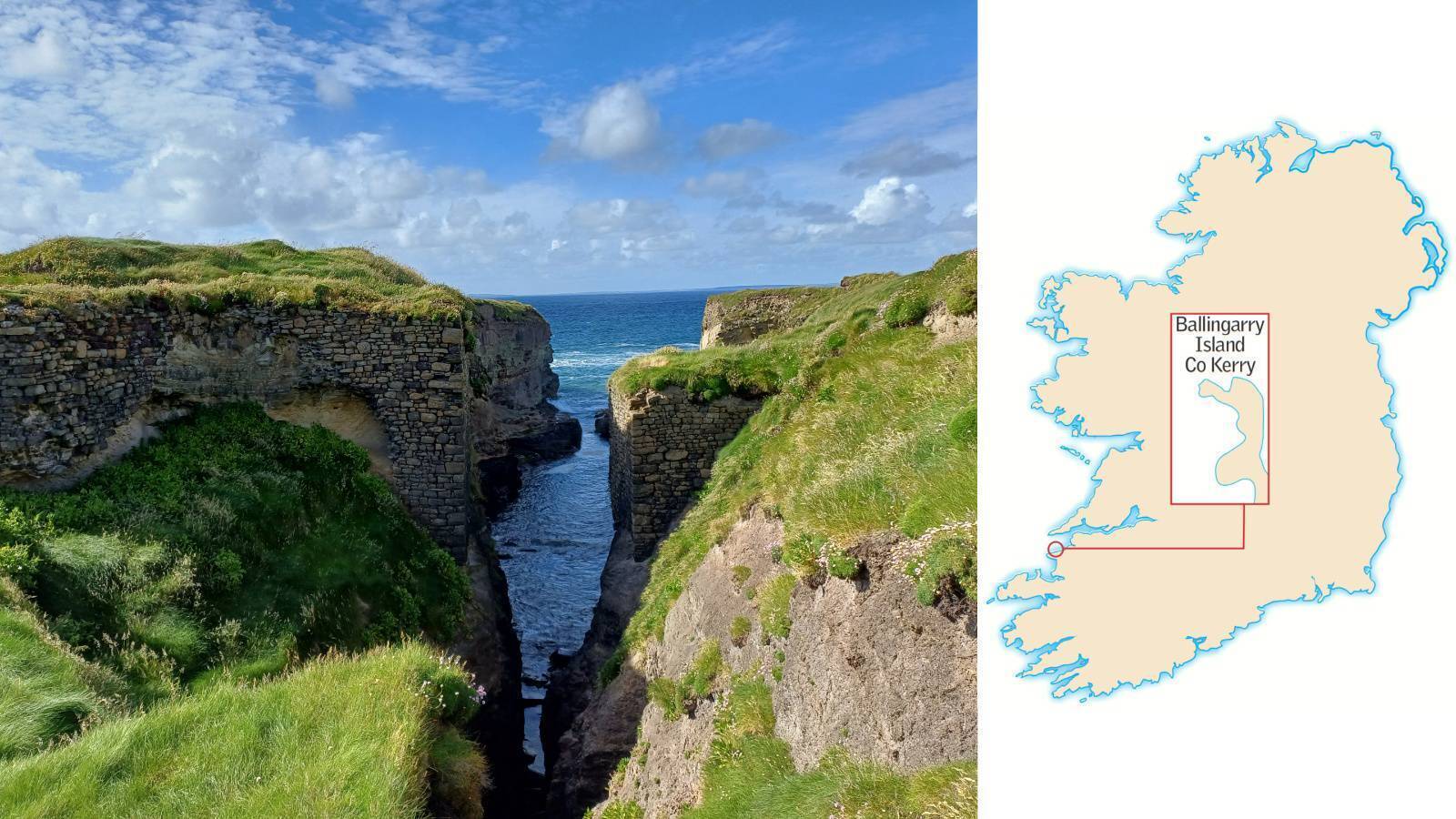
Ballingarry drawbridge, Kerry. Picture: Dan MacCarthy
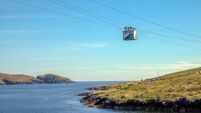
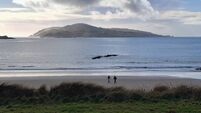
The northwest coastline in County Kerry mainly consists of downward sloping farmland to cliffs where the usually rough seas surround some very small islands and sea stacks. It is a coastline as dramatic as anywhere in the country with its caves, sea arches and waterfalls but it is well off the beaten track and tourists are few and far between. There are the remains of several Iron Age promontory forts there from where the occupants watched for any invasion by sea. There are also the ruins of a few castles including Brown’s Castle, Castle Shannon — and Ballinagarry Castle sitting just beside the eponymous Ballingarry Island.

The castle comprises an entire complex including a castle which is linked to an enclosure of eight buildings by subterranean passage. It also had a drawbridge and sheepfold. The name translates as ‘the Town of the Garden’ and its buildings of red sandstone are shown on the 1841-42 OS map The original castle dates to 1280 and was built by the Norman Cantillon family. By 1585 all of these lands were granted to a George Isham, “who left the occupants undisturbed, taking only the head rents”. In 1603 the castle was besieged and Gerald Mac Morris, who surrendered, was executed.
By the time of the Cromwellian wars in the 1640s, Ballingarry Castle came under the ownership of a colonel David Crosbie who rebuilt the castle and retreated there with several English families “to avoid the fury of the Irish”. He expanded the defences and built a fortified drawbridge the walls of which are still intact. Crosbie was supported by his friend Lord Inchiquin of Clare, who victualled the garrison.
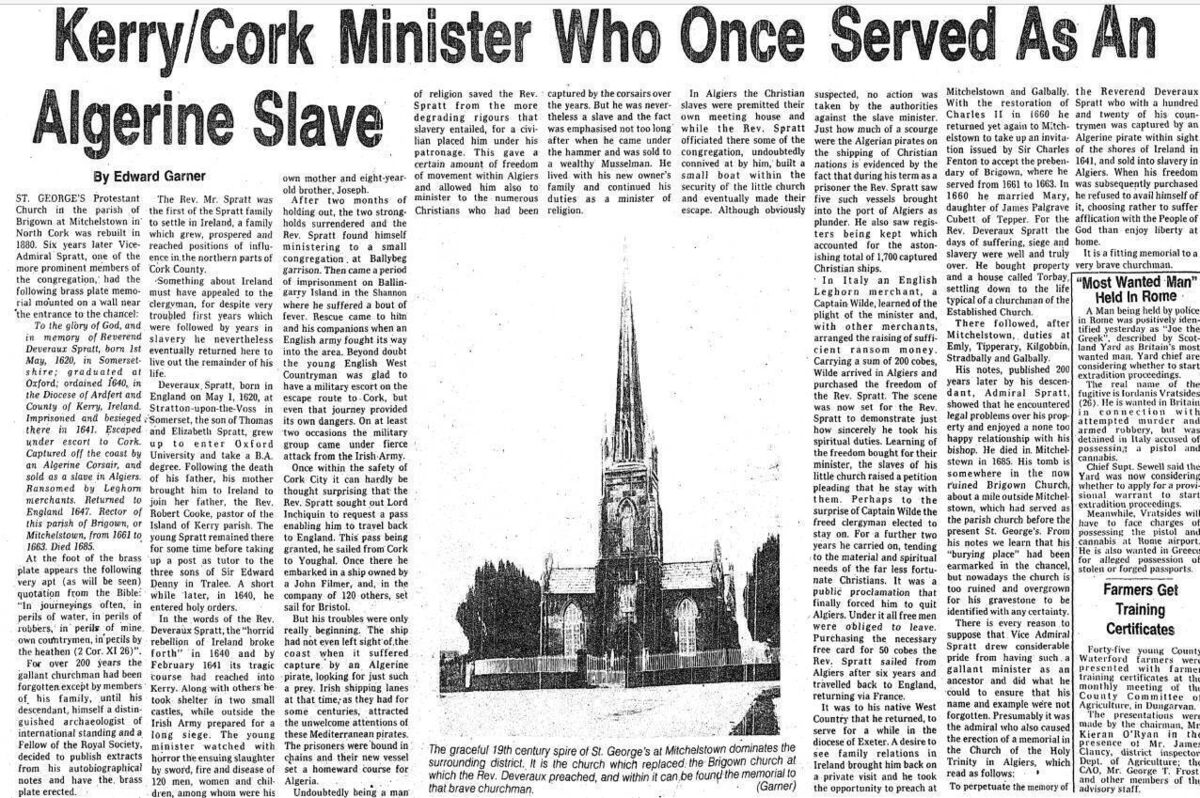
In 1641, the castle received as a visitor... a certain Deveraux Spratt aged 21 who was to lead an extraordinary life. Deveraux was born in England but moved to Kerry with his family to train as a Protestant minister in Tralee. As the Cromwellian war began to engulf the country Deveraux witnessed a terrible sight: “The young minister watched with horror the ensuing slaughter by sword, fire and disease of 120 men, women and children among whom were his own mother and eight year-old brother Joseph.” Deveraux was then imprisoned in Ballinagarry Castle where he fell into ‘a feverish state’. By now the English army had fought its way to the castle and Deveraux made plans for a return to England after a sojourn in the relative safety of Cork. He then secured passage on a ship to Bristol from Youghal but it was a case of from the frying pan into the fire. Ten years after Algerian pirates raided Baltimore and carted off 100 of the occupants, Deveraux and his fellow passengers were abducted by the Algerians who were still raiding up and down the coast. They were brought directly to Algiers.
According to the writer Edward Garner “undoubtedly being a man of religion saved the Rev Spratt from the more degrading rigours that slavery entailed for a civilian placed him under his patronage”. Despite being a slave he was allowed to continue his religious practices. Through the bustling trade links to southern Italy an English captain named Wilde heard of the plight of Deveraux and promptly sailed to Algiers and paid a ransom to secure his freedom. However, Deveraux refused to abandon his parishioners before eventually being obliged to leave six years later.
The next stage in his incredible life saw him return to England but he later decided to relocate to Ireland where he married and took up his ministry in Mitchelstown, County Cork and Emly and Galbally, County Limerick.
There was a memorial to Devereaux Spratt erected by a relative in the church at Brigown near Mitchelstown which was later replaced by the church of St George. The plaque includes a biblical quote: “In journeyings often, in perils of waters, in perils of robbers, in perils of mine own countrymen, in perils by the heathen 2 Cor. XI 26.”
A very interesting footnote to the tale: While in Algiers, Spratt claimed to have seen registers detailing the capture of 1,700 ‘Christian ships’.
: About 4km directly north of Ballyheigue, County Kerry. Ask permission as the island is on private land.
: Geohive.ie/mapviewer; archaeology.ie; logainm.ie; Evening Echo 07/02/1979
CONNECT WITH US TODAY



Be the first to know the latest news and updates