Islands of Ireland: Skull Island — a better name for this Cork island featuring a ruined mortuary chapel and graveyard?
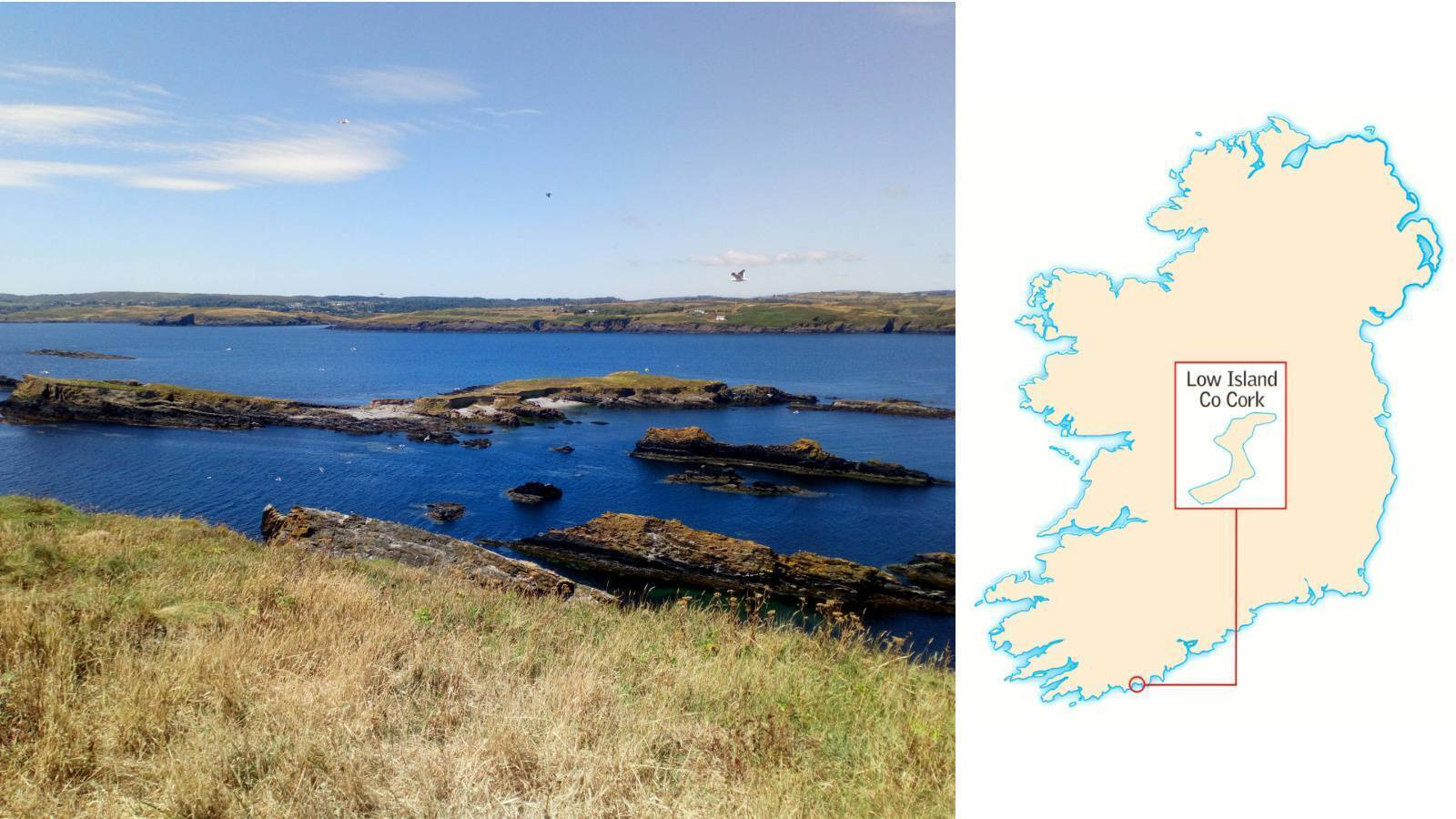
Low Island, County Cork with the entry to Castlehaven Bay in the background and High Island in the foreground. Picture: Dan MacCarthy for outdoors
There are a number of islands off the historic village of Castletownshend in West Cork and all but one of which have appeared here. The exception is the undramatically named Low Island which surprise, surprise, has High Island as a companion.
The two islands are frequented by grey seals and occasionally a huge bull seal announces himself with an intense gaze and presence. With trepidation, the nervous kayaker moves on. At up to 300kg and a 2metre body length this is a potential encounter best avoided.
Low island is effectively two islands joined in the middle by a strand. The tops of the islands have small pleasant meadows where sea thrift thrives.
Geology students would benefit from a trip here to see dramatic folds in the rock of crushed shale. A tall sea arch provides a window to the wide Atlantic and an entry to the interior for the pulverising waves.
The northern part has an area where an outline of dark foliage including ivy suggests a manmade structure of some sort. A graveyard perhaps. The answer lies in the Ordnance Survey maps of 1842 though it records an entry for the southern part of the island (but this is not necessarily accurate).
The record states: “On narrow neck of land at south side of Low Island. Named 'Old Grave Yard' on OS 6-inch map (1842). According to Burke (1914) there was also a 'mortuary chapel there'. No visible surface trace survives”.
The story of the graveyard is connected to one of the most important periods in Irish history. The Battle of Kinsale saw victory for Queen Elizabeth’s army in 1601-2 and the end of the Gaelic order. While the main battle occurred at Kinsale, a Spanish supply force of six ships under the command of Don Pedro de Zuibar landed at Castletownshend (or Porto Costello as they knew it) in West Cork. The English dispatched Richard Levison from Kinsale to scupper the Spanish. The Spaniards were guided into the harbour by members of the O’Driscoll clan who promptly ceded their castle to their guests as they did also in Baltimore.
The Spanish transport ships were no match for the English battle ships and immediately three of them were sunk and three others were driven onto the rocks. Cometh the hour, cometh the man. The Spanish were saved by the arrival of their ally Donal Cam O’Sullivan Beare who arrived with 500 men, writes the author Peter Somerville Large. De Zuibar was now able to take cannon from his ships and attack the English from the shore.
The Spanish erected a battery and launched a counterattack on Levison. Accounts of the ensuing slaughter vary with the highest estimate of English losses at 575 and many other Spanish and Irish. “During this time he [Levison] received 200 shots in his masts, hull, and rigging, but the wind taking a favourable change he warped his vessel out of the harbour and returned to Kinsale in a very shattered condition.” The battle was won but the war was lost and five weeks later the English were victorious at Kinsale. There was one more role for Castlehaven in proceedings as the Gaelic leader Red Hugh O’Donnell sailed from there to Spain to solicit more help from the king of Spain.
Somerville Large has written that he was informed by a local that on occasion the skulls would come tumbling out of the side of the graveyard, such was the erosion.
There are suggestions that the graveyard on Low Island is pre-Christian in origin. Possibly, but it likely also had the graves of English and Spanish sailors imposed on top of it. Neighbouring Horse Island also has an ancient graveyard and it is possible more sailors were buried there. The majority, it can be assumed, went to 'Davy Jones’s locker'.

Archaeology.ie has also recorded a hut site of indeterminate age on Low Island, suggesting that someone may have eked out a living there.
Low Island (Oiléan Íseal) is an unimaginative name, as suggested above, perhaps Skull Island would have been more appropriate.
: No ferry. Kayak from Squince Harbour or a small beach at the mouth of Castlehaven Harbour. Nearby islands include Stack of Beans, High Island and Rabbit Island.
: archaeology.ie; heritagedata.maps.arcgis.com; Southern Star 15/10/1904