Richard Collins: Migration timing is crucial — so what happens if birds travel too early or too late?
Pity the poor migrants arriving hungry and exhausted after an arduous journey, only to find that the locals have eaten the lion’s share of the creepy-crawlies and commandeered the best nesting locations
Richard Collins: Migration timing is crucial — so what happens if birds travel too early or too late?

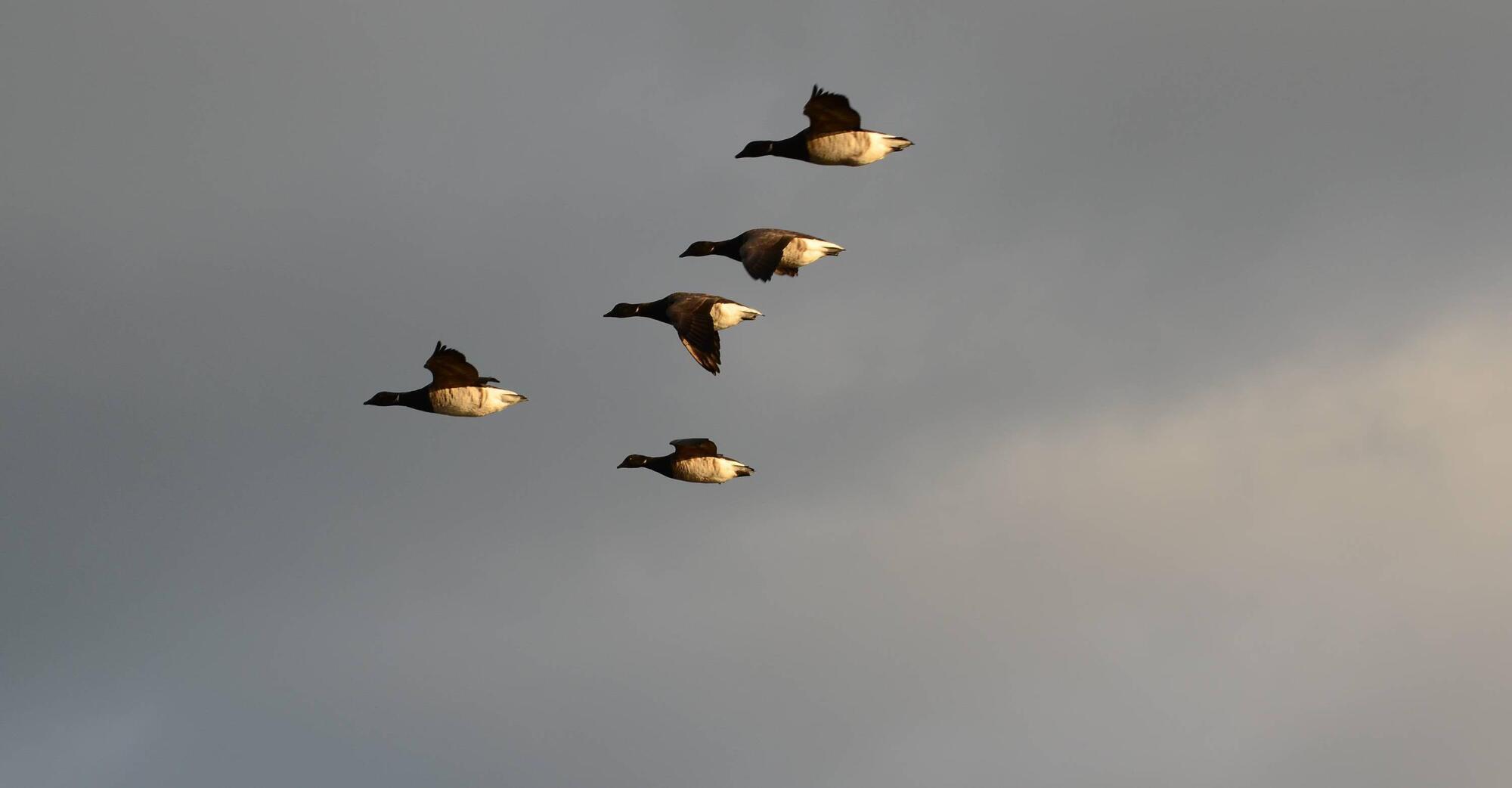
Brent Geese nest on the islands of the Canadian Arctic and then embark on a 6,000 kilometre journey to Ireland

To everything there is a season and a time for every purpose under heaven

The writing is on the wall for frequent flyers: air travel must be curtailed if we are to tackle the climate problem. The greenhouse gas emissions from aircraft are unsustainable. But we won’t be the only species having their wings clipped — migrant birds have a problem also.

‘Spring in the UK arrives a month earlier than in the 1980s’ was the title of an article in the Scientific American last year.

Flowers are blooming a month earlier than ‘normal’.

The seasonal shift also affects birds. According to a UCLA and Michigan State University study, just published, birds are raising fewer young than they used. The earlier arrival of spring, it seems, is to blame — many birds, and the creatures they eat, can’t adapt to climate change quickly enough.

The researchers studied the migration dates of 41 bird species ringed at 179 sites in North America over 16 years. They correlated them with laying dates and maps of vegetation-change obtained from satellites. By the end of this century, they estimate, spring will begin 25 days earlier than in the recent past. Birds, however, will start egg-laying a mere seven days earlier. Overall, their breeding productivity will decline by about 12%.

The problem is particularly acute for migrants. A bird, wintering far away, can’t tell what conditions are like in its distant breeding location. Relying on local cues, it may migrate too late. 

"Bird breeding phenology is failing to keep up with climate change," the authors say.

An Irish Light-Bellied Brent Goose. Picture: Wildfowl and Wetlands Trust

Timing problems predate the recent global temperature rise. Brent geese, for example, have a swings-and-roundabouts approach to breeding. Having nested on the islands of the Canadian Arctic, they embark on a 6,000km journey to Ireland.

The numbers of goslings in the winter flocks here vary wildly. In some years, there are many family parties, each with several goslings. In other years, there are hardly any youngsters. Like the cows in Pharaoh’s dream, years of plenty compensate for years of failure: successful breeding years make good the losses in leaner ones.

Timing the spring migration is crucial for Brent. If the geese, having flown from Ireland, arrive in the Arctic too early, the terrain will still be frozen; food won’t be abundant enough to form eggs and any youngsters that do hatch may starve.

If, on the other hand, the geese arrive too late, winter weather may set in before the juveniles are strong enough to migrate. Global warming isn’t to blame in this case — Arctic weather is notoriously unstable.

But it’s an ill wind that blows nobody good — ‘The early bird catches the worm’.

Species staying at home throughout the winter may benefit from earlier springs, giving them a head start over their late-arriving migratory cousins. Without competition from the blow-ins, residents can gorge themselves. Multiple broods may be raised.

Pity the poor migrants arriving hungry and exhausted after an arduous journey, only to find that the locals have eaten the lion’s share of the creepy-crawlies and commandeered the best nesting locations!

x

CLIMATE & SUSTAINABILITY HUB

More in this section

Revoiced

Newsletter

Sign up to the best reads of the week from irishexaminer.com selected just for you.

Cookie Policy Privacy Policy Brand Safety FAQ Help Contact Us Terms and Conditions

© Examiner Echo Group Limited