Rock of Dunamase is a once-mighty medieval fortress just off the motorway

The Rock of Dunamase. Pictures: Neil Jackman
There is a certain Tolkien-esque feeling when you first spot the Rock of Dunamase perching above the well-tended plains of Laois.
Much of what can be seen today is the shattered ruin of a once-mighty medieval fortress, but the site has earlier origins. It first appears in recorded history when the abbot of Terryglass sought shelter here in AD 844 when it was a fort known as Dún Masc. The defences of this earlier incarnation did not hold and the abbot was slaughtered by the Vikings.
The formidable natural defences of this great rock outcrop were noted by the Anglo-Normans. Dunamase formed part of the dowry paid by the King of Leinster, Diarmait MacMurchada, when his daughter Aoife married Richard de Clare (Strongbow), the leader of the Norman invasions. It is thought that Strongbow may have appointed Geoffrey de Constentin to fortify the site, some time in the 1170s.
However, by 1181, Meiler FitzHenry had been ordered to hold the castle, which was on the dangerous and unsettled borderland with powerful Irish tribes. The famous chronicler Giraldus Cambrensis, who was a first-hand witness to the early days of the Norman invasion, described FitzHenry as, ‘a dark man with black, stern eyes and keen face … he was very strong, with a square chest … was high-spirited, proud, and brave to rashness'.
FitzHenry was seen as the perfect man to hold the fiercely contested borderlands of Laois. Though his formidable character also led him to battle his allies as much as his enemies, and he regularly quarrelled with the other powerful Anglo Norman lords.
In particular, Meiler FitzHenry became highly disgruntled when Dunamase was given to William Marshal as part of the dowry Marshal received upon marrying de Clare’s daughter, Isabella. It was Marshal that continued the work begun by de Constentin and FitzHenry, and who transformed Dunamase into a truly formidable fortress.
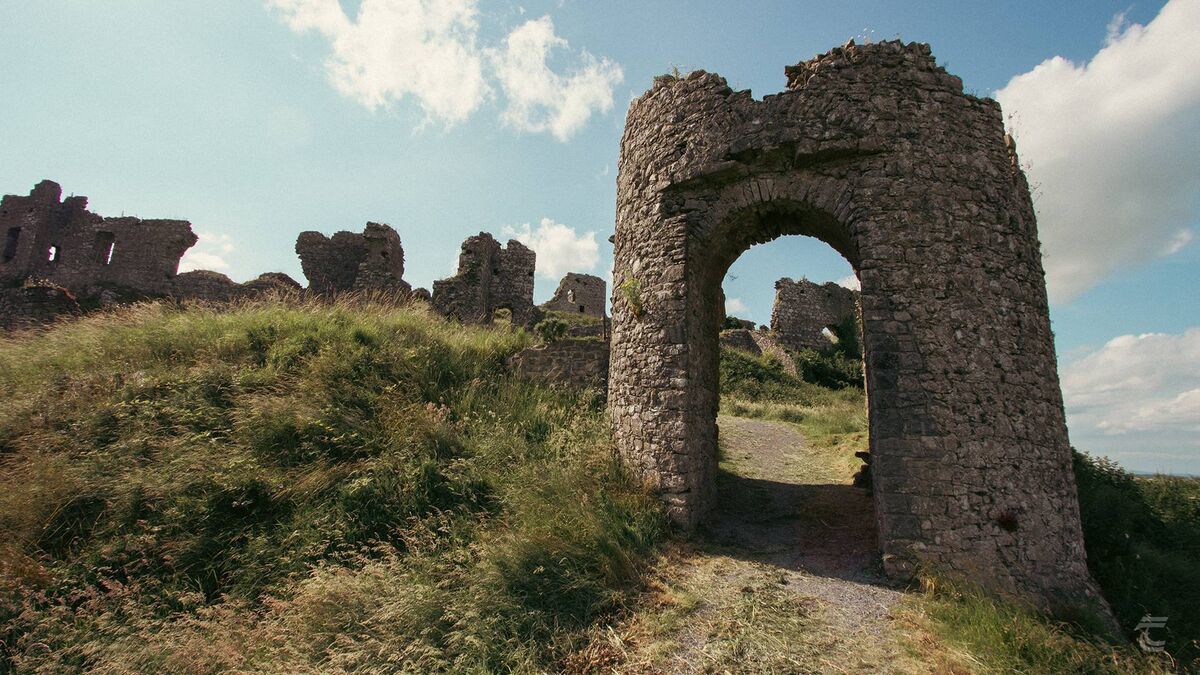
The castle was developed with an outer barbican surrounded by a deep ditch. This could only be traversed through the barbican gate, protected by its murder-holes and a portcullis. It gave access into the Inner Barbican, where attackers would have to overcome steep ditches and tall stone walls. The walls feature fighting platforms and wall-walks, from where archers could have rained arrows down upon the enemy. The twin-towered gatehouse gave access into the lower ward. This area had a number of buildings, including accommodation for the troops and essential facilities such as forges and blacksmiths’ workshops to ensure the weapons and armour were well maintained. The inner ward on the summit of the hill was the heart of the fortress, and housed the great hall. From this vantage point you can enjoy spectacular views over the rolling countryside below.
Through the 14th century Anglo-Norman control in the midlands began to weaken and crumble under the relentless pressure of the local O’Mordha (O’Moore) family. The O’Mordhas finally managed to seize Dunamase in the 1330s, but they left the site unoccupied. The castle then fell into disrepair and then much of the fortress was deliberately destroyed, often attributed to Colonel Hewson, one of Oliver Cromwell’s officers during his invasion of Ireland in the 17th century, although no records of this survive in Cromwell’s accounts and the damage may have occurred much later.
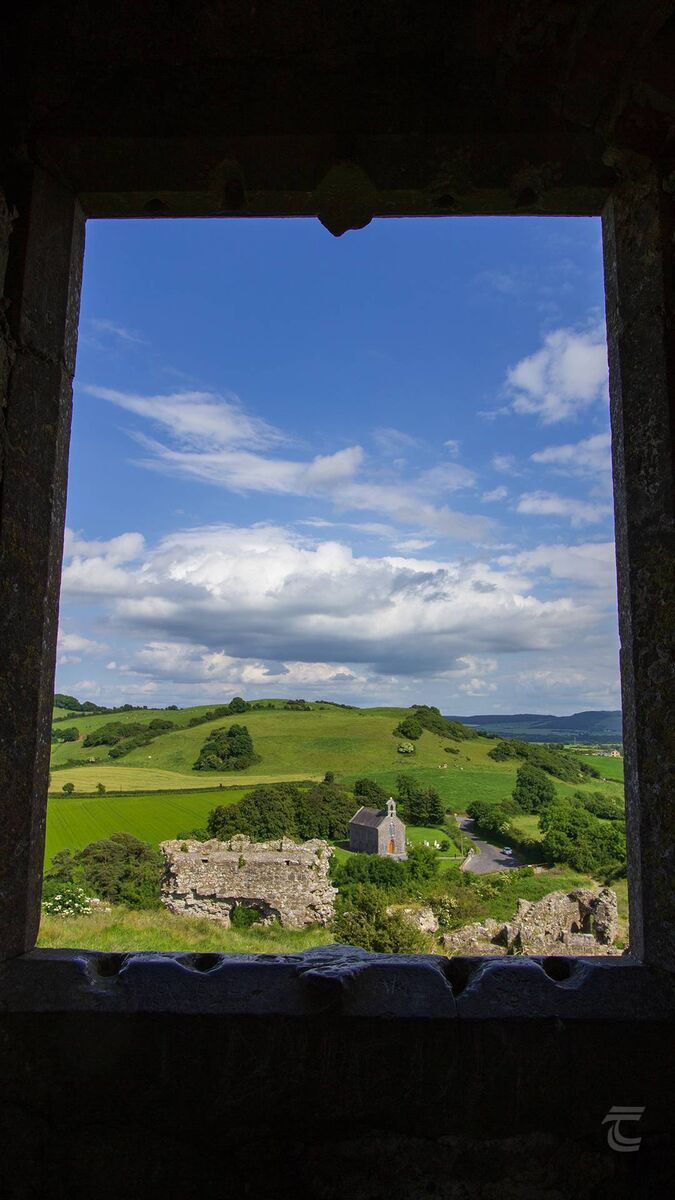
The Rock of Dunamase was acquired in the 18th century by John Parnell, (great-grandfather of Charles Stewart Parnell). It had become fashionable during the 18th century to refurbish ruins to serve as picturesque settings for glamorous soirées and dinner parties. John Parnell took many features such as the stone-lintelled doorway and the window mouldings from other later medieval sites in the area and brought them up to decorate his hall at Dunamase. The work was never completed by Parnell — and after his death the site continued to fall into disrepair.
Evidence of the final destruction of Dunamase can be found near the gatehouse. There you can find a small lime kiln that probably dates to the 19th century. The stones were taken from the walls and heated in kilns like this by local farmers to create unslaked lime, which was then added to the fields to help to neutralise the acidity of the soil and increase fertility. So piece by piece this once mighty stronghold was broken down. Today all we are left with, are just the shadows and scattered fragments of its once fearsome defences.
The site is a wonderful place to explore, but be careful with young children as there are some very steep drops. Although there are good paths throughout, the steep slopes may pose a challenge for some wheelchair users.
You’ll find the Rock of Dunamase at coordinates Lat. 53.031783, Long: -7.210743. It is just off the M7. Take the exit from the M7 at Junction 16 (Stradbally/Carlow/R445). Take the second exit off the roundabout and continue on this road for a little under 4km. The Rock of Dunamase will be on the right.
Alternatively, take the N80 from Portlaoise and follow the signs for the Rock of Dunamase.
- Neil Jackman is an archaeologist, travel writer, and owner of tuatha.ie — an online membership for people who want to explore more of Ireland’s wonderful heritage.
CONNECT WITH US TODAY



Be the first to know the latest news and updates