Sky Matters: When and where to watch the Geminids meteor shower
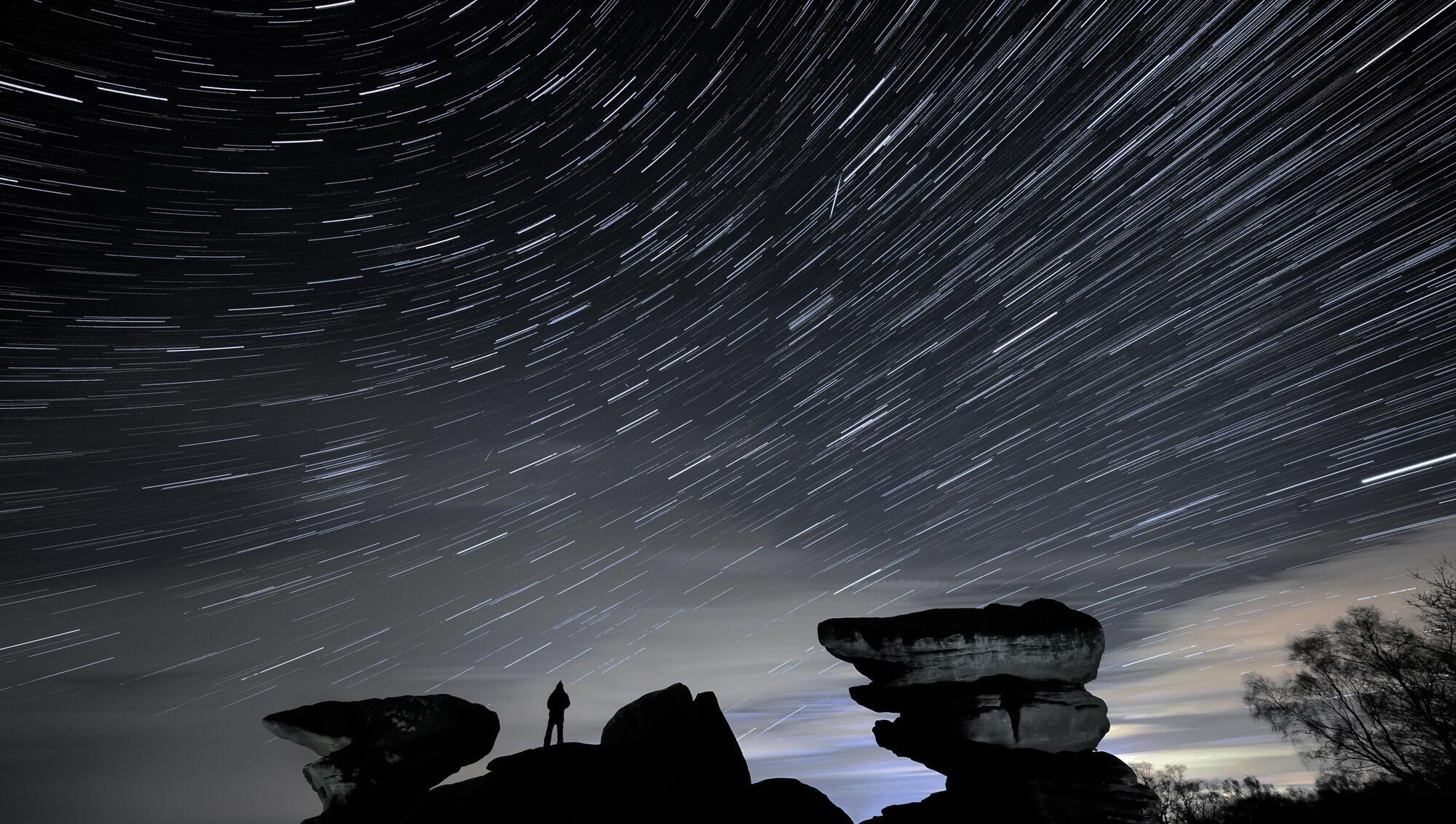
A man watches a meteor during the Geminid meteor shower over Brimham Rocks, a collection of balancing rock formations in the Nidderdale Area of Outstanding Natural Beauty in North Yorkshire, UK.
While it’s a little early to look back at the space highlights for 2022, there is one highlight that will be impossible to ignore. The beginning of the year saw the James Webb Space Telescope (JWST) successfully deployed to its position some 1.5 million km from Earth where it will remain operational for the next 20 or more years, thanks in part to a perfect launch on a European Space Agency Ariane 5 rocket. Already Webb is sending back jaw-dropping images of the universe. We’re literally seeing distant galaxies which heretofore been impossible to see.
It’s worth stressing that it hasn’t been “difficult” to see these, it has literally been “impossible”. And initial results are intriguing. It seems that galaxies, which are essentially groups of stars held together by their mutual gravity, may have formed much sooner after the Big Bang (13.7 billion years ago) than we had previously thought. This suggests that something in the “early universe” was different to our expectations and that makes this potentially very exciting. We can only speculate until we get more data, which Webb will give us in abundance.
Knowing how galaxies form is important if we want to chart the history of formation of our own galaxy, the Milky Way. And that’s important if we want to know how stars like our Sun and planets like our Earth form. And that’s important if we want to build a complete picture of how you and I ended up reading an article in a newspaper some 13.7 billion years after the Universe came into being! While Darwin crafted the seminal work “On the Origin of Species” and laid out the fundamental mechanism of evolution, his treatise really didn’t truly touch upon the “origin” question. That’s still very much open.
And although JWST won’t be able to answer the question directly about how “life” itself came into being, it will fill out parts of the story of the origin of the atoms and molecules which make us all up which can only help. That said, we already know that stars are responsible for making pretty much all matter in the universe which isn’t hydrogen, it’s just that we’re not fully sure of all the intricate details. And who knows, lurking in those intricate details might be an unexpected gem of information which challenges elements of current-held beliefs.
And while we’re on the subject of beliefs, December brings with it the annual Winter Solstice. This is the day when the Sun appears to “stand still” in the sky, celebrated nowhere more impressively than at the ancient burial mound at Newgrange. Despite the visible outstanding engineering feat of constructing such a mound and aligning it with the rising of the mid-winter Sun, nothing remains of the belief system that spawned this gargantuan effort. An effort that could symbolically, at least, be compared to JWST.
Not to be missed in the run-up to the festive period is the Geminids meteor shower, one of the finest of the year capable of producing up to 2 meteors every minute, often multi-coloured. It is produced by debris left behind by an asteroid known as 3200 Phaethon, which was discovered in 1982. It peaks on the night of 13th and morning of 14th December. A few days later, between 20th-22nd December, the Ursids meteor shower will be visible. For both meteor showers the absence of a bright Moon will make it easier to observe some of the fainter meteors. As always, the best way to look at meteors is with the unaided eye, allowed to adapt to the dark for 10-20 minutes, from the darkest place you can find in your locality. And at this time of year, a little mulled wine or your favourite tipple might make this cosmic spectacle all the more enjoyable!
- Dr Niall Smith is the Head of Research in MTU, Cork and the Head of Blackrock Castle Observatory.
Read More

CONNECT WITH US TODAY



Be the first to know the latest news and updates