'You have this horrendous feeling of loss': Women highlight lack of understanding surrounding miscarriage
National Women's Health Survey 2025: The medical response in Ireland to the loss of a pregnancy has not always been compassionate — and that lack of understanding compounds the pain, four women who have experienced it tell Breda Graham
'You have this horrendous feeling of loss': Women highlight lack of understanding surrounding miscarriage

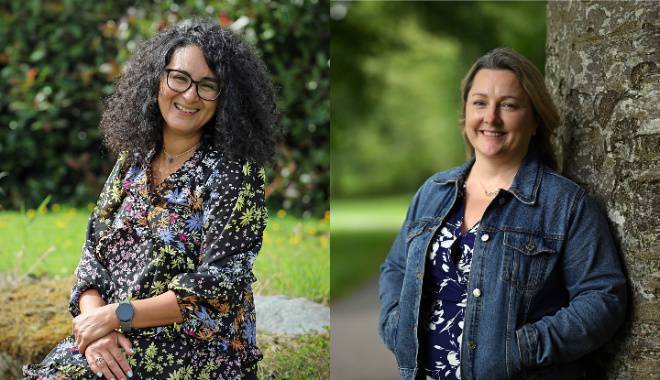
L-R: Jihane Petticrewe; Naomi Collins

Jihane Petticrewe, 43, Cavan

Petticrewe had a miscarriage at 31. She recalls the emotional and physical pain and the lack of support from the healthcare system.

She says it wasn’t until later in life that she realised how her miscarriage wasn’t taken seriously by healthcare professionals.

“My GP prescribed me strong medicine. He said ‘If you really are in pain, here’s the medicine.’ Later that day, I was in bed in bits. I’m not someone who takes medicine if I can avoid it. But I was in a lot of pain.

Jihane Petticrewe and her children Savannah, Lyla & Harley at their home outside Kilnaleck, Co. Cavan. Picture: Lorraine Teevan

“When I went to the pharmacy with the prescription, the pharmacist said ‘I can’t give you that prescription. Your doctor shouldn’t have prescribed it, as it’s very addictive. It’s very strong’.”

Petticrewe picked up some paracetamol instead and made a natural chamomile infusion, but had no follow-up call from the GP.

“I felt like I was treated like somebody who was not in pain — and that pain was worse than giving birth. I gave birth three times, but I still remember that pain. I still remember how I was in bed, curled up and profusely bleeding.”

Petticrewe says miscarriage is not taboo: “It happens to a lot of women... we need to come together for the bigger picture here and speak up.”

Naomi Collins, 45, Galway

Collins had her first miscarriage at 26. She was 10 weeks pregnant. It was her second pregnancy, having already given birth to her son.

She went to the hospital as she was spotting, describing the reception she received as “very cold”.

She was told that the spotting would progress to miscarriage and that she should go home and wait for it to happen: “That was the extent of the help I got in the hospital, and nobody checked up on me after that. That was disappointing.”

“The overwhelming feeling was that I felt hollow.”

Speaking about how pregnancy changes everything once you get a positive result, she says: “The minute you get pregnant, you make so many plans, you’ve reorganised the house and rooms, your husband is even changing the car in his head, your whole life plan changes the minute you look at your positive pregnancy test.

“Even though I had three miscarriages, all at relatively early stages, each time your life has changed, so when you miscarry, you have this horrendous feeling of loss in so many ways, not only for your baby, but for the life that you’d planned.”

Naomi Collins from Corrandulla, County Galway spoke about her experience with her miscarriages. Photo: Ray Ryan

Collins says something that struck her during her experience with miscarriage was her husband’s sense of loss: “He was a dad from the minute I got the positive pregnancy test, as well.”

After three miscarriages, Collins experienced secondary infertility, and it was another seven years before she fell pregnant with her twin boys.

“They say one in four women miscarry at some point in their lives. That’s a huge number. And I think there’s an awful lot of people who are not aware, whatsoever, that the woman sitting next to them at work has had a miscarriage, the woman next to you on the bus has had a miscarriage,” she says.

“Talking to different people over the years, I realised how many women in my circle have had miscarriages and never said, because they feel like they don’t want to put it upon you, or that they’re looking for sympathy. I think we’re getting a bit more open, but I think there’s a lot more to be done.”

Dawn Troy, 68, Dublin

When Troy was pregnant at 29, she had a bleed and went to her GP. It was March 1986.

She was told by her GP that a lot of women would go to the hospital, but that there was no need, and that she might feel some discomfort when the ‘product’ passed — the ‘product’ being Troy’s baby, whom she had carried for almost 14 weeks.

“I had what felt like labour pains. I was bleeding profusely. Friday, I went to the doctor, and, by Sunday, my sister-in-law said I should go to the hospital, and they admitted me.

“I had five student doctors, obstetricians, give me an internal examination — they felt the open cervix. Forty years ago, I was afraid to say boo. I was 29. I was very naive.

“They did a D&C, discharged me and simply said, ‘Try not to get pregnant for three months’. I was also told that they would not examine the cause of the miscarriage until I had three miscarriages.”

Troy went on to have two more miscarriages and decided to go private, with Dr Paul Bowman, at the Coombe Hospital: “When I became pregnant, he brought me in straight away, and he put me on HCG injections (human chorionic gonadotropin, used primarily for treating infertility in women), and I was there for maybe three months, and my daughter was born in June 1989.”

Troy gave birth to her son in November 1990.

She acknowledged how things have changed since her miscarriage, that people nowadays feel as though they can show their emotions, something that wasn’t the done thing in the 1980s.

“I probably didn’t realise at the time that I was grieving. It [miscarriage] is a trauma.”

Catherine, 74, Waterford

Then recently married, Catherine was 22 when she had her first miscarriage in the 1970s.

She went on to have three children in four years, but had three more miscarriages before she gave birth to her fourth child at 39.

She says the reason she was miscarrying was never investigated, as she was “producing perfectly healthy babies in the meantime”.

Her first miscarriage was her first time in the hospital. After some bed rest, a D&C procedure was performed, and she was discharged a couple of days later: “There was no support. I was working at the time, and I sent in a note saying I was unfit for work; I didn’t even say I had a miscarriage.”

“When I went back to work and was asked what happened, the response was, ‘It’ll be grand, better luck next time’. And that was it.”

“I had four miscarriages, but they were sprinkled in among perfectly sound pregnancies.

“I did ask my obstetrician, at one stage, what was causing [the miscarriages], and they said it was probably a rhesus problem, and that was it. I assume if I were having a series of miscarriages, there might have been greater concern, but the fact that I was producing perfectly healthy babies in the meantime, it was treated as no big deal.”

Click here to read our National Women's Health Survey.

The Irish Examiner Women's Health Survey 2025

Ipsos B&A designed and implemented a research project for the Irish Examiner involving a nationally representative sample of n=1,078 women over the age of 16 years.

The study was undertaken online with fieldwork conducted between April 30 and May 15, 2025.

The sample was quota controlled by age, socio-economic class, region and area of residence to reflect the known profile of women in Ireland based on the census of population and industry agreed guidelines.

Ipsos B&A has strict quality control measures in place to ensure robust and reliable findings; results based on the full sample carry a margin of error of +/-2.8%. 

In other words, if the research was repeated identically results would be expected to lie within this range on 19 occasions out of 20. 

A variety of aspects were assessed in relation to women’s health including fertility, birth, menopause, mental health, health behaviour, and alcohol consumption.

More in this section

Lifestyle

Newsletter

Eat better, live well and stay inspired with the Irish Examiner’s food, health, entertainment, travel and lifestyle coverage. Delivered to your inbox every Friday morning.

Cookie Policy Privacy Policy Brand Safety FAQ Help Contact Us Terms and Conditions

© Examiner Echo Group Limited