Female mechanic, electrical apprentice and drains expert on their experiences in trades
The trades are no longer the all-male bastion they once were. Three women talk about their experience
Female mechanic, electrical apprentice and drains expert on their experiences in trades

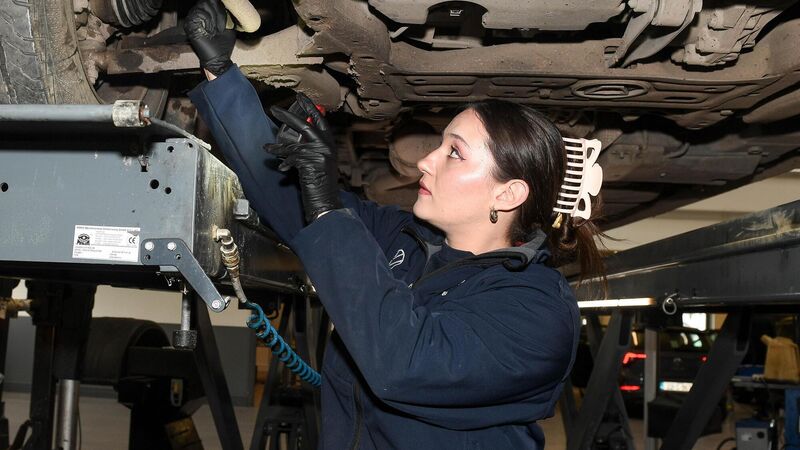
Diagnostic technician Alice Handke, at her workplace at Blackwater Motors, Forge Hill, Cork.


Gender used to determine our career choices. In Ireland, most young people attended same-sex schools, which funnelled boys and girls onto different career paths. Girls were directed towards teaching, nursing, and hairdressing, while the trades and professions in law, medicine, science and engineering were deemed for the boys.

Change is happening, albeit slowly in sectors such as construction. The 2022 CSO Labour Force Survey found that 15,500 of the 167,300 people employed in that sector were women, representing 9.3%, up from 8% in 2020.

Apprenticeship numbers are rising, too. In 2015, there were 26 female apprentices in Ireland, but by 2021, this had increased to 1,000. It was still only 5.2% of the total, but a significant increase nevertheless.

As International Women’s Day approaches, on March 8, three women tell us what working in male-dominated sectors is like.

Mary B Teahan is managing director of Irish Drain Services, a company that cleans and unblocks drains. “When I go on-site or meet clients for the first time, most of them are men and they are usually surprised to see me,” says the 52-year-old, who lives in Cromane in Co Kerry. “They assume I’m the office manager or the secretary, not the boss of a drains company.”

Teahan’s response is to smile and wait for them to realise their mistake. “Then they apologise, I smile again, and we start over,” she says.

Teahan set up IDS with her business partner, Liam Brosnan, in 2009. “I’d been working as an office manager for many years before that, but I spotted this opportunity,” she says. “Even though we were in the middle of a recession, I’d always believed that women should step forward, not back, so I went for it.”

Since then, Teahan has spent her working days surrounded by men. “We work with domestic, commercial, hospitality and industry clients and most of the owners and managers I meet as clients are male,” she says.

“On-site and in meetings, engineers and quantity surveyors are predominantly male. Even our staff of eight only has one other female.”

She doesn’t let the gender imbalance bother her. “I was the only girl in a house full of boys and, as a result, men don’t intimidate me,” she says. “My experience has been that as long as I know my subject matter, I get their respect and vice versa.”

This is why she works hard to keep up to date with developments in her field. “When I started, I had no idea about maps or site layouts or anything like that and had to learn the hard way,” she says. “I’ve made sure that I’ve continued learning since then.”

Teahan has huge enthusiasm for her work. “No two days are ever the same,” she says. “There are accounts to stay on top of, clients to meet, projects to price, sites to visit and training sessions to attend. Then there’s the end result. Some might think that waste management is simply dealing with dirt, but I don’t see it like that. I see it as keeping our environment clean and protecting it for future generations.”

She thinks women are just as capable of doing this type of work as men. “As long as they have an appetite for it and an interest in it, a woman can do this job just as well as any man,” she says.

 Mary B Teahan, proprietor, Irish Drain Services in Faranfore, County Kerry.
Mary B Teahan, proprietor, Irish Drain Services in Faranfore, County Kerry.

Only female mechanic at her firm

Alice Handke is a 29-year-old diagnostic technician who works for Blackwater Motors in Fermoy. Growing up, she never dreamt of becoming a mechanic.

“I wasn’t especially into cars,” she says. “I was into animals and wanted to be a vet.”

After school, she found a job as a nursing assistant in a veterinary clinic and might still be there had she not had a negative experience with a mechanic.

“I’ve always had a mechanical mind and when my first car started acting up, I had a fair idea what was wrong with it,” she says. “But the mechanic I brought it to told me it required more work than I thought. I didn’t believe him and brought my car home and fixed it myself. That’s what made me think I could probably do his job. So, I signed up for an apprenticeship.”

That apprenticeship took four years, some of which was spent in a training centre and the rest in the workplace. In both settings, Handke was surrounded by men.

“I was the only woman on my college course and the only woman mechanic at work,” she says.

She has never found this to be a problem. “As an apprentice, I was surrounded by young men and we all know that boys will be boys and that there will be some banter,” she says. “But there was never a time when anyone stepped over the line. Mostly, all we talked about was cars.”

Nor has she ever experienced sexist attitudes from customers. “They’re often surprised to see me, but they’re usually delighted and congratulate me on doing something unusual for a woman,” she says.

Handke understands why her job might not be attractive to women. “It’s physically demanding work and some women might not have the stamina for it,” she says. “It’s a dirty job too and you come home every evening with dirty overalls and hair, and that’s a big turn-off for many women.”

But for women who can see past that and are interested in the mechanics of cars, she reassures them they will find satisfaction in the work. “In my work as a diagnostic technician, I have to find the root of problems, which is mentally challenging,” she says. “I apply my skills and knowledge to different problems every day, which is great exercise for the mind.”

No experience of sexism

Caoimhe Spillane is a 20-year-old second-year electrical apprentice with Mark Rael Electrical in Tralee. Her friends thought she was having them on when she first told them she was going to train as an electrician.

“They thought it wasn’t a job for girls,” she says. “But they don’t think it’s a joke anymore.”

Spillane spent a lot of time with her grandfather as a child. “He was a welder and I’d always be trying to help him,” she says. “

It was my uncle who suggested I should consider becoming an electrician. He thought I’d be good at it, so I gave it a go.”

In her training class of 14, Spillane is the only female. And at Mark Rael Electrical, she’s the only female too. But this doesn’t faze her in the slightest.

“I’ve never had a negative experience or a sexist comment,” she says. “The most common thing I hear from my customers is how great it is to see a girl in a trade.”

Rather than focusing on the gender disparity in her workplace, Spillane prefers to direct her attention to the work.

“I find it so interesting and varied,” she says. “From switches for heating systems to wiring an extension, there’s so much to it and the more I learn, the more I realise it’s what I want to do.”

The only potential drawback is that sometimes physical strength can be an issue. “There are times when I have to ask one of the lads for help tightening something, but that’s the only time I notice that I’m a woman and the others are men. Otherwise, I’m just one of the team.”

More in this section

Lifestyle

Newsletter

The best food, health, entertainment and lifestyle content from the Irish Examiner, direct to your inbox.

Cookie Policy Privacy Policy Brand Safety FAQ Help Contact Us Terms and Conditions

© Examiner Echo Group Limited