Sean Rothery still rising to new challenges at 86-years-old
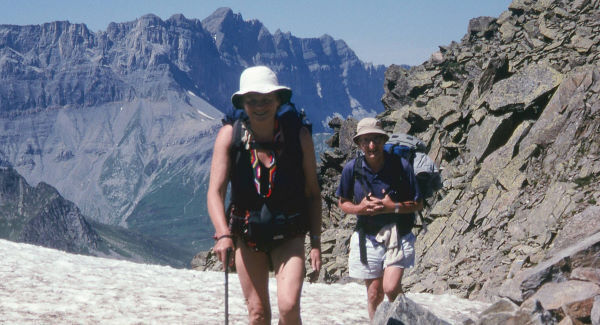
WHEN writer and former mountaineer, Sean Rothery, attended a mandatory Dublin Institute of Technology retirement session in 1993 — he was a lecturer — a doctor advised the attendees to take daily ‘long walks’ of 30 minutes.
Rothery was not impressed. The group was “so passive and accepting,” says 86-year-old Rothery.

“When you retire, you’re given a lamp or a gold watch and told what a wonderful thing it is to put your feet up, play golf, and everything will be alright. In fact, you’re being told you’re too old and to get lost.”
Rothery had no intention of hanging up his hill-walking boots. Despite nearly dying when he was 40, while climbing the Alphubel, one of the Swiss Alps, Rothery completed a 2,300km walk from the North Sea to the Mediterranean when he was 66. His account of that adventure, A Long Walk South: An Irishman’s Trek on the GR5, has just been re-issued. It is a remarkable book about self-discipline, the wonder of nature, and a refusal of the easy life.
But Rothery, whose walk started in Holland in May, 1994, and ended that year in Nice in September, says he is not a big risk-taker. “The accident ended my rock-climbing career, but it didn’t finish my Alpine career. Five years after the accident, I went back to the place where it happened and climbed a beautiful mountain that I used to look at from my hospital bed.”

The accident was in 1967. Rothery was one of a team leading trainee mountaineers who were preparing for an expedition in Greenland. An inexperienced climber caused “a gigantic rock, the size of a dining room table,” to tumble down in Rothery’s direction. It smashed his leg and injured his shoulder. It was three years before Rothery walked again. He had bone grafts from his hip to his leg.
The worst that happened on Rothery’s ‘long walk south’ was painful blisters on his feet. But the book also recalls the accident and two friends who died while climbing the Alps. Rothery followed the GR5 (Grande Randonée Cinq) route, which was established in France after the Second World War, originally stretching from the Vosges Mountains through the Jura, before traversing the French Alps onto Nice.
In the 1980s, the Dutch extended the route to the Hook of Hollland. Rothery started from the steely North Sea and headed to the brightness of the Mediterranean.
Carrying 20 pounds of luggage on his back, including the three-novel Forsyte Saga as his reading material, Rothery walked for 110 days, just 17 of which were spent with friends and his late wife, Nuala.
Was he lonely? “I recently read a review of the film, Tracks, about a lone woman’s walk across the Australian desert with camels and a dog. The reviewer made an interesting comment. She said that the woman’s walk was a meditation on the pleasure of loneliness. That may seem strange, but I agree with the whole business of a long walk being a meditation. It’s very important to walk solo, as William Hazlitt wrote about in his essay, ‘On Going on a Journey’,” he says.

Rothery, who kept a detailed journal of his walk, which described the remnants of concentration camps and included sketches of unusual buildings, says that the evenings were often “very lonely. People rarely spoke to me in restaurants. A person sitting alone is usually left alone. That was one of the hardest things. It was wonderful when I met people and was able to have dinner with them.”
When Rothery “re-entered civilisation, I found it very difficult. I really felt lost. I wanted to get on with walking.
“That had often happened when I took rest days on the expedition. I couldn’t always rest and sometimes took a walk.
“It became an obsession. I thought I was becoming a walking hermit, at times, talking to myself and day-dreaming,” he says.
Despairing of the neurotically safe way society lives, whereby “we’re prepared to hail people as heroes when they climb Everest, but are afraid to let children out to play,” Rothery can look back on a life full of adventure.
These days, he is having injections in his knees to relieve pain. It is only six years since he closed his architectural practice. He now devotes his time to writing, and walking in the Dublin Mountains, near where he lives. So much for gratefully accepting the gold watch that normally goes with sedate retirement.
*