Irish designers from Derry and Clare take centre stage in Paris
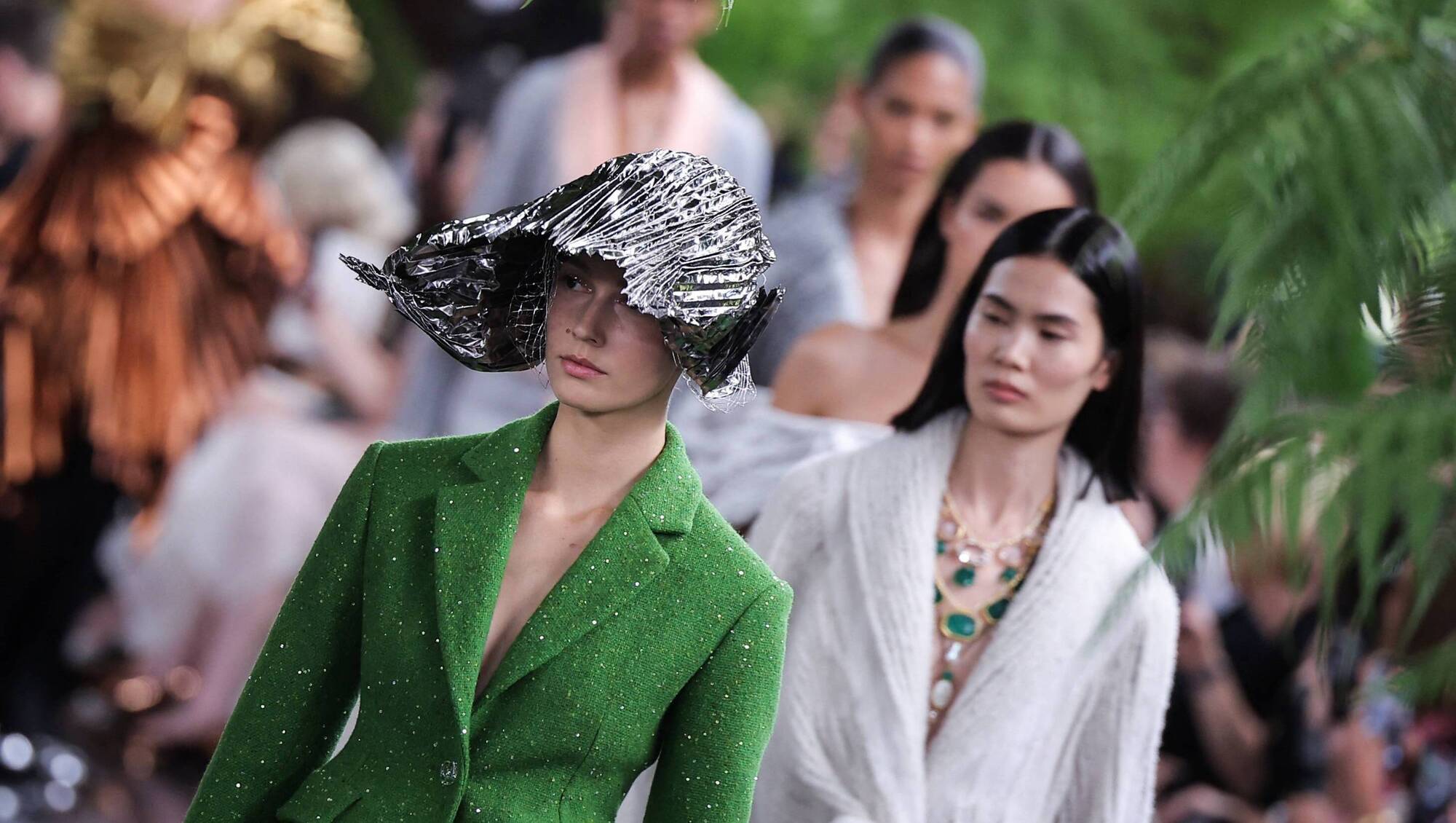
Irish designer Jonathan Anderson's show today for Christian Dior at Paris Haute Couture Week was staged in the veranda of the garden at the Musée Rodin. Picture: Kenzo Tribouillard/AFP/Getty
Days after Ireland assumed the presidency of the Council of the European Union, the country’s most promising design exports took centre stage at Paris Haute Couture Week.
Jonathan Anderson demonstrated his ability to stoke desire once more with his second haute couture collection for Christian Dior on Monday afternoon.

Brimming with fresh ideas about how women can configure their wardrobes, the Northern Irish designer’s show was inspired by the American sculptor Lynda Benglis.
In the show — staged in a purpose-built open-air, black-lacquered wood veranda in the garden of the Musée Rodin — Anderson skilfully took references from the sculptor’s post-minimalist artworks, stitched them together with his discerning taste and stylist’s eye, and translated them for a modern audience in the form of a well-rounded couture offering.

There were hallmarks of couture: Hand-plissé, knotting, and draping, in response to the artist’s three-dimensional forms, in twists on classic tailoring like the Dior Bar jacket in hand-embroidered tweed with dégradé motifs, and elegant silk dresses with dropped waists and undulating layers of pleats.

The orgiastic colour palette riffed on the artists’ Peacock series from the 1970s, made in Ahmedabad, India: technicolour and layered with beaded embellishments, shots of fuchsia pink, neon green, and scarlet red, cut through black and the classic Dior grey, powder blue and pale pink, with the terrific result of being zingy and fresh.
Hand-embroidered eucalyptus flowers and hand-appliquéd rhododendron gave the collection a natural depth, juxtaposed with the hand-pleated copper lamé bustier dresses and architectural headpieces.

It led Anderson to further research Indian craft, specifically the 13th century tradition of chintz.
Finely woven cottons which are hand-painted and block-printed find a place on the runway.
Specialist antiques adorn the brand’s Lady Dior bag.
While the rarefied practice of haute couture is reserved for the uber-wealthy who can spend upwards of six figures on a single garment, the top brands are increasingly using it as a storytelling opportunity to command the attention of their Very Important Clients (VICs).

It has also become a conduit for connecting with aspirational customers who are buying into more accessible categories, from accessories to ready-to-wear.
The general public will have a chance to view pieces from the collection, alongside creations from the Dior archive, and a curation of Lynda Benglis’ art at the show space from July 7, to July 12.
A generational talent, Anderson continues to build momentum around his collections as pressures mount in the luxury fashion industry amidst political and economic uncertainty.

Sales at Christian Dior’s parent company LVMH grew 1% on an organic basis to €19.12 billion.
However, the fashion and lifestyle division reported a 2% decrease in sales to €9.25 billion, against the backdrop of weakened consumer demand and ongoing political instability in the Middle East.
The United States and Asia showed steadier momentum, while Europe and the Middle East weighed on the conglomerate’s overall performance.
In an earnings call in April, LVMH CFO Cécile Cabanis highlighted that results at Christian Dior were improving considerably compared with previous quarters.
She noted that the initial response to Anderson’s takeover was auspicious. The starry front row at the show, including Irish actress Ruth Negga, and Josh O’Connor, was further confirmation that the brand is as relevant as ever.
Later in the day, in a much more intimate setting, the London-based Standing Ground brand, designed by Clare-born Michael Stewart, made its return to the runway following a two-year hiatus.
The show took place at the Irish Embassy.
Newly-appointed Irish Ambassador to France Alison Milton, who commenced her role in June, and Delphine Arnault, Chairperson and CEO of Christian Dior, and one of Stewart’s mentors, watched from the front row.
The models snaked through the residence’s gilded parlours at a glacial pace.

Standing Ground’s handcrafted vision earned Stewart a reputation as a maestro of modern eveningwear, focusing heavily on draping, sculpting and handcrafted techniques.
In 2024, Stewart won the Savoir-Faire award at the LVMH Prize for Young Designers, along with a €200,000 windfall and a one-year mentorship by LVMH teams.
The judging panel, which included Jonathan Anderson, rewarded his innate sense of craftsmanship and commitment to haute couture-inspired practices.
Since he founded his label, Stewart has sold directly to private clients.
Monday’s show affirmed Stewart’s skill in proportion, silhouette, and material. He transforms silk-jersey column gowns in cobalt blue, scarlet red, and ash grey, into statuesque pillars of beauty, each exit a forthright expression of his singularity.

Its elegance is a rejection of the casualisation of contemporary fashion.
The centrepiece of the collection was an homage to Irish craftsmanship: an ethereal gown featuring Carrickmacross lace, completed over months by Irish lacemakers in Monaghan.
Unlike other lace traditions, Carrickmacross lace, which dates back to the 1820s, is made by appliquéing fine net onto sheer fabric and securing intricate motifs with careful stitching.
“It’s been a long journey and everything has been directed towards showing a couture from the very beginning,” Stewart told Vogue Runway.