Opera review: Testament takes on Colm Tóibín's account of Christ's mother Mary
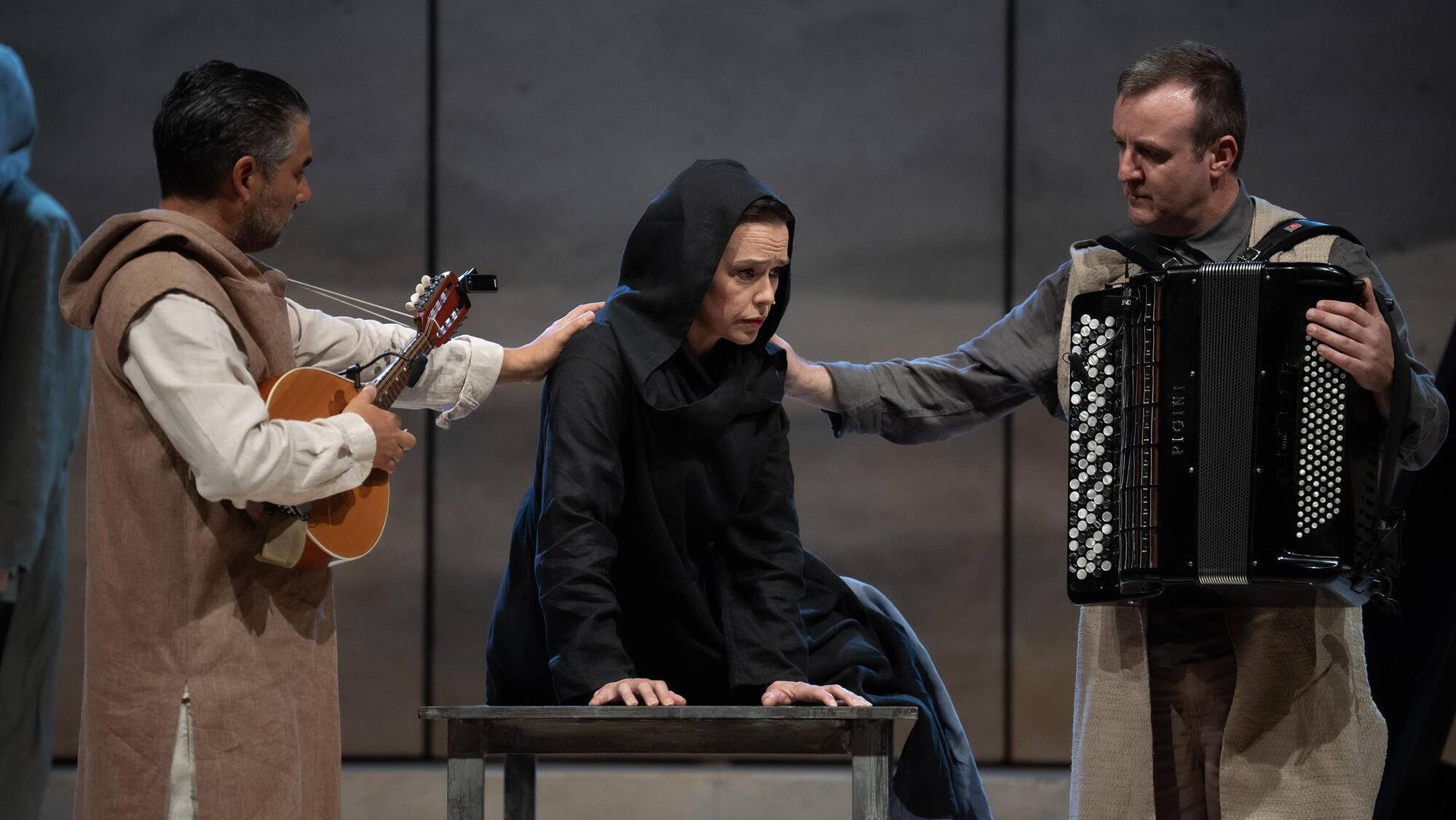
Ariel Hernandez, Sharon Carty, and Dermot Dunne in Testament. Picture: Pat Redmond
★★★★☆
Colm Toibin’s , a short, intense account of the Virgin Mary’s experience as the mother of Christ, and of his crucifixion, is here given a startling, fluid, and invigorating staging by Irish National Opera and Galway International Arts Festival, with libretto by the author, and composed by Tarik O’Regan.
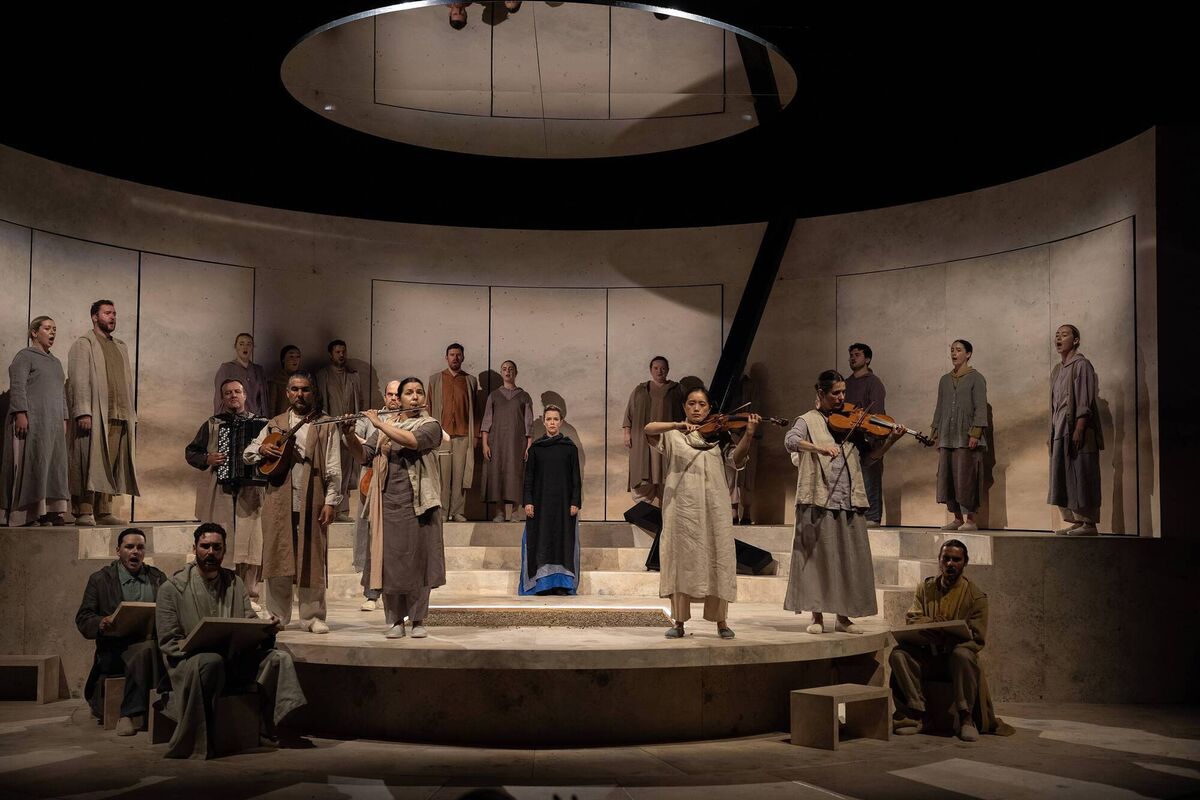
It’s a sinuous, well-choreographed 80 minutes, with the seven-strong cast of musicians woven beautifully into the action by director Rachel Hewer, each dressed in the same mix of pastel-coloured robes as the main players. Only Mary wears black: her traditional, canonical blue barely showing beneath the robes of mourning.
And this is a fitting symbol: the conventional idea of the Blessed Virgin, meek and dutiful, is here upturned. She’s more like an angry widow out of Greek myth, a lone voice against a chorus of believers, who spout their version of events, their idea of Christian love, which is nothing like as visceral or searing as a mother’s for her only child. Mezzo-soprano Sharon Carty brings intense emotional authority to the role in a superb performance.
Francis O’Connor’s set is beautiful and practical. It leans into the classical allusions by being a curved amphitheatre, carrying all the eclectic music towards us and allowing the action to develop across numerous layers. This works particularly well when the chorus and Mary give their contrasting interpretations of various events: her scepticism against the wilful, nascent cult. It’s sometimes like a serious Life of Brian.
The set’s marble tones evoke also the Shroud of Turin, thus neatly echoing Toibin’s dual points of reference. A crucifix, that logo of Christianity, sits inverted, broken and black at stage left.
Mary when we meet her is old, practically a prisoner of the evangelists, who harry her like Penelope’s suitors. They want confirmation of their version of the Passion. But for her, even if miracles were possible, they should not happen. Stark illustration of this comes when we see Lazarus dig himself out of the grave, only to find himself a wrecked shell whose fate is simply to await a second death.
“Will water be dry?” Mary asks, incredulous at the idea that natural order can be upended on a divine whim. “She doesn’t understand,” say the Christians.
From this opening, time is fluid, as events such as the Wedding at Cana are remembered. For Mary, even this supposedly benign miracle carries an ominous shadow. A child actor emerges to play Christ at the moment of execution, a symbol of Mary’s parental love, then, in contrast to the role given him as Saviour.
In a stark moment, that broken crucifix becomes like a digital banner, running the same phrase over and over: “It was not worth it.” But this remains Mary’s interpretation. The resurrection itself is neither depicted nor debunked. Toibin is content with mystery, with depicting what it means to love, and provoking questions about authority and truth that resonate today as much as ever. A production to look out for at the Dublin Theatre Festival.
Meanwhile, another examination of crowd dynamics came without a word said, or indeed sung, in (★★★★). The only sounds were occasional wild shrieks in darkness: unsettling and disturbing, as befits a dance piece that imagines what a crowd can be: a team, a raging mob, a furious mass. But mostly, the 50-strong performers, almost all women, are a community. They move with exquisite timing, but their individuality nonetheless shines out. A touching, pulsing spectacle from the Stephanie Lake Company in Melbourne.
- is at the Dublin Theatre Festival, October 8-10