West Cork actress Ayoola Smart: 'I've had many pinch-me moments, like working with Fiona Shaw'
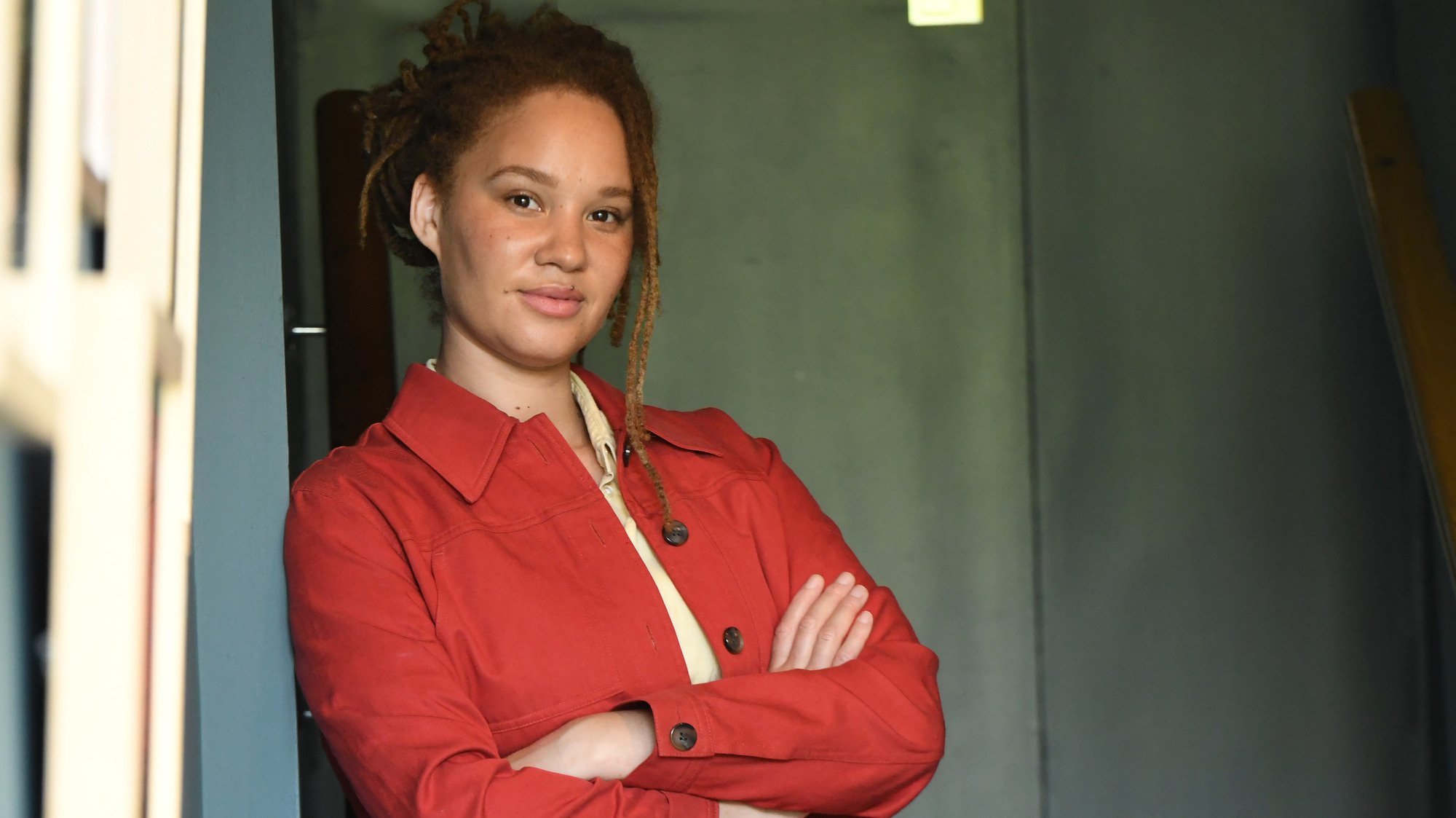
Ayoola Smart grew up in Schull. Picture: Moya Nolan
She has enjoyed a string of screen successes in shows including the BBC’s Killing Eve, RTÉ drama-mystery Smother, and Prime Video international hit The Wheel of Time. Now, actress Ayoola Smart is returning to the stage for an adaptation of an Oscar Wilde classic.
The West Cork actress is one of a strong ensemble in An Ideal Husband, Wilde’s witty and sharp tale of secrets, scandal, and romance. It has never felt more potent or relevant.
Smart is a number of days in to the show’s lengthy summer run at Dublin’s Gate Theatre and is fascinated at how it is being received by audiences. Hearing and seeing an audience’s reaction is one of the great thrills of working in theatre, she says.
“The bones of the play are the bones of the play, and so where audiences laugh, or where they respond to things, has been a really interesting observation, particularly as one of the female characters in the play. You get to see how a modern-day audience responds to a text that is as old as it is.”
Written in 1893, An Ideal Husband is a tale of corruption in politics, intrigue, blackmail, and secrets. Wilde’s characteristic social satire is sharp. It centres on Robert Chiltern, a politician threatened by a past scandal. Smart plays his wife, Lady Chiltern.

“In many ways, I think my character acts as a moral compass, but also the backdrop of the play. She’s constantly reminding audiences and characters of this high moral tone that she inhabits, but she’s also very progressive, particularly for the time. She’s at the forefront of running the perfect house, she’s part of the women’s liberation society, and she champions further education. She’s very political.
“She does genuinely enjoy, and is involved with, Robert, Lord Chiltern’s political life, and so she is very much a modern woman within the time. But she also has this very high moral compass that gets pulled into question. She has to wrangle with that, and other characters also have to wrangle with that, throughout the play.”
Audience interest has been strong since the play was first announced, right through to when it wraps on July 11. Why does she think Wilde’s story has such an enduring appeal? “I think it’s because it feels relevant, it feels timeless, and that’s for both good and bad reasons,” says Smart.
“It is very feminist of its time, there are a lot of really feminist, progressive elements about the play; even just to have female characters that take up so much space. But it also is problematic. There’s misogyny within it, and there’s misogyny written within it. I think the time that we’re in now, with politics geopolitically, and with the role of men and women, and this morality that we seem to be grappling with across the world, or lack of morality, what does that mean?
“What does it mean to be in politics or to be a good person or good politician or how to get away with things? It allows us, performing, but also audiences, to laugh at the state of where we’re at, at the moment, and also resonate with it, and see ourselves in it. I think texts that are able to do that will always endure for that reason.”

Though she loves acting for screen, working on the play has caused Smart to reflect on the buzz of live theatre. There’s something so immediate, she says, about being in a play, and how it requires you to be in the moment with your co-stars, with yourself, and with an audience. It can also be nerve-wracking, she laughs.
“I think there’s always those few seconds before a play starts, when we’re all backstage being like: ‘Why do I do this?’ and I don’t think that ever goes away. That’s probably a good thing, because it means that you’re there.”
Of Irish, English, and Nigerian heritage, Smart was a child when she moved to West Cork with her mother, Schull-based drama teacher and community arts worker Sally Smart.
Smart always had an interest in the arts, and her mother’s passion meant she got to express that interest from an early age. “I’ve always had access to a creative space, and so I think I always thought I would go in to the creative arts in some aspect.”
She moved to London to train, and says she was lucky to meet her agent, and get a breakthrough job in her final year of college.
“I think that was the first time I was like: ‘Wow, this is brilliant,’ I spent four years training, and it seemed to be paying off. That was a very special first job, because it was for the centenary of the 1916 rising, and they did The Taming of the Shrew at Shakespeare’s Globe, and it was an all-Irish cast, and I think that just felt so incredible to be the first thing that I did.”

Having a mother who worked in the arts helped give her the belief, Smart says, that an acting career could be a possibility.
“I think that is a testament to my mother: She just instilled that I should do whatever it is that I am passionate about doing.
“She’s a single mother of three of us, and she was just always working so hard to provide and within that she always made sure that she figured out a way that I could go to my dance classes and my acting classes.
“She would drive me up to the city and she’d sit in the car and wait for me to do whatever it is. She always facilitated that path for me.”
Smart was on her way, and some other key roles would help her break through in what can be a notoriously volatile and unpredictable profession. Shortly after her maiden run at The Globe, Smart landed her first screen role, in Jesse Peretz’s adaptation of Nick Hornby’s novel Juliet, Naked. Her co-stars? Hollywood actors Ethan Hawke and Rose Byrne.
It was a special experience, she says, getting to improvise as a young actor with Hawke — she plays his daughter in the film.
“There’s been so many jobs that I’ve felt are pinch-me moments, like getting to work on Killing Eve with Fiona Shaw— she’s such an icon. That was incredibly special, and I was cast in The Wheel of Time in 2021 and that was a very different world to step into. The Wheel of Time was unlike anything I had ever done, because of the scale of production and locations and the sets and the depth of the world that was built.”
She played Aviendha, a highly skilled fighter, in the Prime Video fantasy series; one of the most expensive productions in the streaming giant’s history.

Smart had to undergo fight training, which she had never done before. “You’re always, hopefully, learning something, but when you get to pick up a new skill, it’s such a privilege to get access to that kind of stuff.
“You’re training with world champions in kickboxing and various martial arts, and you’re like: ‘This is my life’. It feels so unreal.”
Other recent shows have included the hit RTÉ murder mystery Smother, filmed on the coast of Co Clare. And like a lot of contemporary actors, Smart is looking at creating her own work, exploring producing, writing, and directing as she looks at potential projects to take on.
“I think it’s helpful to widen your skill set, so you have access,” she says. “I like to have an overview of things, and you can feel quite trapped sometimes when you’re in an acting role, and you don’t have any access to how or why or who.
“Producing opens that door, where it’s just really nice to have a seat at the table of decision making, or even just access to information. I think it’s why so many actors are doing that now.
“Specifically for marginalised communities, it’s a way that work and representation gets made, and I think it’s still incredibly hard to get those projects greenlit,” she says, adding that she’s been inspired by the success of shows like I May Destroy You and Insecure.
“They’re from actors who created that space and made that.”
- ‘An Ideal Husband’ runs at Dublin’s Gate Theatre until July 11

Cancel anytime