Book review: United through shared oppression

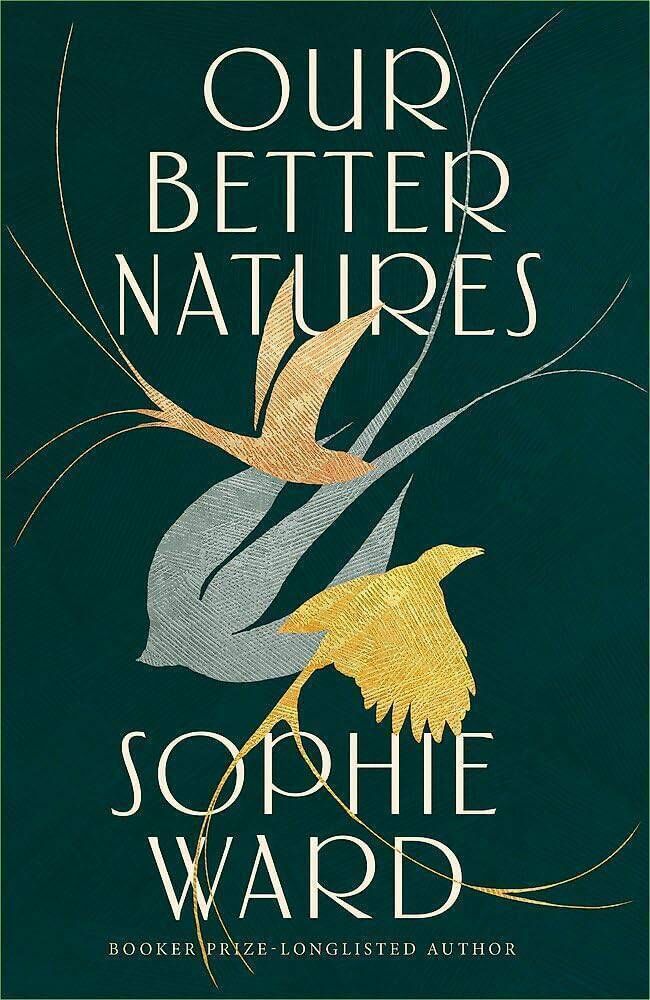
Set in the early 1970s, 'Our Better Natures' interweaves the real lives of radical feminist Andrea Dworkin, poet Muriel Rukeyser with that of fictional housewife, Phyllis Patterson
Book review: United through shared oppression

Sophie Ward's 'Our Better Natures' is a nuanced work, led by three distinct personalities. Picture: Jonathan Phang

  • Our Better Natures 
  • Sophie Ward 
  • Corsair, €26.40 

In one of the more surreal turns of Sophie Ward’s  Our Better Natures, we find Michel Foucault, Noam Chomsky, and a young Andrea Dworkin in a canteen kitchen. 

They are high and hungry. Foucault offers to make omelettes.

“What ingredients do you need?” Chomsky asks. “Apart from eggs?” “That’s it, Noam,” Foucault replies. “You wish to overcomplicate?” 

In her critique of the women’s movement, Joan Didion complicates the aphorism “you cannot make an omelette without breaking eggs”, changing it to “you need not only those broken eggs, but someone ‘oppressed’ to break them.” 

Key to her criticism is what she deems the movement’s creation of an ‘oppressed’ everywoman at the expense of ambiguity and experiential reality.

Set in the early 1970s, Our Better Natures interweaves the real lives of radical feminist Andrea Dworkin, poet Muriel Rukeyser with that of fictional housewife, Phyllis Patterson. 

Although Ward does indeed unite her protagonists through their shared oppression, she largely succeeds in doing so without flattening them. This is a nuanced work, led by three distinct personalities.

Most of the ‘Andrea’ chapters consist of drunken conversations with Chomsky and Foucault, following the Eindhoven University debates. 

Although the set-up verges on farcical — at one point, the three even don red noses — watching Andrea gain in confidence is convincing and immersive. 

Ward excels when replicating the dismissive rhetorical strategies employed by these older male intellectuals. When Andrea challenges them, we are emboldened with her.

Although still an ardent protester of the Vietnam War, Muriel — hampered by a series of health problems — cuts a wearier figure. 

Corporeal realities of ageing, war, and womanhood

One of Our Better Natures’ greatest strengths is its refusal to shy away from the corporeal realities of ageing, war, or womanhood. 

Muriel, to borrow Phyllis’ observation, seems testament to “how women’s bodies might take on the world’s sorrow”.

At times, Ward is overwhelmed by Muriel and Andrea’s biographies, meaning that major life events — Muriel’s past imprisonments, Andrea’s abusive marriage — feel shoehorned in. 

This is a problem of space, not skill: both women could sustain their own novel.

But it is Phyllis — struggling to understand her Korean daughter-in-law, Choon Hee, and her grandchildren — who is the heart of this novel. 

Her looming sense of obsolescence is funnelled into a fascinated suspicion of Choon He’s ‘foreignness’, and her headstrong granddaughter, Soozie. 

In Choon Hee and Soozie are alternative kinds of femininity, which threaten but also liberate Phyllis. Ward handles these dynamics with real sensitivity: it is heart-wrenching and exhilarating to watch Phyllis begin to entertain possibilities beyond the life she knows.

In her memories — especially those of losing a baby, a ‘little rabbit’ — Ward demonstrates not just Phyllis’s pain, but her isolation. 

Unlike Muriel or Andrea, she is unable to fully articulate or frame her experiences of grief and loss. This separates her from the world, an experience mirrored in the enigmatic Choon Hee, forced to exist in a foreign language, an inner life left untranslated.

Our Better Natures gestures towards a future in which words lead to understanding, empathy and change. 

At the novel’s end, men are reading Woman Hating; Phyllis fantasises about Soozie becoming a poet; Chomsky is marching alongside Muriel and Andrea.

To read this upon the release of the second batch of the Epstein files — further evidence that elites stick firmly with other elites, that they will abuse power and people — feels chilling. We have not got there.

A captivating invocation of a moment of revolutionary zeal and hope, Our Better Natures invites us to consider what has been achieved since the 1970s — and what hasn’t.

It is also a prescient reminder of the importance of testimony in the fight for justice, of individual stories. Eventually, they will be heard.

x

BOOKS & MORE

Check out our Books Hub where you will find the latest news, reviews, features, opinions and analysis on all things books from the Irish Examiner's team of specialist writers, columnists and contributors.


More in this section

Scene & Heard

Newsletter

Music, film art, culture, books and more from Munster and beyond.......curated weekly by the Irish Examiner Arts Editor.

Cookie Policy Privacy Policy Brand Safety FAQ Help Contact Us Terms and Conditions

© Examiner Echo Group Limited