Calling Wuthering Heights the greatest love story is like comparing The Exorcist to Father Ted
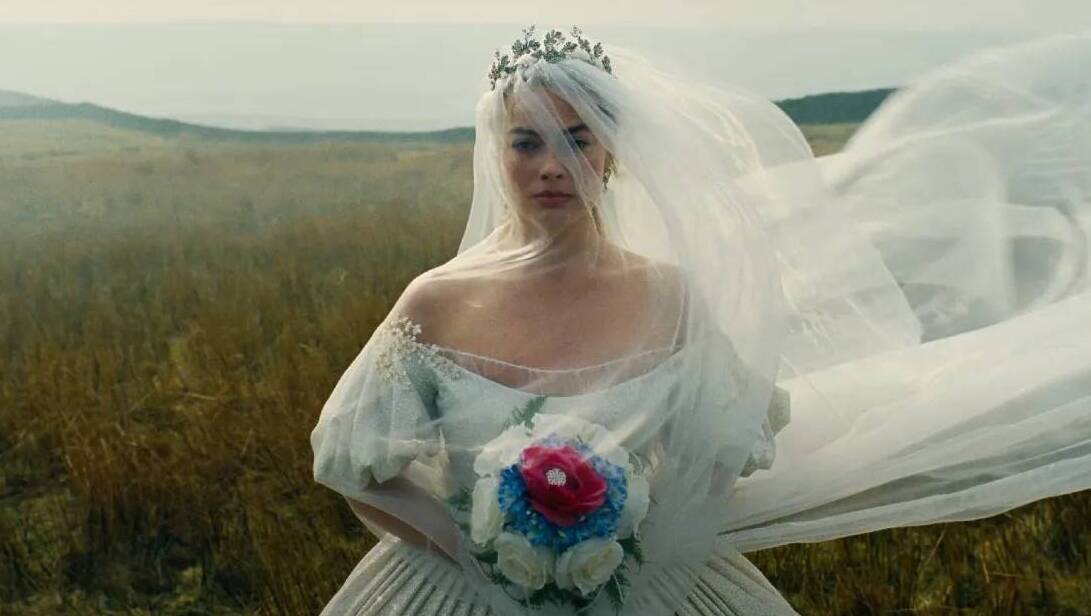
Margot Robbie in Wuthering Heights
In the latest adaptation of Wuthering Heights, envelopes will be not just be pushed, but hurled at us with the force of a Yorkshire gale. Director Emerald Fennell, who gave us such memorable aspects of Barry Keoghan in her 2023 film Saltburn, is set to throw everything at her audience — kink, nuns, egg yolks, rubber frocks.
Yes please. Wet shirts worn by Mr Darcy no longer cut it. Too vanilla. Today’s post-porn audience wants a sensual feast rather than a faithful historic reenactment involving bonnets and reserve.

Margot Robbie and Jacob Elordi will play Cathy and Heathcliff, and while there has been some moaning about these casting decisions — the novel describes Cathy as teenage and Heathcliff as “a dark-skinned gypsy” (Robbie is in her mid 30s, and Elordi is white) — the real disconnect is how wider culture continues to perceive the Wuthering Heights story. That is, to misconstrue it.

Wuthering Heights is once again being presented in this latest adaptation as a love story. The greatest love story ever. It was released just in time for Valentine’s Day, urging viewers to “come undone” as we are dissolved into puddles of lust by its erotic sumptuousness, its breathy Charli xcx soundtrack. This love story interpretation is not unique to Fennell, but has happened in every film adaptation of the novel since the first major one was released in 1939.
Fennell has called her adaptation “primal, sexual”, and talked about her own teen experiences of reading the book, how it “cracked me open” when she read it at 14. This is when many of us girls read it — when we were still febrile teens, inexperienced, insane with lust, yet clueless in affairs of the heart. (I read it at 16 — it was on the Leaving Cert syllabus — and loved it.)
It is, wrote the late literary critic Elizabeth Hardwick, “a virgin’s novel” written by a young woman widely regarded as sexually inexperienced, dubbed by one critic in 1886 as “the sphinx of our modern literature”. The reclusive, isolated Emily Brontë wrote her only novel while in her mid 20s before dying at 30, thinking it had been a failure.
There is no record of her ever having had lovers or romantic relationships — is this why her novel seethes with unmet desire? One of the more disturbing rumours around the isolated Brontë family (formerly Brunty, from Co Down, until their father changed it when he went to Cambridge) has been a persistent incest myth, involving her drunken brother Bramwell.
The point is, Wuthering Heights is not the greatest love story ever told. It’s not even a love story. Love doesn’t come into it. Hate, yes, obsession, need, fury, vengeance, jealousy, madness — but not love. To call it a love story would be like comparing The Exorcist to Father Ted. It just isn’t.
Yet, read by countless schoolgirls over time, it has been reshaped and remoulded by generations of fevered female fantasy into a love story, of the obsessive unmet-desire kind so adored by youth. Iconic doomed love — what teenage girl’s imagination doesn’t feast off such agonies?
Kate Bush, who had the same birthday as Emily Brontë, wrote that genre-defying song when she was just 18. Sylvia Plath read the novel in her teens, before writing her poem Wuthering Heights in her 20s, two years before her death in 1963 — after she’d been married to Ted Hughes, a real-life Heathcliff. Jeanette Winterson read it when she was 16, although she has said how she read it not as a love story but rather more accurately “as a loss story”. How “Heathcliff loses Cathy. Cathy loses Heathcliff. Edgar Linton loses Cathy, their daughter, his life and Thrushcross Grange. Hindley loses Wuthering Heights.” (She still loved it though.)

The plot of the novel is insanely complicated, unreliably narrated with time doubling back and forth on itself, and a cast of characters with Dostoevsky-levels of confusingly similar names spread over two generations. Classism, racism, sexism are all present too — it was, after all, published in 1847, and set decades earlier. Cathy and Heathcliff at Wuthering Heights represent rugged isolation, passion, and chaos, while Cathy and Edgar at Thrushcross Grange are all about order, respectability, and convention. No wonder the novel’s teenage fanclub has traditionally zoned in on the Cathy Heathcliff relationship dynamic.
As have film directors over the past hundred years, tending to focus only on the first half of the book, cutting the story when first-generation Cathy dies rather than continuing with the bleak second half of the book that involves Cathy’s daughter — second generation Cathy — and all kinds of cruelty and abuse. Oh, and — spoiler alert — the death of Heathcliff.
Only one significant film version, directed by Peter Kosminsky in 1992, covered the whole book. Starring Juliette Binoche and Ralph Fiennes in his cinematic debut, it did what no other adaptation dared to do, and followed the plot to the end. Despite such broad scope, plus a soundtrack by Ryuichi Sakamoto and a cameo by Sinead O’Connor playing Emily Brontë (whose voiceover urges viewers “not to smile at any part of it”), it didn’t get great reviews.
Fennell’s is the latest version of literally dozens of Wuthering Heights adaptations for big and small screen. The first was a silent version from 1920, followed by a black and white version in 1939 starring Merle Oberon and Laurence Olivier as Cathy and Heathcliff, directed by William Wyler. It was nominated for the 1939 Academy Award for Best Picture, but lost to Gone With The Wind.
Legendary film maker Luis Bunuel made a Spanish/ Mexican version in 1954, retitled Abismos de Pasion — Abysses of Passion. In 1958, Richard Burton played Heathcliff with typical Byronic intensity for a television adaptation, followed by Ian McShane in another TV series in 1967.

Robert Frost directed Timothy Dalton and Anna Calder-Marshall in yet another film version in 1970, which again focused only on the first generation of the novel, and added some extra material — Hindley shoots Heathcliff, and the ghosts of Catherine and Heathcliff are reunited in the afterlife. In a five part BBC series from 1978, the entire novel was adapted to include the second generation — Cathy junior, Linton, and Hareton.
Tom Hardy played Heathcliff in a 2009 mini-series, and in Andrea Arnold’s low-key, bleak 2011 feature film, Kaya Scodelario and James Howson were cast as Cathy and Heathcliff — Howson being the first black actor to play the character on screen. Another BBC adaptation from 2002, Sparkhouse, reimagined the story in a modern setting with the gender roles reversed. There have been international interpretations from Italy to India, Venezuela to the Philippines.

Wuthering Heights references have popped up in the vampire series Twilight, in a Sandra Bullock movie, The Proposal, where the protagonist reads the novel every Christmas, and there’s an episode of Friends where Phoebe and Rachel discuss the novel on a literature course. Ernest Hemingway, Henry Miller and Joan Didion all loved it. Anne Rice, author of Interview With A Vampire, called it a “high pitched and utterly committed work of madness”, declaring how she “loved its strange cruelty and enchantment.” It has even been referred to on The Simpsons (by Lisa, naturally). It may be the most loveless love story in the history of love stories, but that hasn’t stopped us all from loving it. From making it into something of a cult.
Although not initially. When the novel was first published, with Emily Brontë using the male pen-name Ellis Bell, people were mystified. Baffled. Appalled. One review from Graham’s Magazine, a US periodical that ran from 1840 to 1858, thought that Bronte’s vision of “vulgar depravity and unnatural horrors” was a literal result of cheese toastie nightmares: “How a human being could have attempted such a book … without committing suicide … is a mystery.”

It was variously panned in publications of the time as “utterly hateful”, “thoroughly contemptible”, “coarse and disagreeable”, “stupid blasphemy” and “morbid imagination”.
Even Emily’s sister Charlotte — no stranger to Gothic tropes of love and desolation within her own masterpiece, Jane Eyre — wasn’t sure what to make of Wuthering Heights.
Soon after Emily died, Charlotte wrote a preface for her sister’s book: “Whether it is right or advisable to create beings like Heathcliff, I do not know. I scarcely think it is.” It was not a best seller. 19th century readers found it shocking and distasteful even though it contains no sex or gore — just lots of unrequited love, mad unexpressed passion, and an awful lot of cruelty.
Nor do the main characters grow into likeable, never mind lovable, adults. Cathy goes from wild nature girl to a respectable lady enmeshed by patriarchy, while Heathcliff goes from oppressed to oppressor. She develops a fever from all the unrequited passion; he bangs his head against a tree until it bleeds, and digs up her grave. Today, they’d both be in trauma therapy, or Sex and Love Addicts Anonymous. Or both.
Critic Elizabeth Hardwick described Cathy as “nihilistic, self-indulgent, bored, restless, nostalgic for childhood, unmanageable” with all “the charm of a wayward, schizophrenic girl” who has “little to give” because she’s “self-absorbed, haughty, destructive”. Which, given the dullness of so many demure 19th century literary heroines hiding behind their teacups in stuffy drawing rooms, makes Cathy one of the most interesting female characters in literally hundreds of years.
Hardwick adds that the “peculiarity” of the novel lies in “the harshness of its characters”. She described Cathy “as hard, careless and destructive”, a “brutal Heathcliff”. That Cathy too “has a sadistic nature,” and that “the love the two feel for each other is a longing for an impossible completion”.
Maybe that’s what Emerald Fennell means when she says that the book is bursting with sadomasochism. Is it though? Or is it just an attempt to rebrand 18th century patriarchy via 21st century wishful thinking?
Rather than seeing him as a dashing romantic hero, Philip Larkin compared Heathcliff to “a cousin to Mary Shelley’s monster, a creature of the northern mists, a gnome”. Heathcliff has also been compared to Shakespeare’s Caliban, a kind of dehumanised feral being shaped by abuse. And still, the teenage girls continue to swoon.
Perhaps we should consider this analysis from writer Anne Tyler, who told an interviewer how she has “tried several times to read Wuthering Heights but it just strikes me as silly, so I always quit it.” Tyler avoided telling her friends her true feelings about their favourite book — “they have very fond memories of reading it…and I don’t want to hurt their feelings.”
But having heard several of her female friends rate Heathcliff as their number one romantic hero, Tyler finally gave the book another go as an adult. She said she “immediately developed some serious concerns about the mental health of my friends”.
She would undoubtedly have the same concerns for the flocks of (I’m guessing mostly) women who will be swarming cinemas this Valentine’s Day. Myself included. Egg yolks and rubber? Can’t wait.